skin
Complexion
Likely olive to medium brown
Population ancestry and sun exposure patterns of the ancient Levant point to an olive to medium-brown skin tone.
Portrait reconstruction
0–0 · Levant / Mesopotamia (ancient Near East) · Middle Bronze Age (circa 2000–1500 BCE)
Abraham likely looked like a Middle Bronze Age Levantine man: olive to light‑brown skin, dark hair, a working, sturdy build, and a trimmed to moderate beard.
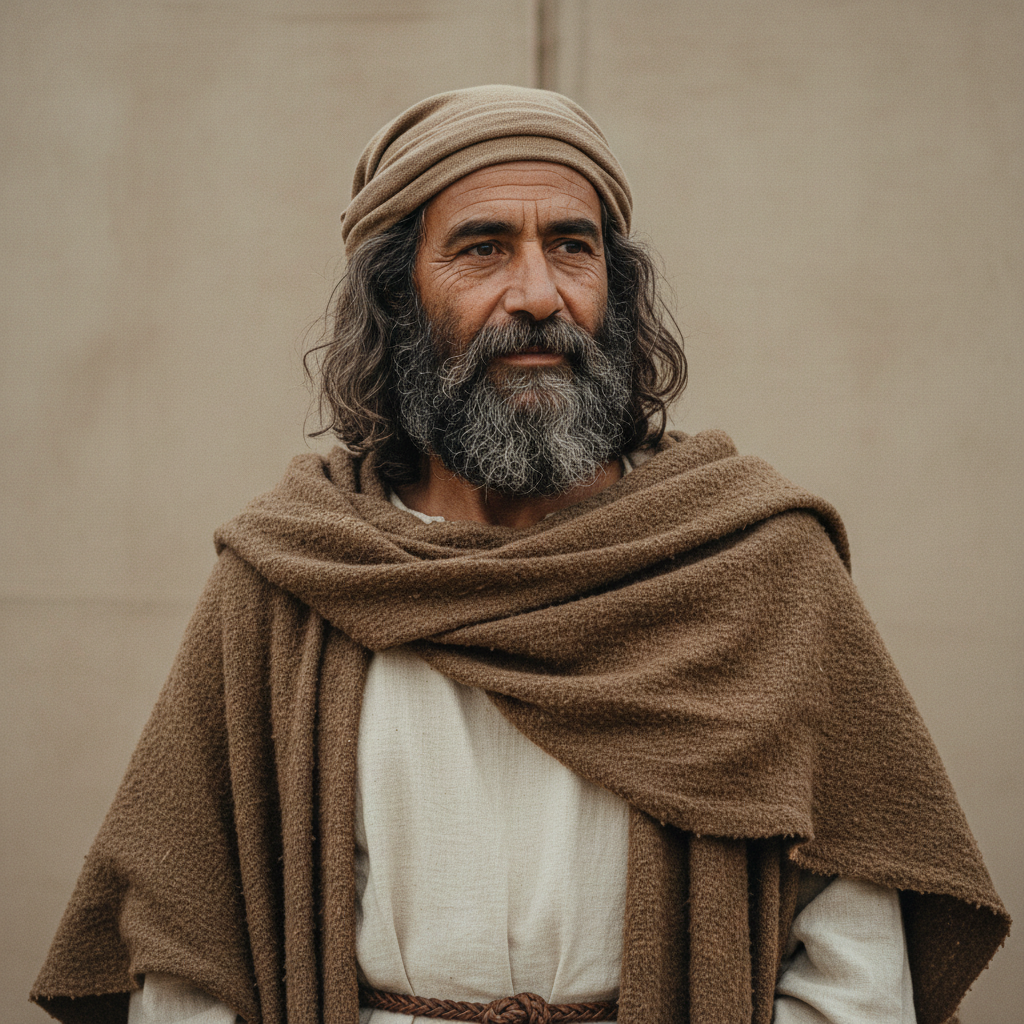
Skin tone and hair: He would most likely have had olive to light‑brown skin and dark hair—black to dark brown—typical of ancient Near Eastern populations. Hair texture was probably wavy to curly, kept at a practical length for daily work and travel. Facial hair and age: As a respected patriarch and clan leader, Abraham would commonly be shown with facial hair; a short to moderate beard, neatly tended rather than wildly flowing, suits the social norms of the region. In later life he would appear elderly—lined face and greying at the temples—yet still physically capable from years of tending flocks and traveling. Build and stature: Expect a compact, robust frame with strong forearms and weathered hands from long days of shepherding and camp life. Average male heights were lower than modern averages, so he was probably shorter by today’s standards but muscular and resilient. Clothing and gear: He likely wore a simple wool or linen tunic, a heavier cloak for travel and cold nights, a wrapped headcover or hood to shield sun and sand, leather sandals, and a belt to carry tools or a knife.
Height / build
Likely average to slightly tall for his time · Likely lean and muscular
Hair
Likely dark to graying · Likely wavy to curly · Likely intact but possibly receding with age
Eyes
Likely dark (brown)
Complexion
Likely olive to medium brown
Face
Likely oval to long · Likely straight to slightly prominent/aquiline
Notable features
Olive-brown skin, dark eyes, full beard, weathered complexion, commanding posture
Grooming
Likely a full beard, dark to graying · Groomed but practical: kept beard and hair in a tidy, functional manner consistent with Near Eastern male norms.
Dress / presentation
Simple tunic, long mantle/cloak, head wrap or shawl, leather sandals — typical Bronze Age nomadic/semisedentary garb
skin
Complexion
Likely olive to medium brown
Population ancestry and sun exposure patterns of the ancient Levant point to an olive to medium-brown skin tone.
eyes
Eye color
Likely dark (brown)
Dark-brown eyes are overwhelmingly predominant in West Semitic populations and are the most likely eye color.
hair
Hair color
Likely dark to graying
West Semitic ancestry implies dark hair; as a mature patriarch he was probably partly gray.
hair
Hair texture
Likely wavy to curly
Regional populations and surviving artwork commonly show wavy to curly hair among Levantine men.
other
Facial hair
Likely full beard
Beards were a cultural marker of masculinity and status in the ancient Near East and feature in Biblical and Near Eastern depictions of respected men.
height build
Height
Likely average to slightly tall for his time
Skeletal data from the region place average male heights lower than modern norms; a physically active herdsman often appears tall and solid.
In Abraham's world, a full beard, visible age, and practical but well-kept garments signaled maturity, social standing, and leadership. Ornamentation mattered less for nomadic leaders than the visible signs of experience — weathered skin, steadiness, and the ability to provide for a clan.
Abraham would most likely resemble other West Semitic/Levantine men: dark hair and eyes, olive-toned skin, and a sturdy but lean body shaped by travel and animal care. These traits are consistent across Bronze Age Levantine populations and neighboring Mesopotamian groups.
Modern Western art often shows Abraham as white or Greco-Roman; historically he would have looked Near Eastern — darker skinned, dark-haired, and dressed in local nomadic garments.
Western art has often recast Abraham in Greco-Roman or Northern European terms — pale skin, light hair, classical features. Historically he would have looked Near Eastern; portraying him as white obscures the regionally typical complexion and dress.
Likely average to slightly tall for his time.
Likely dark brown.
Likely dark, probably streaked with gray in later life.
Probably a full beard, the Near Eastern norm for adult men and leaders.
A layered tunic and heavy mantle or cloak, head-wrap, and sandals — practical nomadic clothing of the Bronze Age Levant.
By combining biblical descriptions of his life and status with archaeology, regional portrait conventions, and population studies of the Bronze Age Levant.
Genesis (Hebrew Bible) — Narratives about Abraham
Genesis (Biblical text) · Traditionally attributed to 2nd millennium–1st millennium BCE; compiled later
Describes Abraham as an elder patriarch, a wandering herdsman and clan leader; includes social cues (tents, flocks, headship) that imply dress and lifestyle but offers no physical portrait.
Medieval Jewish and Christian illustrations of Abraham
Medieval manuscript art and icons · 7th–15th centuries CE (various)
Shows evolving visual traditions: elderly man with beard, often robed; these images shaped later popular ideas of Abraham's appearance though they reflect later cultural styles.
Ancient Near Eastern reliefs and sculptures (regional portrait conventions)
Assyrian, Babylonian, Canaanite reliefs and seals · 2nd–1st millennium BCE
Regional art conventions depict men with beards, layered clothing, and headdresses — useful for dress and grooming context though not depicting Abraham specifically.
Archaeological textile and clothing reconstructions from the Bronze Age Levant
Middle Bronze Age Levantine archaeology reports · excavation reports and reconstructions (20th–21st century)
Recovered textile fragments and grave goods inform reconstructions of tunics, cloaks, and head-wraps used by pastoral and semi-sedentary groups.
Levantine Bronze Age skeletal and stature studies
Anthropological studies of ancient Near Eastern remains · 20th–21st century studies
Provide average stature and health indicators for regional populations; useful for estimating height and build (average male heights lower than modern averages; robust activity markers common).
Later Islamic and Jewish textual traditions about Abraham
Quranic and Islamic exegetical texts; rabbinic literature · 7th century CE onward; rabbinic texts later
height build
Build
Likely lean and muscular
A nomadic pastoral lifestyle produces a wiry, muscular physique from long walking and animal husbandry.
face
Nose/face
Likely straight to slightly prominent (aquiline) nose; oval-long face
Common facial types in West Semitic populations and frequent depiction conventions favor a prominent, straight nose.
grooming
Grooming
Likely practical and tidy
Male grooming in the Near East kept beards and hair maintained; a patriarch would present himself with visible dignity and care.
clothing
Clothing
Tunic, mantle/cloak, head-wrap, sandals
Textual descriptions and archaeological textile finds show nomads and semi-nomads of the Bronze Age wore layered tunics and cloaks with head coverings.
other
Visual presence
Commanding, elder patriarchal bearing
Age markers, beard, clothing, and leader status would project authority and respect in social settings.
Emphasize Abraham's role and age; later descriptions influenced visual portrayals across traditions, reinforcing the image of an elderly, bearded patriarch.