skin
Complexion
Likely Mediterranean to dark
Ancient testimonia sometimes identify Aesop as 'Ethiopian' or from regions where darker complexions were frequent; literary tradition often describes him as dark or swarthy.
Portrait reconstruction
0–0 · Traditionally Phrygia / Thrace / Ionia (Greek world of Anatolia / Black Sea fringe) · Archaic Greek (traditionally 6th century BCE)
Aesop likely appeared as an older, dark‑complexioned man with short dark hair and a weathered beard, clothed simply and often shown slightly hunched or limping.
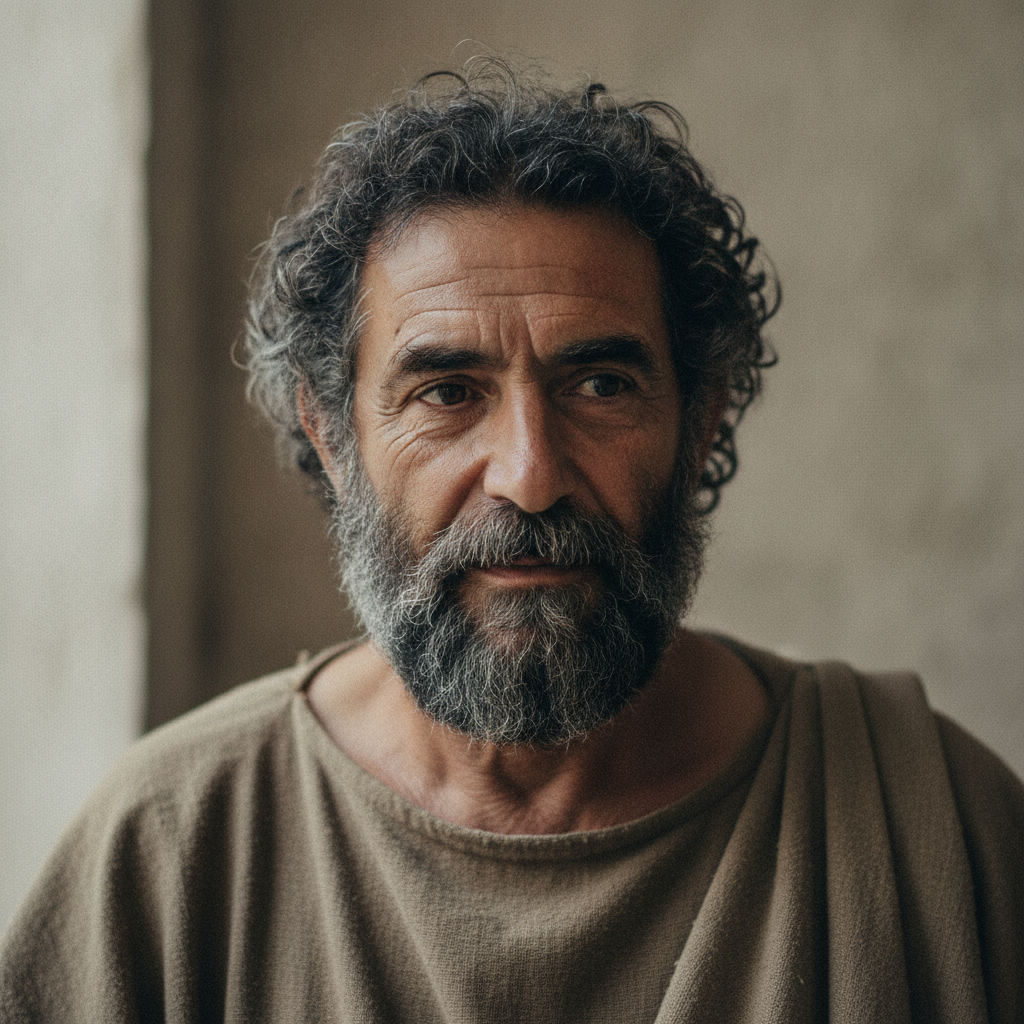
Face and hair: Imagine a face lined by years of outdoor life—olive to darker skin, dark brown to black hair kept short or closely curled, and a full, weathered beard that frames a keen, expressive mouth. His eyes would be sharp and watchful, the kind that size up people and animals quickly. Build and posture: He was probably compact and sturdy rather than tall, with a posture affected by work or injury—many traditions picture him slightly stooped or with a noticeable limp. That stance, paired with compact hands and a ready turn of the head, gives the impression of someone who speaks in quick, pointed turns. Clothing and bearing: Dress would be plain and functional: a simple tunic (chiton) with a coarse cloak (himation) or cloak-like wrap, worn sandals or bare feet, and clothes that show frequent wear. Overall he presents as humbly dressed but alert and quick-witted—an unassuming figure whose presence commands attention through gesture and expression rather than finery.
Height / build
Likely average height · Likely average to slightly compact build
Hair
Likely dark to graying · Likely wavy to curly · Likely receding in later life
Eyes
Likely dark
Complexion
Likely Mediterranean to dark
Face
Likely broad, expressive features · Likely prominent nose
Notable features
Possibly stooped or lame; often shown with a distinctive, plain face that reads as ‘outsider’
Grooming
Likely bearded (dark to graying) · Simple, practical grooming: trimmed beard and short hair, not elaborately styled.
Dress / presentation
Likely simple Greek tunic (chiton) or slave's dress; later freedman portrayals may show basic himation
skin
Complexion
Likely Mediterranean to dark
Ancient testimonia sometimes identify Aesop as 'Ethiopian' or from regions where darker complexions were frequent; literary tradition often describes him as dark or swarthy.
height build
Height
Likely average height
No source highlights extraordinary height; common reconstructions assume typical Archaic Greek male stature.
height build
Build
Likely average to slightly compact
As a working man / slave and later storyteller, he’s portrayed in literature and art as functional rather than athletic or gracile.
hair
Hair color
Likely dark to graying
Regional pigmentation and depictions of Aesop as an older man suggest dark hair that grays with age.
hair
Hair texture
Likely wavy to curly
Typical Mediterranean/Anatolian hair texture and period portraits favour wavy/curly hair.
grooming
Facial hair
Likely bearded (dark to graying)
Archaic and classical Greek culture valued a balance of dignified age, expressive face, and civic dress for elders and storytellers; Aesop’s traditional look—plain clothes, expressive features, and modest grooming—matches the social image of a persuasive oral performer rather than an elite aristocrat.
Traditions place Aesop on the eastern edges of the Greek world (Phrygia, Thrace, Ionia) where Mediterranean, Anatolian and Balkan features mixed; think olive to darker skin tones, dark eyes and hair, and sturdy, compact builds typical of that region.
Modern images often turn Aesop into a stock 'wise old man' or grotesque hunchback; actual tradition mixes respect for his wit with repeated emphasis on a plain, possibly dark‑skinned, older man rather than a fairy‑tale caricature.
Popular images often make Aesop a tiny, grotesque hunchback or a generic 'wise old man' with Victorian dress; the older tradition emphasised a plain, sometimes dark‑skinned and possibly lame storyteller in simple Greek clothing—less fantasy caricature, more grounded elder of the Archaic Greek world.
Probably average height for an Archaic Greek man.
Likely dark.
Likely dark, later graying.
Likely yes—a trimmed beard that went gray with age.
Traditionally portrayed as plain and often described as lame or stooped; 'deformed' is an exaggeration in later art.
Simple Greek tunic or slave's dress; later images show plain himation.
Aesopica (collection of ancient testimonia and fragments)
Ben Edwin Perry, Aesopica (editor/collector of testimonia) · 1952 (collection of ancient sources)
Compilation of ancient and later testimonies, biographies, and anecdotes that form the main basis for Aesop's traditional life‑image: enslaved origins, dark complexion mention, lameness or deformity motifs, and humble dress.
Pseudo‑Plutarch, 'Life of Aesop'
Pseudo‑Plutarch (ancient biographical tradition) · first centuries CE (later ancient biography)
One of the principal ancient life narratives describing Aesop as a slave of low appearance who becomes known for cunning and storytelling; contains anecdotes that contributed to his visual depiction.
Athenaeus, Deipnosophistae (mentions of Aesop)
Athenaeus of Naucratis · c. 3rd century CE
Collects older citations and remarks, including references that at times label Aesop as 'Ethiopian' in tradition—feeding interpretations of a darker complexion or non‑mainland origin.
Medieval manuscript illustrations of Aesop
Various medieval bestiaries and Aesop manuscripts · 12th–15th centuries
Manuscript images repeatedly portray Aesop as an older, often hunched or misshapen man in simple dress—these images crystallized the popular visual stereotype used through the Renaissance.
Renaissance and early modern paintings and prints
European Renaissance art (various artists) · 15th–17th centuries
Artists rendered Aesop variously as grotesque, wise, or plainly severe; such depictions reflect and amplify narrative motifs (lame, ugly, clever) and influenced modern imagery.
Classical portraiture and grooming norms
Scholarly synthesis of Archaic/Classic Greek portrait conventions · Modern scholarship (20th–21st c.)
Greek men of his probable social and age group were normally bearded; many later images show him with a beard.
face
Facial expression & shape
Broad, expressive features; characterful rather than beautiful
Biographical tradition emphasizes a plain, striking face used to mark him as an outsider and storyteller.
face
Nose
Likely prominent
Later portraits and the caricature tradition often show a distinctive, larger nose—an artistic shorthand for character.
grooming
Hairline
Likely receding in later life
Depictions of Aesop as an older figure and textual references to his age imply hair thinning or receding.
other
Stature or gait
Probably stooped or lame (traditionally emphasized)
Multiple later biographies and images present Aesop as lame, limping, or somewhat deformed—an image that became standard in iconography.
clothing
Clothing
Likely simple Greek tunic (chiton) or slave's dress
Tradition calls him a slave and later a humble freedman; visual tradition consistently depicts him in plain everyday garments.
cultural
Overall presentation
Plain, older storyteller—expressive face more than conventional beauty
Writings and images emphasize his wit and outsider status rather than youthful attractiveness or aristocratic bearing.
Contextualizes likely hair, beard, clothing and grooming (beards common among older Greek men; tunics and himations typical dress) which inform a reasonable reconstruction of Aesop’s appearance.