face
Face shape
Long, narrow face
Amarna reliefs and statues consistently portray Akhenaten with an elongated face and narrow chin as a defining motif.
Portrait reconstruction
1380 BCE–1336 BCE · Ancient Egypt (Amarna, 18th Dynasty) · Late Bronze Age (Amarna Period)
Akhenaten is most often shown with a long, narrow face, pronounced full lips, almond eyes, an elongated neck and a slim, elongated body, usually wearing a royal wig or crown.
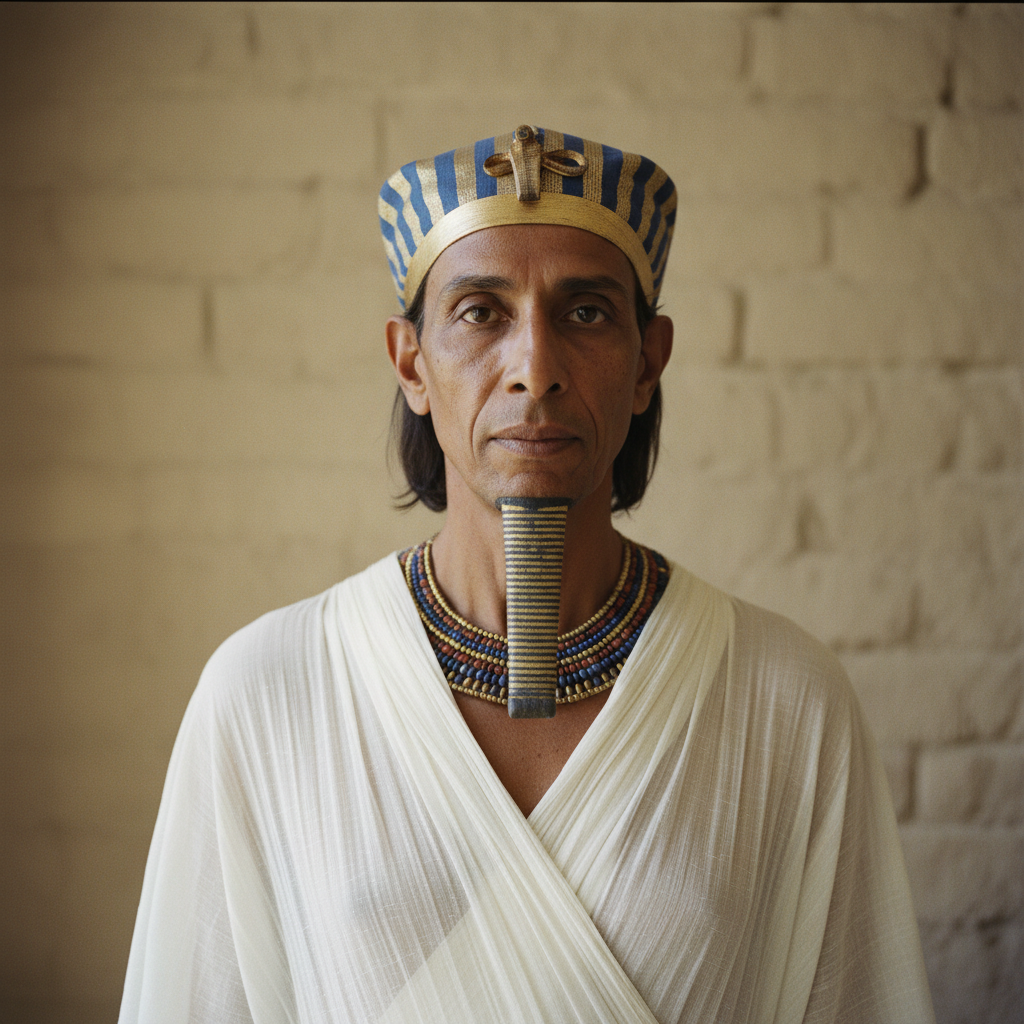
Face and head: Akhenaten is portrayed with a distinct long, narrow face, a narrow pointed chin, prominent full lips and large almond‑shaped eyes set beneath gently arched brows. His cheekbones are often shown as high and the overall profile appears stretched vertically, giving the face an elegant, attenuated look. Hair, headwear and facial hair: In most images he wears the royal wig or crown—khepresh or the tall white crown in formal scenes—so his natural hair is rarely visible; where hair is implied it would likely be dark. He is typically depicted clean‑shaven with a smooth jawline rather than with the short beard often seen on other pharaohs. Body and stance: Amarna art portrays Akhenaten with a lithe, somewhat elongated torso and long, slim limbs. Reliefs show him in close domestic moments and ritual poses, often with a gently rounded belly and narrow hips compared with traditional masculine portrayals, producing an overall graceful, almost willowy silhouette.
Height / build
Likely average to slightly tall for his time · Likely slender to lithe
Hair
Likely dark (black to dark brown) · Likely straight to wavy · Likely intact/full (usually shown covered by crowns or wigs)
Eyes
Likely dark (brown)
Complexion
Likely Mediterranean to North African medium brown
Face
Long, narrow face with rounded full lips · Likely straight to slightly hooked (art often shows a prominent nose)
Notable features
Long face, full lips, narrow chin, almond eyes, elongated neck
Grooming
Probably clean‑shaven in daily life; depicted with a ceremonial false beard in formal imagery · Typically shown with closely kept grooming or wearing wigs and headdresses that signaled royal status.
Dress / presentation
Royal Amarna regalia: kilt or close‑fitting robe, elaborate crowns (khepresh, double crown), wig and occasional sheer garments in private scenes
face
Face shape
Long, narrow face
Amarna reliefs and statues consistently portray Akhenaten with an elongated face and narrow chin as a defining motif.
face
Lips
Full, prominent lips
Reliefs show markedly full, rounded lips, a repeatedly emphasized facial trait in royal Amarna images.
eyes
Eyes
Almond‑shaped, narrow eyes
Contemporary portraits render eyes as elongated and narrow, an Amarna stylistic feature seen across multiple media.
hair
Hair color
Likely dark (black to dark brown)
Egyptian populations and surviving pigment traces indicate dark hair for royal subjects; headdresses and wigs in art are typically dark.
hair
Hairstyle
Usually covered by royal wigs and crowns; sidelock in youth scenes
Amarna scenes depict Akhenaten in royal crowns, wigs and occasionally with the youth sidelock; private scenes show styled hair or wigs.
other
Facial hair
Probably clean‑shaven; ceremonial false beard in formal portraits
Amarna artists reshaped royal imagery to communicate theology and kingship: elongation, androgynous touches and intimate family scenes all signaled Akhenaten’s unique, divine role as Aten’s living representative. The visual choices were as much political and religious branding as portraiture.
Akhenaten belonged to the native Nile Valley ruling elite of the 18th Dynasty. Physically he would have shared typical Egyptian features of the time—medium brown skin, dark hair and brown eyes—while court gene flow could include eastern Mediterranean traits common among elites.
Modern images often convert Amarna stylization into literal deformity or a modern gendered reading; the original art likely blended symbolic stylization with some likeness.
Modern media often treats Amarna stylization as literal pathology (e.g., Marfan, gynecomastia). Original art likely combined symbolism and likeness; the unusual features were a deliberate stylistic and ideological program, not a straightforward medical portrait.
Likely average to slightly tall for his time.
Likely dark brown.
Likely dark (black to dark brown), straight to wavy, usually covered by wigs or crowns.
Probably clean‑shaven in daily life; shown with a ceremonial false beard in formal imagery.
He would have been seen as striking and uniquely authoritative rather than conventionally 'handsome'; Amarna art made him distinctive.
They present a deliberate and consistent royal image combining personal likeness with symbolic stylization.
Colossal Statues of Akhenaten (Karnak / Amarna)
Egyptian Museum collections / Amarna finds · c. 1353–1336 BCE
Large stone statues show the elongated face, full lips, narrow chin and slender torso repeated in royal portraiture of Akhenaten.
Painted reliefs and frescoes from Akhetaten (Tell el‑Amarna)
Amarna archaeological corpus · c. 1353–1336 BCE
Domestic and temple scenes show Akhenaten in intimate poses, with a consistent stylized physiognomy: long face, pronounced lips, almond eyes and elongated necks.
Kneeling statues and painted limestone reliefs
Amarna workshop pieces · c. 1353–1336 BCE
Smaller statuary repeats the same facial features and shows royal regalia—wigs, crowns and garments—highlighting official appearance.
KV55 assemblage (controversial attribution)
Valley of the Kings discovery / KV55 · 1907 discovery; bone analysis 20th–21st c.
A single burial (KV55) has been proposed as Akhenaten’s remains by some researchers; skull and bone reports have been used in reconstructions but attribution remains debated.
Amarna inscriptions and boundary stelae
Royal inscriptions at Akhetaten · c. 1353–1336 BCE
Textual inscriptions emphasize Akhenaten’s divine role and royal titles rather than physical description, but they contextualize the imagery as intentional royal propaganda.
Post‑Amarna royal statuary and reliefs
Ramesside and later depictions · Post‑Amarna (after c. 1332 BCE)
Later art often erased or altered Amarna imagery, which shows how distinctive the original portraits were and how later generations reacted to them.
Pharaonic practice was clean‑shaven men in daily life but the false ceremonial beard appears in formal royal depictions.
height build
Build
Likely slender to lithe
Amarna art emphasises elongated limbs and a narrower torso; as a royal he would not show heavy labor musculature.
skin
Complexion
Likely Mediterranean to North African medium brown
Population context for Nile Valley elites and the pigments used in portraits support a medium brown skin tone.
clothing
Typical dress
Royal Amarna regalia (kilt/robe, wigs, crowns, and occasional sheer garments)
Reliefs and statuary show Akhenaten in formal crowns (khepresh, double crown), wigs and the close‑fitting garments of pharaonic office.
other
Overall look in public art
Deliberately stylized and distinctive
Amarna art intentionally gives the pharaoh a unique, almost androgynous appearance to mark his special relationship with Aten.