hair
Hair color
Likely dark (black to dark brown)
Khwarezmian and Persian urban populations overwhelmingly had dark hair; contemporary portraits of similar scholars show dark tones.
Portrait reconstruction
780–850 · Khwarezm (born); active in Baghdad, Abbasid Caliphate · Islamic Golden Age (9th century)
Al‑Khwarizmi probably had dark hair, brown eyes, an olive‑brown complexion, a neatly kept beard, and dressed in the plain robe and turban of an Abbasid scholar.
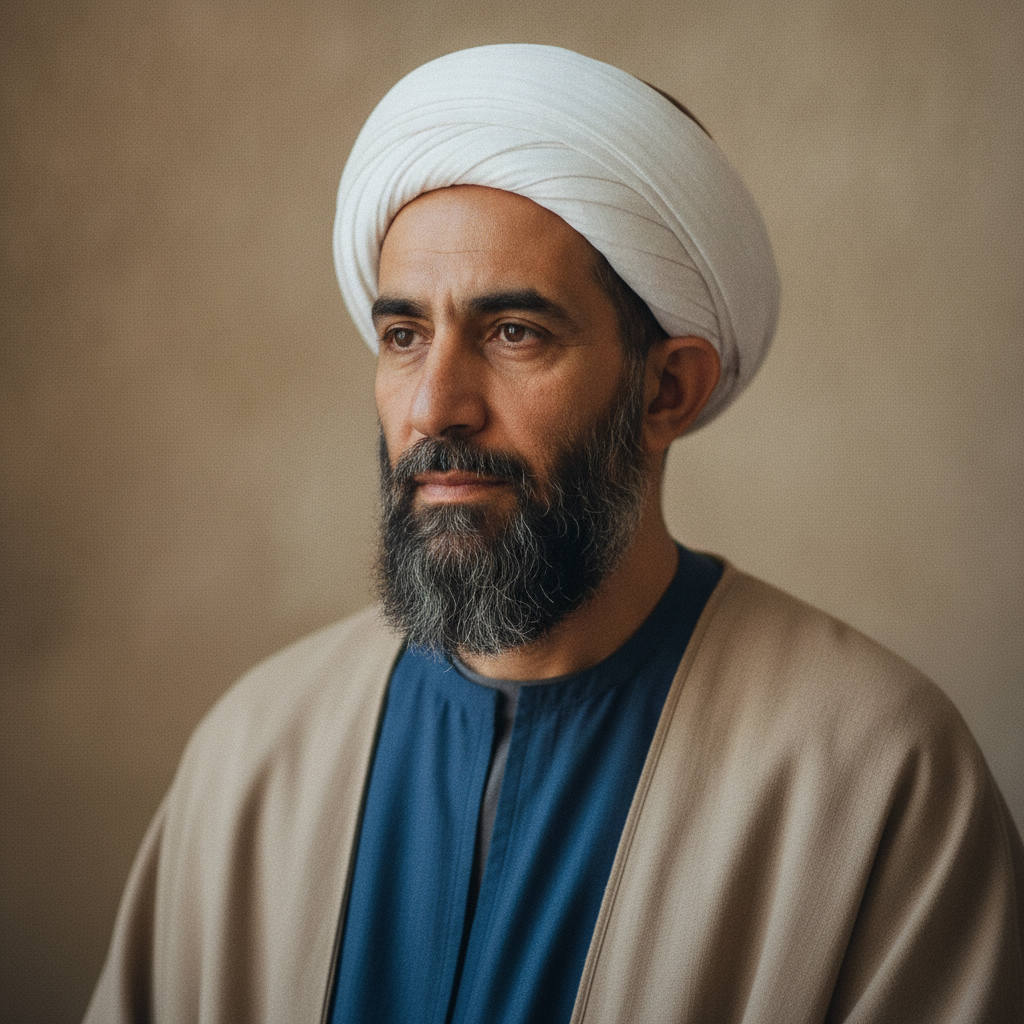
Face and coloring: He most likely had dark brown to black hair and brown eyes, with an olive to light‑brown complexion typical of Khwarezm and the northeastern reaches of the Islamic world. His features would have reflected Central Asian/Iranian regional types—compact, clear‑lined facial bones rather than the long, narrow faces sometimes imagined in later art. Hair and facial hair: Hair was probably kept short or tucked under a turban; a neatly trimmed beard and mustache would have been normal for a learned man of Baghdad. Grooming for scholars tended toward tidy and conservative rather than flowing or wild, giving him a composed, deliberate look. Build and age: At the height of his career he would have appeared middle‑aged and lean from a life of study—an alert expression, a strong brow from hours bent over manuscripts, and steady hands often stained with ink. He projected the quiet authority of an experienced teacher and mathematician rather than physical grandeur. Clothing and accessories: In public he would have worn layered, modest robes and a mantle with a wrapped turban—fine but restrained fabrics such as wool or lightweight silk in muted dyes. Practical details like a pen case, reed pens, and an inkpot at his belt signaled his profession and gave him the purposeful, scholarly bearing seen in later miniature conventions.
Height / build
Likely average height · Likely slender to average build
Hair
Likely dark (black to dark brown), probably greying with age · Likely straight to wavy · Likely normal to mildly receding with age
Eyes
Likely dark (brown)
Complexion
Likely olive to light‑brown
Face
Likely oval to slightly elongated · Likely straight, medium-sized (possibly slightly prominent)
Notable features
Dark eyes, trimmed beard, turban and scholar's robe, possibly a prominent nose and thoughtful expression.
Grooming
Probably a well‑kept full beard · Trimmed beard, tidy hair under a turban, reflecting scholarly and religious grooming norms of the Abbasid elite.
Dress / presentation
Abbasid-era scholar's robes (long gown), mantle, and turban—modest, high‑quality fabrics appropriate to a respected scholar.
hair
Hair color
Likely dark (black to dark brown)
Khwarezmian and Persian urban populations overwhelmingly had dark hair; contemporary portraits of similar scholars show dark tones.
eyes
Eye color
Likely dark (brown)
Brown eyes predominate historically in Central Asian/Persian populations; no contrary evidence exists.
other
Facial hair
Probably a well-kept full beard
Muslim scholarly culture in the Abbasid era favored beards; scholars are typically described or depicted with trimmed beards.
skin
Complexion
Likely olive to light-brown
Regional ancestry (Khwarezmian/Persian) and climate suggest a medium Mediterranean/Central Asian skin tone common among Iranianate urbanites.
clothing
Typical dress
Abbasid-era scholar's robe and turban
As an active scholar in Baghdad's intellectual circles, he would wear the long gown, mantle, and turban associated with learned men of the period.
height build
Height
In Al‑Khwarizmi's world, learned men projected authority through modest, high‑quality dress, a neat beard, and composed demeanor rather than showy jewelry or extreme hairstyles. Age and a trimmed beard were marks of credibility, so scholars cultivated a restrained, respectable look.
Khwarezm lay in the East Iranian cultural zone; Al‑Khwarizmi would share features common to Persianate urbanites of the time — medium olive skin, dark hair and eyes — while his time at Baghdad added metropolitan Abbasid sartorial touches.
Modern images often turn him into an exotic 'wizard' or generic bearded sage in fantasy robes; historically he would have been plainly but finely dressed in Abbasid scholarly garments, not the Orientalist caricatures.
Many modern illustrations turn Al‑Khwarizmi into a mythical 'wizard' with exaggerated robes, long white beard, or mystical iconography. Historically he would have looked like a respected, modestly dressed scholar of Baghdad — important, but not fantastical.
Likely average height.
Likely dark brown.
Probably a well‑kept full beard, trimmed in scholarly fashion.
Abbasid-era scholar's robe, mantle, and turban—modest, high‑quality garments signaling learned status.
No — modern images often exaggerate or orientalize him; historically he'd be plainly but finely dressed as a Baghdad scholar.
Through cultural and regional context (Khwarezmian origins, Abbasid Baghdad life) and period dress/grooming norms; no contemporary portrait survives.
Fihrist (catalog) — Ibn al‑Nadim
Fihrist (Ibn al‑Nadim) · c. 988
Lists Al‑Khwarizmi's works and places him in 9th‑century Baghdad; provides no physical description but establishes cultural and professional context for dress and grooming assumptions.
Encyclopaedia Britannica entry — Al‑Khwarizmi
Encyclopaedia Britannica · 20th–21st century reference summary
Modern scholarly summary of his life and works; used here for chronological, geographic, and social context informing appearance reconstruction.
Encyclopaedia Iranica — Khwarazm and scholars
Encyclopaedia Iranica · late 20th–21st century
Background on Khwarezm's culture and population helps estimate likely complexion, linguistic/cultural identity, and regional features.
Encyclopaedia of Islam / Encyclopaedia Islamica entries
Encyclopaedia of Islam · 20th century/online updates
Academic entries summarizing Al‑Khwarizmi's life and role in Abbasid scholarly culture; used to infer dress, public role, and age at peak productivity.
Studies of Abbasid dress and scholarly grooming
Secondary literature on Abbasid dress · 20th–21st century scholarship
Scholarly reconstructions of typical clothing (robe, mantle, turban) and grooming norms for learned men in Baghdad provide direct visual cues for reconstructing Al‑Khwarizmi's appearance.
Later Islamic miniature portrayals of scholars (post‑medieval)
Persian and Ottoman miniatures collections · 13th–18th centuries (later depictions)
Stylized images of scholars show consistent public dress (turban, robe) and bearded faces; they are not portraits of Al‑Khwarizmi but illustrate conventions used to imagine him.
Likely average height
No direct data; regional demographic norms and the absence of any literary praise or comment about unusual height suggest average stature.
height build
Build
Likely slender to average build
A life devoted to study, travel, and clerical duties typically resulted in a lean or average frame rather than heavy musculature.
face
Face shape
Likely oval to slightly elongated
Common facial proportions in Persianate populations and how medieval miniatures stylize scholars suggest oval/elongated face shapes.
grooming
Grooming style
Neat, modest, well-maintained
Islamic scholarly norms favored tidy appearance—trimmed beard, covered head (turban), and clean robes for public presentation.
other
Distinctive presence
Dignified, scholarly, and authoritative
His role as a foremost mathematician and Baghdad scholar would lead contemporaries to view him as a composed, respectable figure.
comparison
Comparable appearance
Like other Persianate Abbasid scholars: turbaned, robed, dark‑haired, bearded
Miniatures and descriptions of contemporaneous scholars show a broadly similar public appearance among learned men of Baghdad.