hair
Signature hairstyle
Forward-swept anastole
Coins, busts and the Alexander Mosaic repeatedly show hair pushed up and forward in a central cowlick known as the anastole.
Portrait reconstruction
356–323 · Macedon (northern Greece) · Classical Greece / early Hellenistic
He looked like a youthful, athletic Macedonian with forward-swept wavy dark hair, a clean-shaven face, clear intense eyes, and a lean, well-proportioned build.
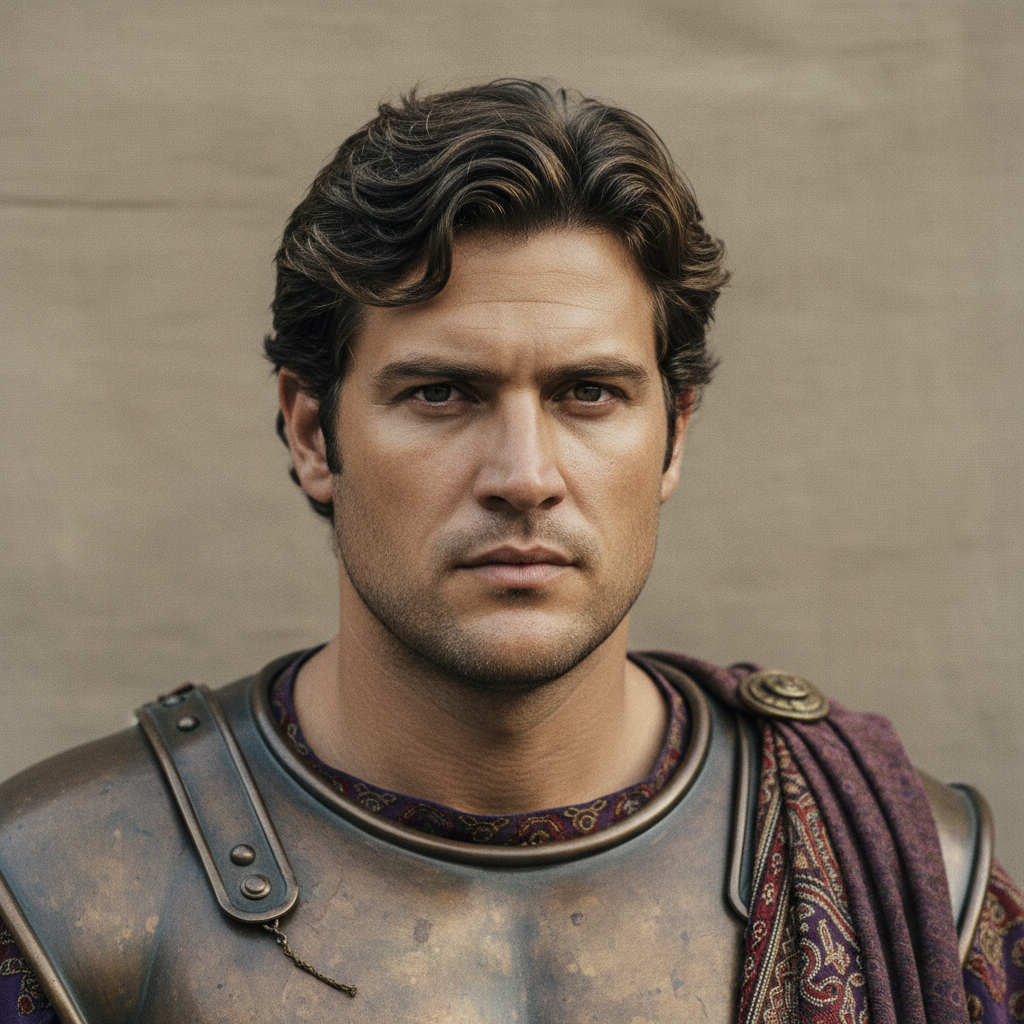
Alexander’s face is usually shown as young and energetic rather than mature or heavily weathered: a narrow, slightly oval face with high cheekbones, a straight nose, and a firm mouth set in an intent, penetrating expression. Portrait tradition emphasizes large, clear eyes that appear forward-looking and focused, giving him a charismatic, commanding presence. His hair is one of the most recognizable features: forward-swept, wavy locks pulled up and back from the forehead in the distinctive anastole—likely dark brown to black—cut to a short-to-medium length. He is most often depicted clean-shaven or with minimal stubble, which reinforces a youthful, athletic appearance rather than a bearded philosopher’s look. Sculptural and coin portraits present a lean, agile body rather than a bulky warrior’s frame: long, well-proportioned limbs, a narrow waist, and a posture that suggests motion and readiness. In battle scenes and formal portraits alike he appears active and alert—helmet often pushed back, gaze fixed forward—projecting energy, leadership, and the physical fitness of a campaigning king.
Height / build
Likely slightly above average height for his time · Likely athletic and slender-muscled
Hair
Likely dark to light brown (often shown with a golden tinge) · Likely wavy · Forward-swept 'anastole' (distinct central cowlick)
Eyes
Likely dark
Complexion
Likely Mediterranean (tanned from campaigning)
Face
Likely oval to slightly long with a strong jaw · Likely straight to slightly aquiline
Notable features
Forward-swept hairline (anastole), prominent brow, sharp/commanding gaze, well-defined jaw
Grooming
Probably clean-shaven · Carefully kept, youthful appearance: stylized hair, smooth face, and the polished look of a Hellenistic royal.
Dress / presentation
Royal Macedonian military dress (chlamys, cuirass) often shown combined with Persian royal garments in later images
hair
Signature hairstyle
Forward-swept anastole
Coins, busts and the Alexander Mosaic repeatedly show hair pushed up and forward in a central cowlick known as the anastole.
face
Facial expression / gaze
Commanding, intense gaze
Portraits emphasize a large, alert eye and strong brow to convey leadership and charisma in Hellenistic portraiture.
hair
Hair texture
Likely wavy
Surviving sculptural and numismatic images consistently render textured, wavy hair rather than straight or tightly curled hair.
eyes
Eye color
Likely dark
As a Macedonian Greek of the northern Greek population, literary tradition and population context favor darker eye colors.
skin
Complexion
Likely Mediterranean (olive to fair; sun-tanned)
Macedonian origin and extensive campaigning outdoors make a Mediterranean, sun-exposed complexion likely; classical portraits show tanned, healthy skin.
grooming
Facial hair
Greek culture prized youthful athleticism, clean-shaven faces, and a calm but intense look of self-control—traits artists emphasized when depicting Alexander to link him to Homeric heroes and gods like Heracles.
Alexander came from the Argead dynasty of Macedon—ethnically Greek but from the northern Greek world—so his features fit Hellenic types: olive skin, dark eyes, and hair ranging from dark brown to sun-lightened tones from campaigning.
Modern films often exaggerate length/volume of hair, add heavy beards, or impose modern grooming—ancient portraits stress a shorter, stylized wavy hair and clean-shaven face.
Films tend to give him long, flowing hair, heavy beards, or an almost modern celebrity look; ancient art and coins show a shorter, stylized wavy hair (the anastole) and typically a clean-shaven, idealized face.
Likely slightly above average height for his time.
Likely dark.
Likely dark to light brown, often shown with a golden tinge in art.
Probably clean-shaven.
Yes—portrayed as striking and charismatic, linked to heroic Greek beauty ideals.
They show a consistent, idealized visual type—likely reflecting his real features but filtered through artistic and political aims.
Alexander Mosaic (House of the Faun, Pompeii)
Pompeii mosaic (copy of Hellenistic original) · ca. 100 BCE–50 BCE (copy of earlier work)
Dynamic battle scene portrait showing Alexander with forward-swept wavy hair, clear eyes, and a youthful, intense expression—used as a key visual for his facial type.
Alexander-type tetradrachms and coin portraits
Hellenistic coinage (issued by Alexander and successors) · late 4th century BCE and later Hellenistic issues
Numerous coins show a consistent facial type: wavy hair with anastole, youthful features and a particular facial profile used to project royal identity across the empire.
Lysippan portrait copies (Roman busts and herms)
Roman copies after Lysippos · Hellenistic originals late 4th century BCE; Roman copies 1st century BCE–CE
Sculptural tradition attributed to Lysippos standardized Alexander's look—slim proportions, anastole, and a particular facial expression—survives in multiple copies.
Plutarch — Life of Alexander
Plutarch · 1st–2nd century CE
Literary descriptions emphasize his charisma, youthful energy and occasionally comment on his hair and appearance in ways that match the visual tradition.
Arrian — Anabasis of Alexander
Arrian · 2nd century CE
Military-focused narrative that supports the image of Alexander as an active, physically capable leader; complements visual portrayals of a fit commander.
Hellenistic and Roman copies and portraits
Various Hellenistic and Roman artists · 4th century BCE–1st century CE copies and adaptations
Multiple later artistic media preserved and propagated a recognizable Alexander type used by successors to legitimize rule.
Probably clean-shaven
Greek royal and heroic iconography, and most portraits, show Alexander without a beard; ancient Greek elites often appeared clean-shaven.
height build
Build
Athletic and lean-muscled
Leader of cavalry and an active field commander—portraits emphasize a lithe, athletic form typical of Greek heroic ideals.
clothing
Typical dress in portraits
Macedonian military cloak and cuirass; later shown in Persian royal robes
Art and coinage depict him in a chlamys and armor; after conquests, Persian garments appear in some representations to indicate rule over Persia.
face
Nose shape
Likely straight to slightly aquiline
Busts and coins usually show a straight or gently curved nose consistent across many likenesses.
other
Age most depicted
Late 20s to early 30s
Most iconic portraits present him youthful, matching his known age at the height of his campaigns and his death at 32.