height build
Height
Likely average to short (≈5'0"–5'3")
Matches typical female stature in early 18th‑century Irish/British populations and age at capture (~23).
Portrait reconstruction
1697–1720 · Born in County Cork, Ireland; active in the Caribbean · Early 18th century (Golden Age of Piracy)
Anne Bonny likely looked like a compact, strong‑featured Irish woman with dark hair, brown eyes, wind‑tanned skin, and a hard, ready look—almost always in practical men’s sailor clothes.
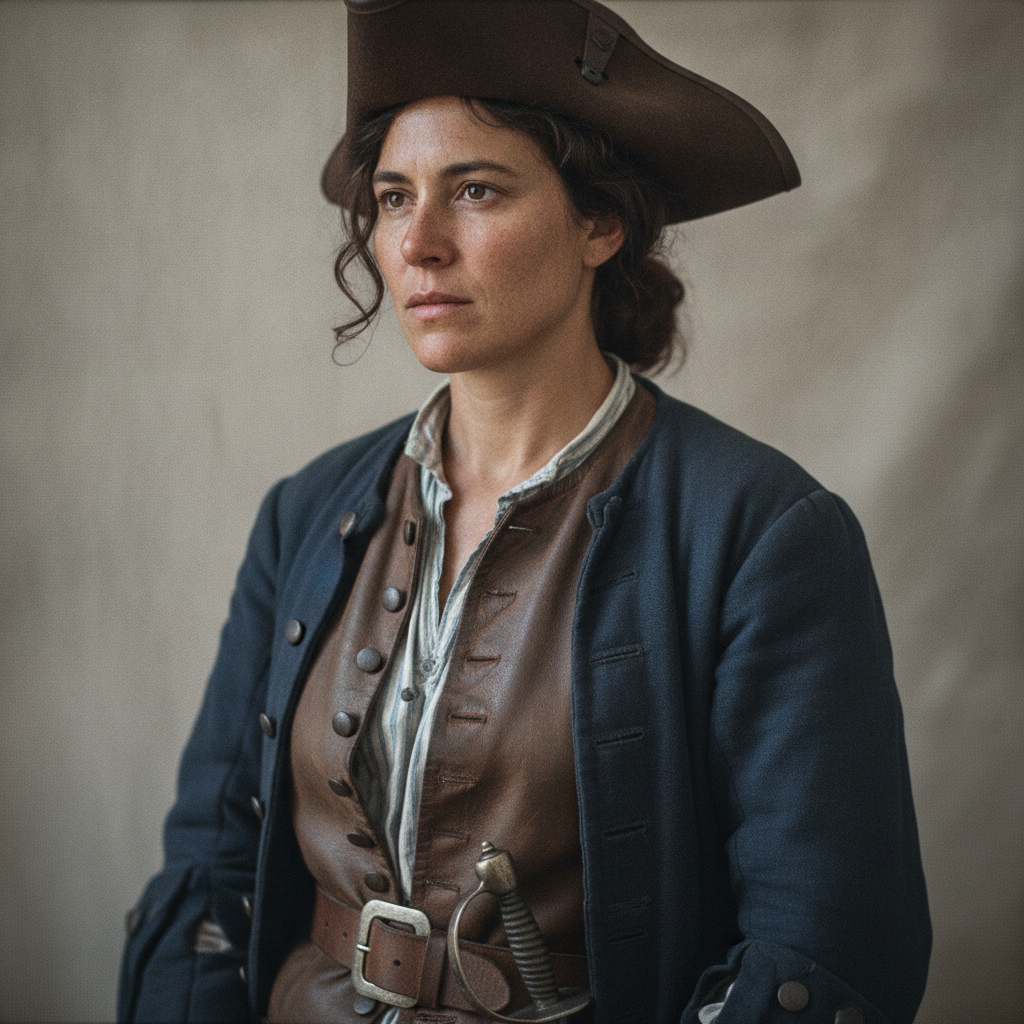
Overall build and bearing: Anne probably had a compact, muscular or wiry build—the sort of small, tough frame that suited shipboard life and close combat. Women of her Irish background and era were commonly shorter than modern averages, so she was likely around five feet to five feet four inches tall, carrying herself with a hard, nimble gait rather than any languid softness. Face, hair, and skin: Her hair was most likely dark brown and kept pinned back, braided, or cropped to stay out of the way during fights and work. Brown eyes are the best single guess; her face would have shown time at sea—sun‑darkened, wind‑creased skin with possible freckles or a sallow olive cast, strong brows, and a firm jaw. Small scars, a weathered nose bridge or a nicked ear are plausible details from life in storms and skirmishes. Hands, dress, and expression: Hands and forearms would have been callused and stained with rope, tar and gunpowder; nails short and often grubby. She is most vividly imagined in a loose linen shirt, breeches or trousers, a rough coat and sturdy boots, with a sash for carrying pistols or a knife—clothing chosen for mobility and combat. Her expression would read quick, alert and dangerous: a woman used to taking risks and answering threats directly.
Height / build
Likely average to short for modern standards (Likely around 5'0"–5'3") · Likely compact and muscular
Hair
Likely dark brown · Likely wavy to moderately curly · Likely typical (no evidence of notable recession)
Eyes
Likely dark (brown)
Complexion
Likely fair to medium when sheltered, but tanned and weathered from sun and salt
Face
Likely oval to rounded · Likely straight to slightly aquiline (common regional types)
Notable features
Often described as bold and attractive; commonly wore male seafarer's clothing when fighting or aboard ship.
Grooming
None (female) · Practical grooming—shorter or tied‑back hair when presenting as a man; otherwise modestly styled by female norms of her class.
Dress / presentation
Practical sailor's attire; often dressed in men's breeches, coats, and boots while fighting—otherwise simple woman's dress when off duty.
height build
Height
Likely average to short (≈5'0"–5'3")
Matches typical female stature in early 18th‑century Irish/British populations and age at capture (~23).
height build
Build
Likely compact and muscular
Active shipboard life and reported fighting suggest a sturdy, strong physique despite modest stature.
hair
Hair color
Likely dark brown
Irish ancestry and contemporary descriptions implying dark hair tones; common regional trait.
hair
Hair texture & style
Likely wavy to moderately curly; tied back or cropped when in men's clothes
Irish hair often wavy; practical sailor roles would favor tied or shortened hair, and accounts note she dressed as a man.
eyes
Eye color
Likely dark (brown)
Brown eyes are common in Irish populations and no primary source reports light eyes.
skin
Complexion
Likely fair originally, tanned and weathered from tropical sun
Early 18th‑century Caribbean society had clear gender expectations; a woman wearing men's seafaring clothes—especially while exercising force—was visually and socially transgressive. Anne Bonny's choice to dress as a man would have amplified perceptions of boldness and physical competence, making her both memorable and notorious.
Born in County Cork, Anne Bonny likely carried the typical Irish combination of fair skin and dark hair; after years at sea and in the Caribbean climate she would have developed a deeper tan and weathered skin—so imagine an Irish complexion aged by salt air and sun rather than an exotic tropical look.
Modern images often sexualize or glamorize her—depicting stylized costume or exaggerated features—whereas contemporary context points to practical, weathered seafaring attire and a compact, athletic build.
Film and fantasy often sexualize or glamorize Anne Bonny with stylized costumes, immaculate hair, or exaggerated height. In reality she was likely practical and weathered; her most distinctive visual trait reported by contemporaries was not glamorous clothing but her readiness to wear men's sailor gear and fight.
Probably not tall by modern standards—likely about average to short for an early 18th‑century woman (roughly 5'0"–5'3").
Likely dark (brown).
Likely dark brown—often tied back or shortened when she dressed as a man.
Yes—contemporary narratives describe her as attractive or striking, though descriptions emphasize character as much as looks.
Usually practical sailor's clothing; she is repeatedly reported to have fought in men's breeches, coats, and boots.
No authenticated contemporary portrait survives; our impressions come from trial accounts, early narratives, and contextual inference.
A General History of the Pyrates
Captain Charles Johnson (1724) · 1724
The principal near‑contemporary narrative that recounts Bonny's life, her fighting in men's clothes, and personal anecdotes; provides the basis for later images but offers limited physical description.
Jamaica Admiralty/Assize Trial Records
Court records, St. Catherine's parish (1720) · 1720
Official proceedings for the trials of Anne Bonny and Mary Read; mention her conduct, clothing, and behavior at capture—primary legal evidence of her male dress and combative role.
Later Victorian and modern illustrations
19th–20th century prints and paintings · 19th–20th c.
Romanticized images that popularized a glamorous, sexualized Anne; useful for tracing modern myths but not for accurate features.
Biographical entries (ODNB / modern historians)
Oxford Dictionary of National Biography; modern biographies · 20th–21st c.
Synthesize primary sources and contextual research (birth in Cork, Caribbean activity, trial) and provide reasoned reconstructions of appearance based on origin and occupation.
Population and anthropological context
Studies of 18th‑century British/Irish phenotype and stature · Modern studies (various)
Provides baseline estimates for height, complexion, and hair/eye frequencies to inform likely appearance.
Contemporary newspaper and pamphlet references
Period press accounts (early 18th century) · c. 1720s
Brief notices and retellings that repeat the elements of her dress and daring; help explain public perception of her look.
Irish birth implies fair base skin; years at sea in the Caribbean produce sun‑tanning and weathering.
clothing
Typical dress
Practical sailor's clothing; often male attire when fighting
Accounts repeatedly state she fought in men's clothes and disguises; shipboard necessity favored durable breeches, coats, and boots.
grooming
Grooming
Practical and functional
Shipboard life requires durable, low‑maintenance grooming; contemporary reports emphasize her active combat role rather than vanity.
face
Facial features
Likely oval face, straight nose—visually attractive
Contemporary writers describe her as attractive; Irish phenotypes combined with youth suggest oval face and regular features.
cultural
Visual impression in a room
Striking because of her dress and manner—often in men's clothes, confident bearing
Reports highlight her wearing men's clothing and fighting, which would make her stand out among civilians and sailors.