face
Face shape
Likely long/oval
Surviving portrait heads attributed to Archimedes show an elongated face and high forehead typical of Hellenistic scholarly portraiture.
Portrait reconstruction
287 BCE–212 BCE · Syracuse, Sicily (Greek world) · Hellenistic Greece (3rd–2nd century BC)
Archimedes most likely looked like an older, long‑faced Greek man with curly dark hair, a prominent nose and a full beard.
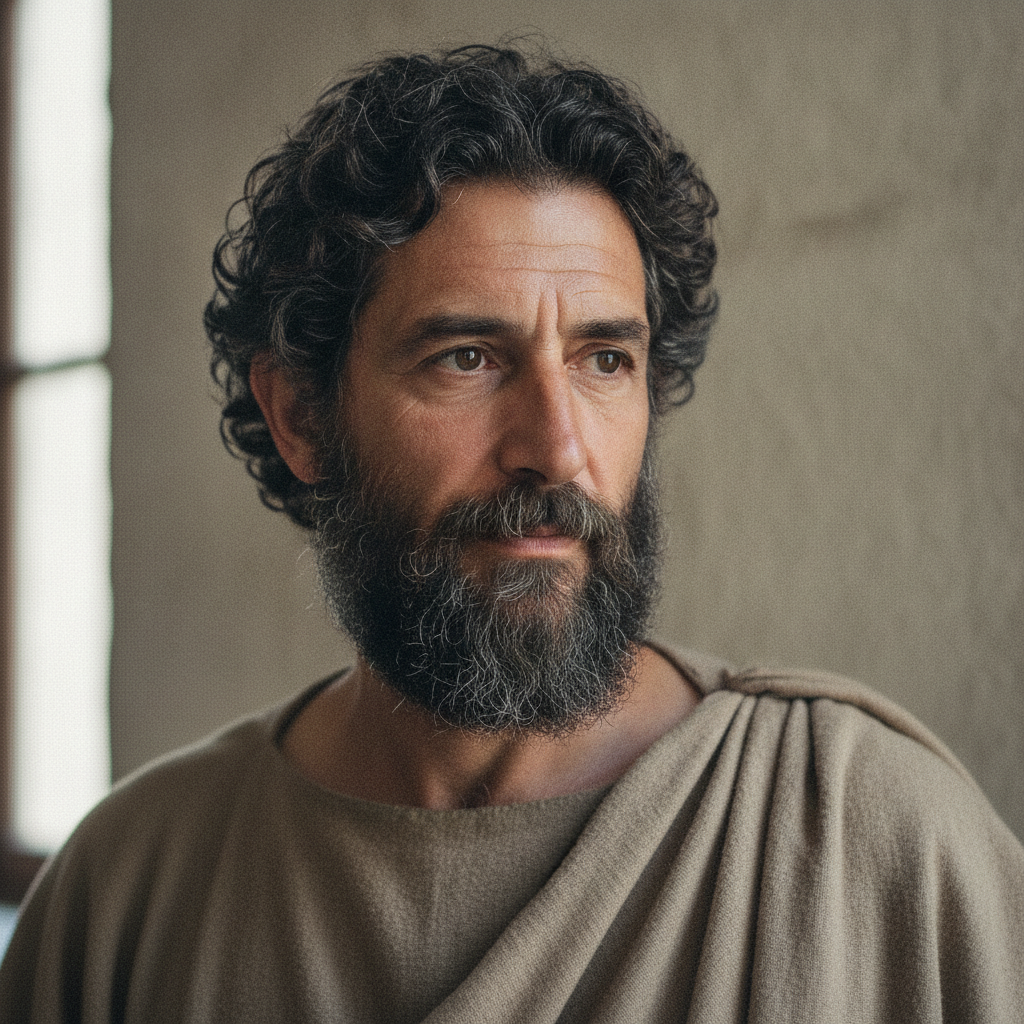
Face: Imagine a long, narrow face with a straight, somewhat prominent nose and a calm, focused expression—features common in Hellenistic portraits of learned men. His brow would be deliberate rather than heavily furrowed, giving an impression of concentration and intellect. Hair and beard: He likely had dark, curly hair—brown to black in tone—kept in a short, controlled style, and a full beard that framed the lower face. The beard would be substantial but not wild, neatly modeled in the classical style that signals a man of study and dignity; a touch of gray at the temples or in the beard would be plausible for an older scholar. Complexion, build and dress: As a Sicilian Greek he would most likely have had an olive to warm tan complexion and dark eyes; build would be average for the time rather than strikingly robust or frail. Portraits and descriptions place emphasis on his head and face, while clothing would be a simple tunic and himation—practical, plain garments suited to a man of learning rather than to a soldier or courtier.
Height / build
Likely average to slightly tall for his time · Likely slender to lean
Hair
Likely dark to graying · Likely wavy to curly · Likely receding somewhat with age
Eyes
Likely dark
Complexion
Likely Mediterranean complexion
Face
Likely long/oval · Likely prominent / slightly aquiline
Notable features
Long face, prominent nose, full scholarly beard, deep-set dark eyes
Grooming
Probably full beard (typical scholarly beard) · Likely kept in a tidy, conventional scholar’s style—neat beard, hair short to medium length, not flamboyant.
Dress / presentation
Greek Hellenistic scholar’s tunic and himation (cloak); practical but respectable urban dress
face
Face shape
Likely long/oval
Surviving portrait heads attributed to Archimedes show an elongated face and high forehead typical of Hellenistic scholarly portraiture.
hair
Hair color
Likely dark to graying
Greek Sicilian origin implies dark hair; Roman copies show an older man with hair rendered darker and with signs of aging.
hair
Hair texture
Likely wavy to curly
Hellenistic portrait sculpture often depicts learned Greek men with wavy/curly hair; regional phenotypes support this texture.
eyes
Eye color
Likely dark
Dark eyes were predominant in the eastern and central Mediterranean populations; ancient portraits render deep-set, dark eyes.
other
Beard
Probably full beard
Hellenistic intellectuals and later portrait types typically show a full beard; surviving marble heads attributed to Archimedes show facial hair.
height build
Height
Likely average to slightly tall for his time
In the Hellenistic world, age, a full beard, and sober dress signaled wisdom and authority. Scholars and engineers were expected to present seriousness rather than youthful beauty—Archimedes would have projected authority through age and composure.
Syracuse was a Greek city on Sicily with a population blending mainland Greek settlers and local Mediterranean peoples; a typical elite male like Archimedes would most likely have olive skin, dark hair, and dark eyes familiar to eastern Mediterranean portraits.
Modern images often exaggerate wild hair, extreme age, or eccentric 'mad scientist' looks; period portraits present a sober, classical scholar with conventional grooming.
Modern portrayals tend to turn Archimedes into an exaggerated 'mad scientist' with wild white hair and frenzied expressions. Period portraits and ancient descriptions show a sober, tidy elder—intense but composed, not theatrical.
No confirmed contemporary painting of Archimedes survives; what we lean on are Roman-era copies of Hellenistic portraits that idealize learned men. These preserve features like beards and hair texture but also reflect later tastes.
Likely average to slightly tall for his time.
Likely dark.
Likely dark, turning to gray with age.
Probably yes—a full scholarly beard.
A simple tunic and a himation (cloak) typical of Hellenistic scholars.
They reflect an established portrait type for an older Greek scholar—useful for imagining his likely look though created later as copies or traditions.
Portrait head attributed to Archimedes (Naples Archaeological Museum)
Museo Archeologico Nazionale di Napoli (attribution tradition) · Roman copy of Hellenistic original (1st–2nd century AD, attributed)
A marble head long associated with Archimedes: shows a long face, prominent nose, curly hair and full beard typical of Hellenistic intellectual portraiture.
Capitoline/other Roman portrait types labeled 'Archimedes'
Capitoline Museums / Roman portrait tradition · Roman Imperial period (1st–3rd century AD, copies of Hellenistic types)
Several Roman-era portrait heads have been traditionally identified as Archimedes; they consistently portray an older, bearded, long-faced man—giving the conventional image used by later generations.
Plutarch, Life of Marcellus
Plutarch · early 2nd century AD
Plutarch recounts Archimedes' role and death during the Roman capture of Syracuse and characterizes him as a serious, temperate man; such accounts influence how later artists pictured his age and demeanor.
Livy, History of Rome (books on the siege of Syracuse)
Livy · late 1st century BC – early 1st century AD
Livy recounts the siege and death of Archimedes, emphasizing his age and scholarly preoccupation at the time of killing—supporting the image of an elder immersed in work.
Roman/Hellenistic portrait conventions (scholarly summaries)
Art-historical literature on Hellenistic portraiture · 20th–21st century scholarship
Scholars trace how Roman copies preserve Hellenistic portraits of scholars: beards, hair texture, long faces and dignified features become standard attributes of learned men like Archimedes.
Valerius Maximus / other Roman anecdotal notices
Valerius Maximus (and other Roman anecdotal sources) · 1st century AD
No measurements survive, but literary emphasis on his presence and stature in accounts of his capture implies he was not notably short.
height build
Build
Likely slender to lean
Portraits and descriptions of learned men and craftsmen favor a leaner frame rather than heavy musculature.
skin
Complexion
Likely Mediterranean (olive to light-brown)
Origin in Greek Sicily and regional population characteristics point to an olive Mediterranean skin tone.
hair
Hairline
Likely receding somewhat with age
Later portraits show a high forehead and slightly receding hairline consistent with an older scholar.
clothing
Clothing style
Greek scholar’s tunic and himation (cloak)
Hellenistic intellectuals and portrait sculpture conventionally depict learned men in simple tunics and cloaks rather than military garb.
grooming
Grooming
Tidy, conventional scholar’s grooming
Contemporary values and later portraits show modest, controlled grooming befitting a respected intellectual.
other
Overall impression
Commanding, learned elder rather than flamboyantly eccentric
Ancient narratives emphasize his seriousness and age; portraits amplify authority over caricature.
Later Roman anecdotal writers recount incidents from Archimedes' life and death, reinforcing an image of an aged, bearded inventor engrossed in work rather than a military figure.