hair
Hairline
Receding
Many portrait busts attributed to Aristotle show a high forehead and receding hairline; later texts note thinning hair in old age.
Portrait reconstruction
384 BCE–322 BCE · Stagira (Macedonia) — active in Athens · Classical Greece (4th century BCE)
Aristotle likely looked like a broad-faced, dark-haired Greek man with a receding hairline, a prominent nose, and a short beard.
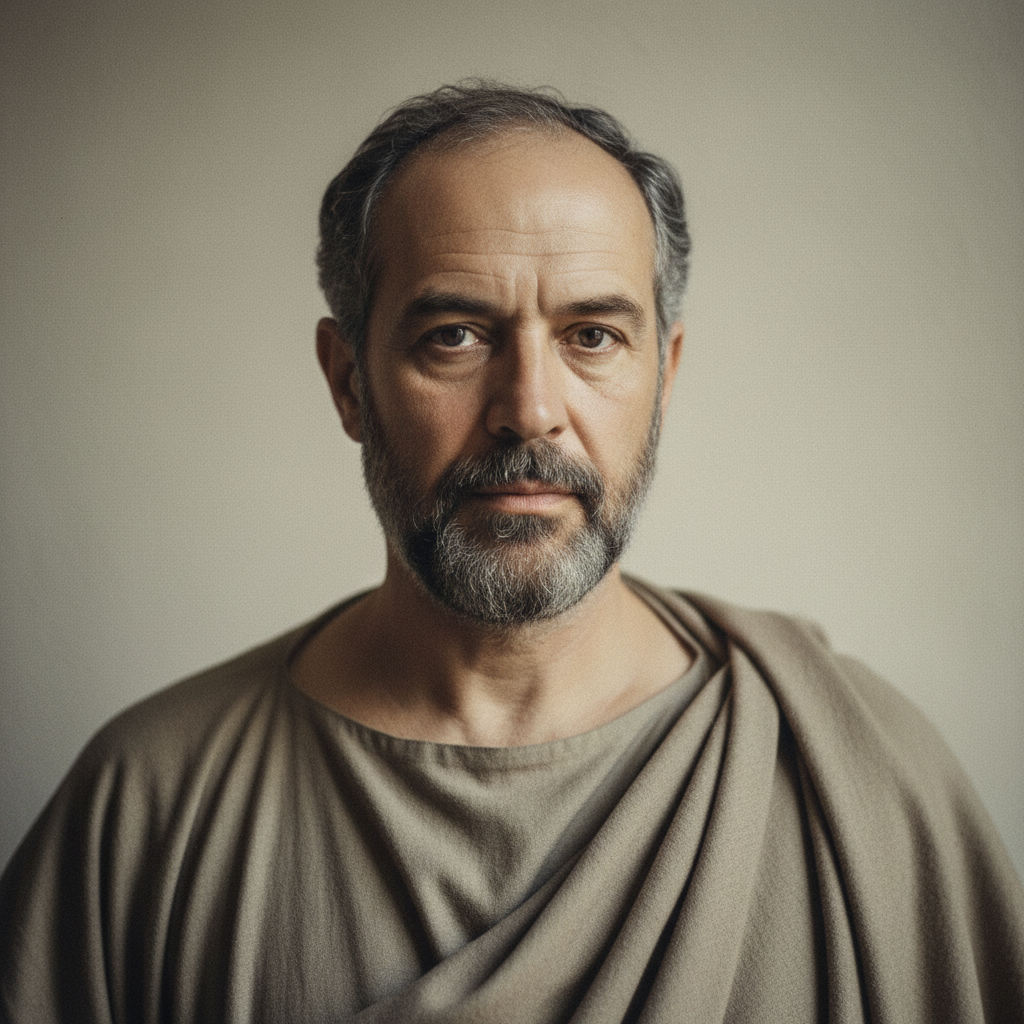
His face was probably broad and solid rather than narrow: rounded cheeks, a strong jaw, and a prominent, slightly hooked nose that gives a commanding profile. The overall effect is of a thoughtful, composed man rather than a gaunt ascetic. Hair was likely dark—brown to black—and cut short, maybe a little wavy; portraits repeatedly show a receding hairline, so his forehead would have appeared high. He probably kept a short, close-cropped beard in adulthood rather than a long, flowing one, and as a younger man he may have been clean-shaven at times. Skin tone and eyes fit the Mediterranean basin: an olive complexion with dark eyes, and a compact, sturdy build typical of classical Greek men. Portraits present him as middle-aged to older—experienced, steady, and measured in expression rather than theatrical.
Height / build
Likely average height · Likely stocky / broad-shouldered
Hair
Likely dark to graying · Likely wavy · Receding hairline
Eyes
Likely dark
Complexion
Likely Mediterranean complexion
Face
Broad, full face with heavy jaw · Prominent, slightly hooked nose
Notable features
Receding hairline, high forehead, broad face, heavy jaw, prominent nose
Grooming
Probably bearded (short/trimmed beard) · Typical philosopher grooming: kept a trimmed beard and short hair, not long or highly styled.
Dress / presentation
Simple Greek scholar’s dress — chiton and himation (plain, unadorned), sometimes Macedonian cloak
hair
Hairline
Receding
Many portrait busts attributed to Aristotle show a high forehead and receding hairline; later texts note thinning hair in old age.
hair
Hair color
Likely dark to graying
Portraits and the Mediterranean origin point to dark hair, with many representations showing age-related greying.
other
Facial hair
Probably bearded (short/trimmed)
Ancient portraits and the philosophical tradition present Aristotle with a short beard typical for male philosophers of the period.
face
Face shape
Broad, full face with heavy jaw
Busts and later iconography consistently show a broad face and fuller jawline rather than a narrow, gaunt visage.
face
Nose
Prominent, slightly hooked nose
Sculptural portraits depict a prominent nose with a slight hook — a recurring element in identified portrait types.
eyes
Eye color
Likely dark
Classical Greek society often separated the athletic, youthful ideal from the visage of wisdom: philosophers presented themselves with beards, sober dress and a mature, sometimes rugged look that signaled experience and authority rather than beauty. Aristotle’s likely trimmed beard and plain himation conveyed the cultural cues of a serious intellectual.
Born in Stagira (Macedonia) and long resident in Athens, Aristotle would have resembled Mediterranean Greeks of his era: dark hair, dark eyes, olive skin and a sturdier build than the classical athletic ideal. Think of a compact, solid Balkan Greek rather than a tall Northern European stereotype.
Modern images often over-idealize Aristotle as a white-bearded, saintlike sage or conflate him with Plato; the historical man was more everyman, stockier, and less coiffed.
Movies and classroom art often turn Aristotle into a soft, saintly white-bearded elder or simply copy the look of Plato; historical portraits and texts instead point to a more workmanlike, solid man with a receding hairline and a trimmed beard — less mythic sage, more seasoned teacher.
No verified contemporary painting survives, but multiple Roman-era marble portraits appear repeatedly with the same facial features; that repetition created a recognizable portrait-type that later generations adopted — giving us a stable, if partly idealized, image of Aristotle.
Likely average height for a 4th-century Greek man.
Likely dark.
Likely dark, turning gray with age.
Probably yes — a short or trimmed beard typical for philosophers.
Probably not fully bald — rather a receding hairline and thinning at the crown.
Our image comes from repeated Roman-era marble portraits and later literary and pictorial traditions that present a consistent portrait-type.
Roman marble portrait busts attributed to Aristotle
Roman copies of Greek originals (various museums) · 1st–3rd century CE (Roman Imperial period)
Several Roman-era marble portrait busts repeatedly present the same features: receding hairline, broad face, prominent nose, and a short beard — this recurring 'Aristotle type' underpins most modern images.
Diogenes Laertius — Life of Aristotle (Lives and Opinions of Eminent Philosophers)
Diogenes Laertius · 3rd century CE (compilation)
Later biographical compilation that preserves anecdotes about Aristotle’s life and character; while not a contemporary eyewitness account it contributes to the tradition about his persona and age in portraits.
Medieval and Renaissance manuscript portraits and statues
Byzantine and Western manuscript tradition · 9th–16th centuries
Later illustrated manuscripts and sculptural programs perpetuated a standard image of Aristotle as a bearded, middle-aged man; these later images reflect and reinforce the Roman portrait-type.
Population and anthropological context for Classical Greeks
Modern anthropological and historical studies of ancient Mediterranean populations · 20th–21st century research
Data on stature, complexion and typical phenotypes for Greek populations in the classical period support likely traits such as Mediterranean complexion, dark hair and dark eyes and average height lower than modern northern Europeans.
Mediterranean population context and later descriptions point to dark eyes as most probable.
height build
Height
Likely average height
No ancient source emphasizes exceptional height; average male height in classical Greece suggests an average stature.
height build
Build
Likely stocky / broad-shouldered
Portraits show a thick neck and full face; literary tradition frames him as earthy and solid rather than lean and athletic.
clothing
Clothing style
Plain Greek scholar’s himation and chiton
Ancient depictions of philosophers and textual references place thinkers in simple draped garments rather than elaborate dress.
other
Overall presence
Earthy, authoritative rather than idealized beauty
Portrait types and textual portrayal emphasize practical sobriety and authority rather than heroic looks.