skin
Complexion
Likely medium to dark brown
Ashoka came from Magadha in the Gangetic plain where populations historically show medium–dark brown tones; Mauryan art and later descriptions imply a native north‑Indian complexion.
Portrait reconstruction
304 BCE–232 BCE · Magadha (northern Indian subcontinent) · Ancient India, Mauryan Empire (3rd century BCE)
Ashoka most likely looked like a dark‑haired, dark‑eyed North Indian ruler in finely draped robes—neat, dignified, and usually clean‑shaven.
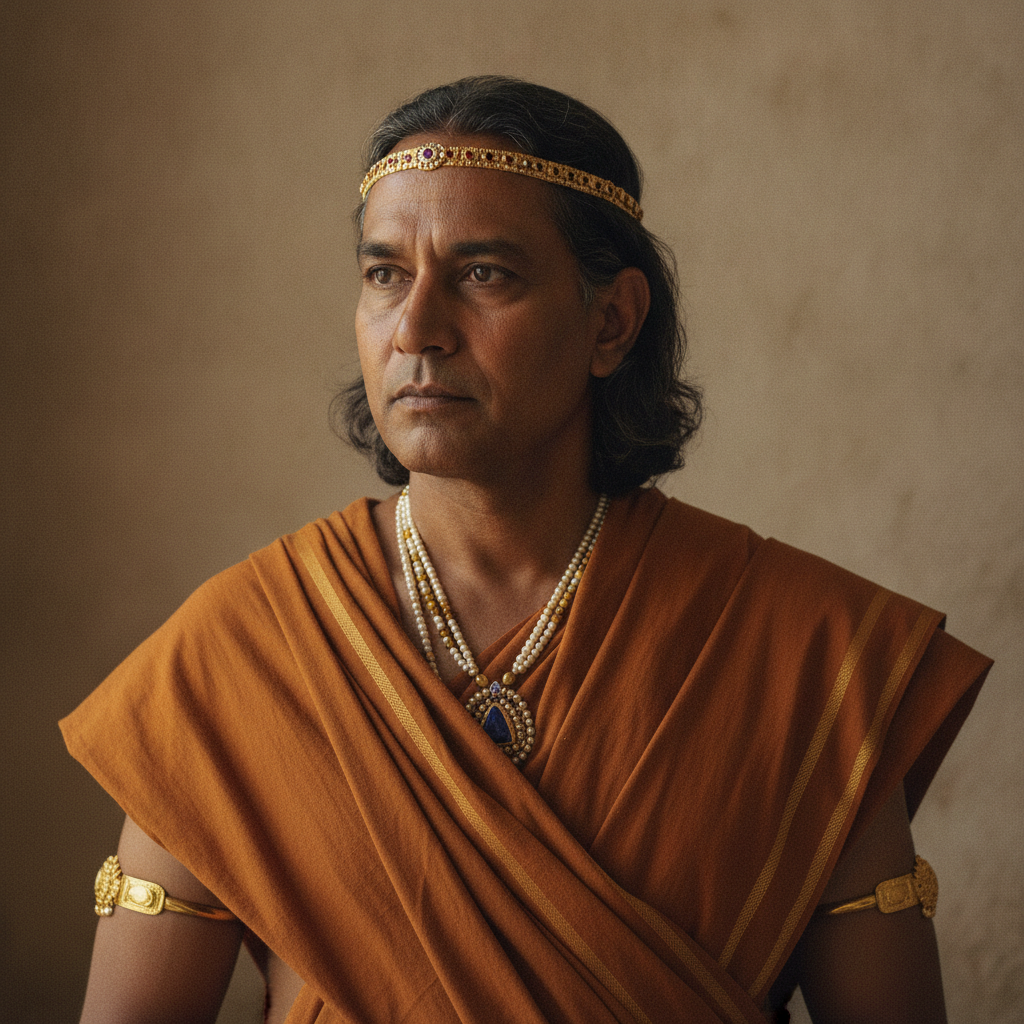
Skin tone and facial features: Think of an adult man of the Indo‑Gangetic heartland—medium to medium‑dark brown skin, dark brown eyes and dark hair. His features would read as strong and composed rather than gaunt, projecting calm authority rather than ostentation. Hair and facial hair: He probably kept his hair short and neatly arranged for public life, with the possibility of tying it up simply for formal ceremonies; many elite men of the time were clean‑shaven or closely trimmed, so a smooth, well‑maintained face is the likeliest look. Dress and adornment: As emperor he would wear finely woven draped garments—layers like a wrapped lower cloth (dhoti/antariya) and an upper shawl or cloak—cut and pleated to signal status. Colors were rich and sober (saffron, deep red, ochre) and his public appearance would include tasteful gold jewelry: a broad necklace or torque, armlets, rings and possibly a simple headband or diadem for ceremonial use.
Height / build
Likely average height · Likely sturdy to solid build
Hair
Likely dark to graying · Likely straight to wavy · Likely receding or thinning in later life
Eyes
Likely dark (brown)
Complexion
Likely medium to dark brown
Face
Likely oval to broad · Likely straight to slightly aquiline
Notable features
Commanding forehead and jawline, dignified bearing; likely no long beard, often shown with royal insignia or later with monastic simplicity.
Grooming
Probably clean‑shaven · Early life: well‑kept royal grooming, jewelry and ornaments; later life: simpler, monastic grooming and shorter or shorn hair/locks.
Dress / presentation
Royal Mauryan court dress (dhoti, uttariya/shawl, jewelry, possibly a jewelled diadem) early; saffron/ochre Buddhist robes later.
skin
Complexion
Likely medium to dark brown
Ashoka came from Magadha in the Gangetic plain where populations historically show medium–dark brown tones; Mauryan art and later descriptions imply a native north‑Indian complexion.
eyes
Eye color
Likely dark (brown)
Dark brown eyes predominate in South Asia and are the most probable eye color for a 3rd‑century BCE north Indian ruler.
hair
Hair color
Likely dark to graying
Native north Indian populations typically have dark hair; as a long‑lived ruler he likely showed graying in later portraits or descriptions.
hair
Hair texture
Likely straight to wavy
Archaeological and ethnographic evidence from the region supports straight to wavy hair in north Indian populations.
grooming
Facial hair
Probably clean‑shaven
Mauryan royal iconography and later Buddhist depictions more often show male elites with minimal facial hair; Buddhist monasticism favored shaven faces/heads.
height build
Height
In Mauryan society regal authority was communicated by stately posture, rich drapery and visible insignia (ornate jewellery, diadems, and polished garments). After converting to Buddhism, visible humility—simpler robes, fewer jewels, shaved or short hair—became a powerful signal of moral authority and renunciation.
Ashoka was a north Indian ruler from Magadha; his likely features—dark eyes, dark hair, medium‑dark skin—match the long‑standing regional phenotype of the Ganges plain. His ruling class would share these traits but display additional markers of status like jewellery and fine textiles.
Modern images often show Ashoka with anachronistic fair skin, long flowing hair, or cinematic Western features; historically he was a north Indian ruler with dark complexion and regional dress.
Many modern portrayals give Ashoka fair skin, flowing long hair and heroic Europeanized facial features. In reality, he was a south Asian king whose appearance and dress reflected local populations and Mauryan aesthetic conventions.
Likely average height for a north Indian male of his era.
Likely dark brown.
Likely dark, turning to gray in later life.
Probably clean‑shaven; later monastic depictions emphasize short or shorn hair and minimal facial hair.
As emperor: richly draped garments (dhoti, uttariya/shawl) and jewelry; later: simpler saffron or ochre Buddhist robes.
No verified contemporary portrait exists; his likely look is reconstructed from inscriptions, Mauryan art and later textual and artistic traditions.
Edicts of Ashoka (inscriptions)
Ashokan Rock and Pillar Edicts · ca. 250 BCE
Public inscriptions that reflect Ashoka’s public persona and moral transformation; they imply a ruler who emphasized moral authority and public display, which influenced how he would dress and present himself.
Ashokavadana (Buddhist chronicle)
Ashokavadana (in Divyavadana corpus) · compiled ca. 2nd century CE (later)
A later Buddhist narrative that describes Ashoka’s conversion and life; provides descriptions of behaviour, dress changes and symbolic episodes that influenced later visual portrayals.
Lion Capital of Ashoka (Sarnath pillar capital)
Sarnath Lion Capital · ca. 250 BCE (Mauryan)
A symbolic imperial emblem produced under Ashoka’s patronage; while not a portrait, its high polish, formal style and royal iconography reflect Mauryan aesthetic values of authority and dignity.
Reliefs at Sanchi and Bharhut
Sanchi & Bharhut relief panels · 2nd century BCE – 1st century CE (post‑Mauryan)
Later visual scenes showing kings and donors in draped garments and specific hairstyles; these help reconstruct likely dress and grooming for elite Mauryan figures.
Mahavamsa & Dipavamsa (Sri Lankan chronicles)
Mahavamsa / Dipavamsa · 5th century CE and later
Later chronicles that recount Ashoka’s life and conversion; they shaped South Asian Buddhist imagery of Ashoka and emphasize his conversion attire and demeanour.
Regional population and archaeological studies
Anthropological and archaeological surveys of ancient South Asia · 20th–21st century research
Skeletal and cultural evidence indicating typical north Indian phenotypes (dark hair, dark eyes, medium–dark skin), which inform most probable appearance traits.
Likely average height
Skeletal and population reconstructions place average male height in South Asia lower than modern values; rulers may be only modestly taller than commoners.
height build
Build
Likely sturdy / solid
As a king and former warrior, Ashoka likely had a robust, broad‑shouldered build, though his later ascetic phase would show a leaner posture.
clothing
Court dress
Royal Mauryan garments: dhoti, uttariya, jewelry
Mauryan-era reliefs, inscriptions and later texts describe and depict elites in draped garments, shawls and jewelled accessories.
clothing
Later dress
Simpler saffron/ochre Buddhist robes
After the Kalinga conversion Ashoka adopted Buddhist patronage and is described as favouring monastic simplicity and religious dress.
face
Notable facial features
Commanding forehead and jaw, dignified bearing
Royal imagery and textual portrayals emphasize a powerful, authoritative presence rather than delicate features.