height build
Height
Likely tall for his time
West African chronicles and traveler accounts emphasize his commanding physical presence and stature as a hallmark of leadership.
Portrait reconstruction
0–0 · Songhai Empire (West Africa, Sahel) · Late 15th–early 16th century
Askia Muhammad I would likely have looked like a dark‑skinned, broad‑featured Sahelian ruler in flowing embroidered robes and a turban, projecting both piety and authority.
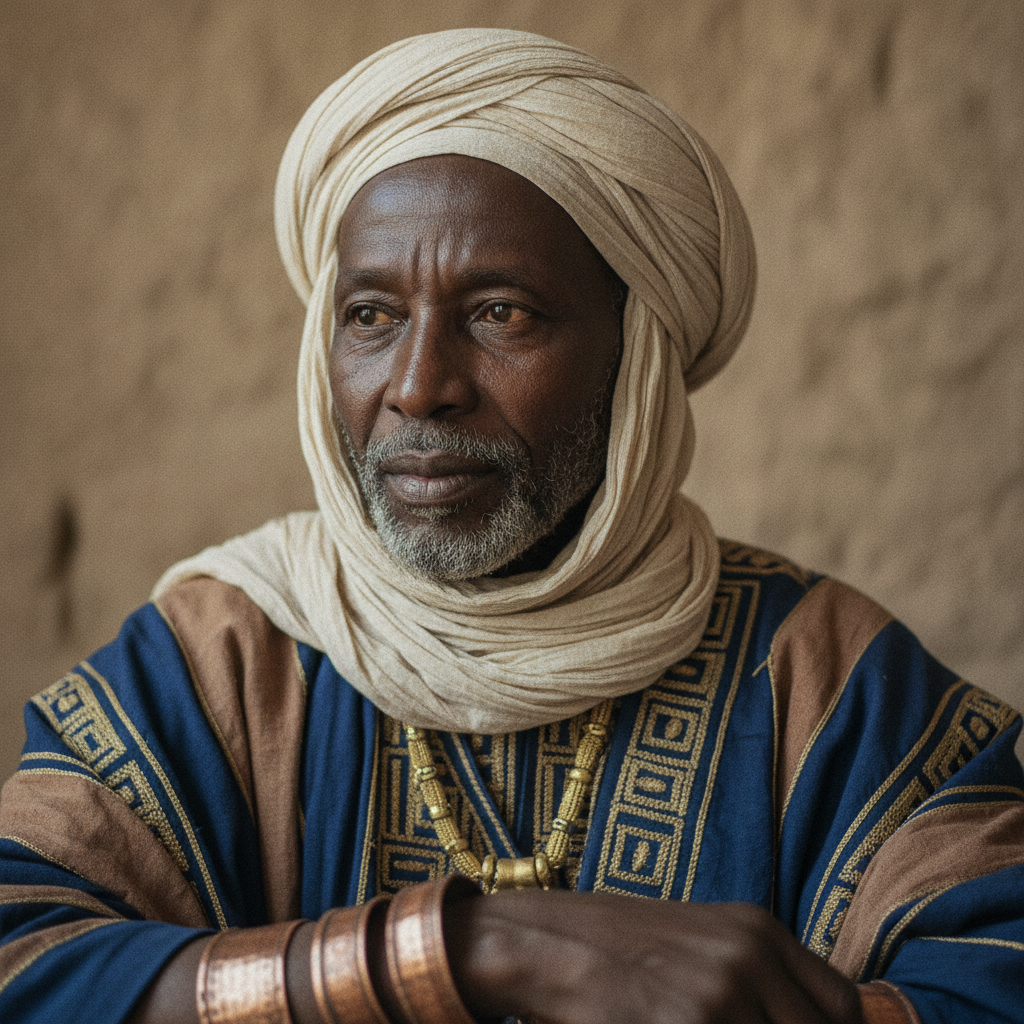
Face and head: He would have had a dark brown to deep brown complexion typical of the Niger‑Bend Sahel, with strong, broad facial features—high cheekbones, a wide nose, and dark brown eyes that conveyed steady authority. His hair was probably short‑cropped and typically wrapped or covered by a turban in public; he was often clean‑shaven or kept only a neatly trimmed beard to conform with elite Muslim grooming of the time. Clothes and adornment: In courtly settings he likely wore flowing, ankle‑length robes (boubous) of finely woven and embroidered cloth—rich indigo, white, and patterned textiles—layered with a long sash and sometimes a light cloak. Gold jewelry (necklets, arm rings, finger rings) and possibly glass beadwork signaled wealth drawn from trans‑Saharan trade; a decorated sword or staff was a visible emblem of rulership. On pilgrimage he would adopt the plain white garments of hajj while retaining an air of careful, ceremonial dress. Bearing and presence: Askia would have looked purposeful and dignified—upright posture, measured gait, and a composed expression used to command a large retinue. His public appearance emphasized piety and statecraft together: elegantly dressed but not ostentatious in a way that conflicted with Islamic norms of the period, so his clothing and accessories communicated both authority and religious standing.
Height / build
Likely tall for his time · Likely robust/stocky
Hair
Likely dark to graying in later life · Likely tightly coiled (typical West African texture) · Likely full in youth; probably receding/graying with age
Eyes
Likely dark (brown)
Complexion
Likely dark brown
Face
Likely broad to oval face · Likely straight to broad Sahelian nose
Notable features
Commanding posture, turbaned head, layered embroidered robes, and gold or copper jewelry indicating royal status
Grooming
Likely a neatly trimmed beard and mustache (Islamic grooming norm) · Usually turban-covered head, well-groomed beard, and clean, well-kept clothing appropriate to a devout Islamic ruler.
Dress / presentation
Islamic Sahelian royal attire—flowing boubou/robes, embroidered cloaks, turban/veil, and visible status jewelry
height build
Height
Likely tall for his time
West African chronicles and traveler accounts emphasize his commanding physical presence and stature as a hallmark of leadership.
skin
Complexion
Likely dark brown
Songhai rulers were Sahelian West Africans; contemporary accounts describe Songhai people as dark-complexioned.
eyes
Eye color
Likely dark (brown)
Dark brown eyes are overwhelmingly common in West African populations and are the expected trait in textual descriptions.
hair
Hair texture
Likely tightly coiled
Typical West African hair texture among Songhai people; chroniclers note hairstyles consistent with Sahelian norms.
hair
Hair color / age
Likely dark to graying
He reigned for decades and made the famous pilgrimage later in life; older rulers commonly described as graying.
grooming
Facial hair
Likely a neatly trimmed beard and mustache
In Askia Muhammad I’s world, a king projected piety, scholarship, and wealth. Visible signs included a neatly kept beard, turbans or headwraps signaling Islamic identity, and layered embroidered robes indicating both status and ties to trans-Saharan trade. Public display of learned men and Qur'anic scholars alongside the ruler reinforced the visual link between faith and authority.
Think of Askia as belonging to Sahelian West Africa: dark brown skin, tightly coiled hair, strong bone structure typical of Songhai people, but wearing the cosmopolitan clothing of an Islamic monarch—silks, cotton embroideries, and turbans obtained through Saharan and Mediterranean trade.
Modern images often exoticize or Arabize him (overemphasizing Middle Eastern features or piles of gold); historically he would have looked recognizably West African Sahelian while wearing Islamic elite dress.
Popular images often either over-Arabize Askia (making him look Middle Eastern) or turn him into a fantasy gold-king. In reality, he would have looked West African in his physical features while wearing Islamic and Sahelian elite dress—rich but regionally rooted, not a Middle-Eastern look or cartoonish treasure-hoarder.
Likely tall for his time—contemporary chronicles stress his commanding stature.
Likely dark brown, matching regional population norms.
Likely dark and tightly coiled in texture; often graying in accounts from his later years.
Probably yes—a neatly trimmed beard and mustache in line with Islamic grooming and kingly presentation.
Flowing Islamic Sahelian robes, embroidered cloaks, and a turban, often with jewelry showing his royal rank.
By combining near-contemporary textual descriptions of his person and court, plus knowledge of Songhai population traits and Islamic Sahelian dress, historians create a responsible composite image.
Tarikh al-Sudan (The History of the Sudan)
Abd al-Rahman al-Sadi (compiled c. 17th c., using earlier material) · 17th century (covers 15th–16th c.)
A West African Arabic chronicle that records events of the Songhai Empire, praises Askia’s leadership and public presence, and records details like his pilgrimage and courtly display that inform his likely dress and bearing.
Tarikh al-Fattash (The Chronicle)
Mahmud Kati and later compilers (manuscript tradition) · c. 17th century (compiles earlier reports)
Another major Sahelian chronicle preserving earlier accounts of Songhai rulers; useful for social and cultural context on appearance, dress, and the emphasis on piety.
Description of Africa
Leo Africanus (Al-Hasan ibn Muhammad al-Wazzan), early 16th c. · c. 1526 (first European print)
A near-contemporary traveler’s account describing West African peoples, their dress, and the visual impact of rulers and traders; provides outsider confirmation of Songhai courtly dress and the dark complexion of the population.
Accounts of Askia’s pilgrimage (hajj)
Arabic chronicles and traveller notes (compiled references) · 1496–1497 events; reported in 16th–17th c. texts
Reports of Askia’s hajj emphasize his large retinue and ostentatious but pious dress—evidence for his clothing style and public grooming.
Modern historical synthesis
Nehemia Levtzion, John O. Hunwick and other modern historians of West Africa · 20th–21st century
Modern scholars synthesize chronicle evidence to reconstruct Songhai court culture, dress, and the social role of rulers, supporting interpretations of Askia’s likely appearance and attire.
Islamic norms in the Sahel prized the beard for adult Muslim men, especially rulers and scholars.
clothing
Typical attire
Flowing Islamic Sahelian robes and turbans with embroidered cloaks and jewelry
Accounts of his pilgrimage and court note rich robes, turbans, and visible signs of wealth marking his royal status.
face
Facial shape and nose
Likely broad/oval face with straight-to-broad nose
Common Sahelian facial proportions and descriptions of Songhai elites support this likely facial structure.
other
Presence
Commanding, regal bearing
Chroniclers emphasize his impressive presence—important for a ruler who led armies and diplomatic pilgrimages.
comparison
Compared to contemporaries
Likely taller and more richly dressed than average Sahelian men
Rulers' attire and stature were emphasized in sources; his retinues and gold/silk garments marked him as above ordinary men.