hair
Hair color
Likely dark (dark brown to black)
Ionian/Attic Greek women are plausibly depicted with dark hair in surviving portrait types; literary references do not contradict this.
Portrait reconstruction
0–0 · Miletus (Ionian Anatolia); active in Athens · Classical Greece, 5th century BCE
Aspasia likely wore wavy dark hair swept into a formal rolled coiffure, a prominent elegant nose, olive skin, and the composed, cultivated bearing of an educated, cosmopolitan woman.
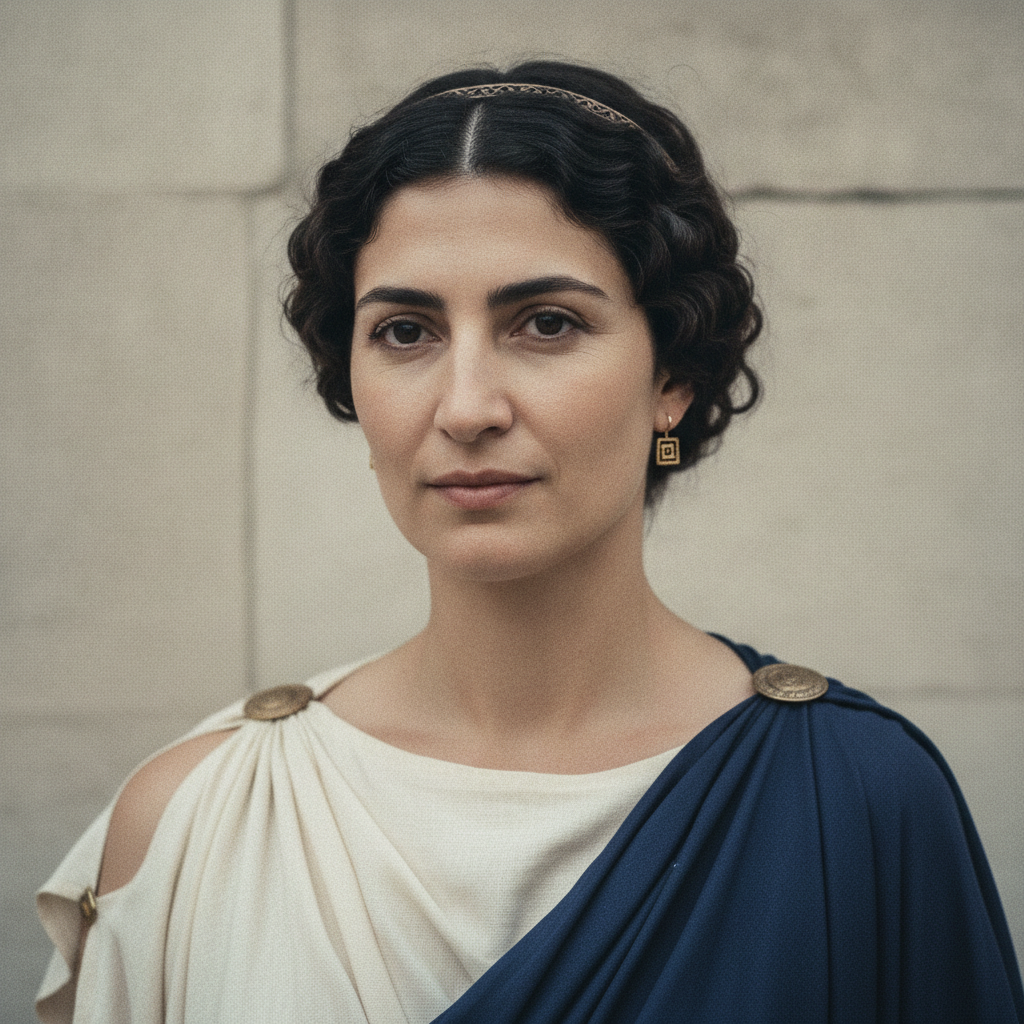
Face and hair: Aspasia probably had dark, wavy hair gathered into a formal style—often shown as soft waves pulled back into coils or rolls above the neck, with a restrained hairnet or ribbon. Portrait heads traditionally linked to her show a long, graceful face with a straight to slightly aquiline nose and a well‑defined jaw, giving an overall impression of refined features rather than overt youthfulness or caricature. Complexion and expression: Her complexion was likely Mediterranean—olive to warm tan—paired with clear skin and a calm, intelligent expression. Contemporary descriptions emphasize her presence and wit, so imagine a composed gaze, attentive eyes, and a mouth set with both firmness and charm rather than exaggerated sensuality. Clothing and adornment: In public she would have worn the fine draped garments of Classical Athens—a light linen or wool chiton layered with a himation—and tasteful jewelry: small gold earrings, a simple necklace, and perhaps decorative pins in her hair. Makeup would have been modest and conventional for elite women: polished skin, subtle rouge, and accentuated eyes rather than modern theatrical cosmetics.
Height / build
Likely average height (for Athenian women of the period) · Likely slender to average build
Hair
Likely dark (dark brown to black) · Likely wavy · Likely full hairline, worn in elaborate styles
Eyes
Likely dark
Complexion
Likely Mediterranean complexion
Face
Likely oval to slightly elongated · Likely straight to slightly aquiline / prominent
Notable features
Prominent, elegant nose; poised mouth and confident bearing; refined hairstyle and jewelry
Grooming
None · Likely carefully groomed: styled hair, cosmetics and jewelry typical of elite hetaerae.
Dress / presentation
Elite 5th‑century Attic dress (chiton and himation), fashionable jewelry and coiffure
hair
Hair color
Likely dark (dark brown to black)
Ionian/Attic Greek women are plausibly depicted with dark hair in surviving portrait types; literary references do not contradict this.
hair
Hair texture and style
Likely wavy, worn in elaborate coiffures
Classical Greek elite women and hetaerae are shown with wavy hair arranged in folded/looped styles and ribbons in surviving art and Roman copies.
eyes
Eye color
Likely dark
Mediterranean populations and classical iconography more commonly imply dark eyes; no ancient source describes light eyes for her.
face
Nose / profile
Likely straight to slightly aquiline (prominent profile)
Several Roman portrait heads traditionally identified as Aspasia show a strong, somewhat prominent nose and dignified profile.
skin
Complexion
Likely Mediterranean complexion
Born in Miletus and living in Athens, she would typically have an olive/medium Mediterranean skin tone consistent with Ionian Greeks.
height build
Athens prized modesty and domestic seclusion for citizen wives, but hetaerae circulated publicly and cultivated a cosmopolitan, learned image. Aspasia would combine classical feminine beauty—careful grooming, fine clothes, and jewelry—with signals of intellect and confidence (direct gaze, poised posture) that set her apart from the archetypal citizen wife.
Born in Miletus, Aspasia belonged to the eastern Greek (Ionian) cultural sphere. Physically she likely shared Mediterranean features common across mainland and Anatolian Greeks—dark hair and eyes and olive-toned skin—while her style of dress and coiffure adapted to Athenian urban fashions.
Modern images often over‑sexualize or anachronistically costume Aspasia; real classical representations emphasize cultured poise and elegant, classical dress rather than lurid exoticism.
Modern portrayals often sexualize Aspasia or dress her in exoticized, anachronistic costumes. In reality, ancient portrayals and descriptions emphasize her cultivated intellect and elegant, classical dress rather than lurid exoticism—she was admired for conversation and style, not only erotic appeal.
Likely average height for an Athenian woman of the period.
Likely dark.
Likely dark and wavy, worn in an elaborate, fashionable style.
Yes — ancient accounts present her as striking and fashionable, admired for both appearance and intellect.
High‑quality chiton and himation with tasteful jewelry and a carefully arranged hairstyle.
Roman portrait heads traditionally identified as Aspasia give a visual model, but they are later copies and reflect classical portrait conventions; they are the best visual basis we have.
Plutarch — Life of Pericles
Plutarch · c. late 1st–early 2nd century AD
Plutarch describes Aspasia as an intelligent, influential companion of Pericles and notes her public role and attractiveness—shaping later impressions of her bearing and style.
Plato — Menexenus (spoken in Aspasia’s name in some traditions)
Plato · c. 4th century BCE (text attribution and traditions vary)
Plato’s dialogues associate Aspasia with intellectual activity and rhetorical skill (tradition attributes a funeral oration composed by/for her), reinforcing a cultured, articulate public persona.
Athenian comic poets and satirists
Aristophanes and other comic poets (general reference) · 5th century BCE (contemporary satire)
Contemporary comedic attacks lampooned Aspasia’s foreignness and sexual role, indicating she was well known and visually memorable to Athens’ audiences.
Roman‑period portrait heads traditionally identified as Aspasia
Various Roman copies in European museum collections · Roman era copies of Classical originals (1st–3rd century AD)
Several Roman portrait heads—often labeled 'Aspasia'—show a poised woman with wavy hair, a stylized coiffure, and a prominent, elegant nose; these inform facial features and hairstyle in reconstructions.
Suda and later Byzantine references
Suda lexicon and later biographers · 10th century AD (Suda compendium) and later sources
Byzantine compilations preserve anecdotal traditions about Aspasia’s life and reputation that colored medieval and modern images of her appearance and role.
Classical Greek dress and portrait conventions
Archaeological and art‑historical survey · Modern scholarship summarizing Classical art
Height
Likely average height (for Athenian women of the period)
Skeletal and demographic data for Classical Greece indicate average female heights around modern 'average' — no source indicates she was notably short or tall.
height build
Build
Likely slender to average build
As an urban, high-status woman and entertainer, she likely maintained a graceful, lithe figure seen in portrait types of cultured women.
grooming
Grooming & cosmetics
Likely used cosmetics and jewelry; carefully groomed
Hetaerae cultivated a public, fashionable appearance; ancient sources and images show use of cosmetics and fine jewelry.
clothing
Typical clothing
Chiton and himation in elite, fashionable style
Classical Athenian women wore chiton/himation; a hetaera of Aspasia’s status would wear high-quality, fashionable variants and jewelry.
cultural
Public bearing
Confident, cultured presence
Ancient writers emphasize her conversational skill, rhetorical polish, and salon role — traits visible in facial expression and posture in portrait types.
Surviving vase imagery, statuary, and Roman copies document typical garments and hairstyles for elite women and hetaerae, providing context for likely clothing and grooming.