height build
Height
Likely average height (~160–165 cm / ~5'3"–5'5")
Bioarchaeological data for highland Andean adult males around the period show averages in this range; elite nutrition could raise but not dramatically alter stature.
Portrait reconstruction
1502–1533 · Tawantinsuyu (Inca Empire; modern Ecuador / Peru) · Early 16th century — Spanish conquest of the Inca Empire
Atahualpa likely looked like a strong, dark‑haired Andean ruler wearing a tight royal headband, gleaming gold and feather ornaments, and a finely woven tunic that marked his status.
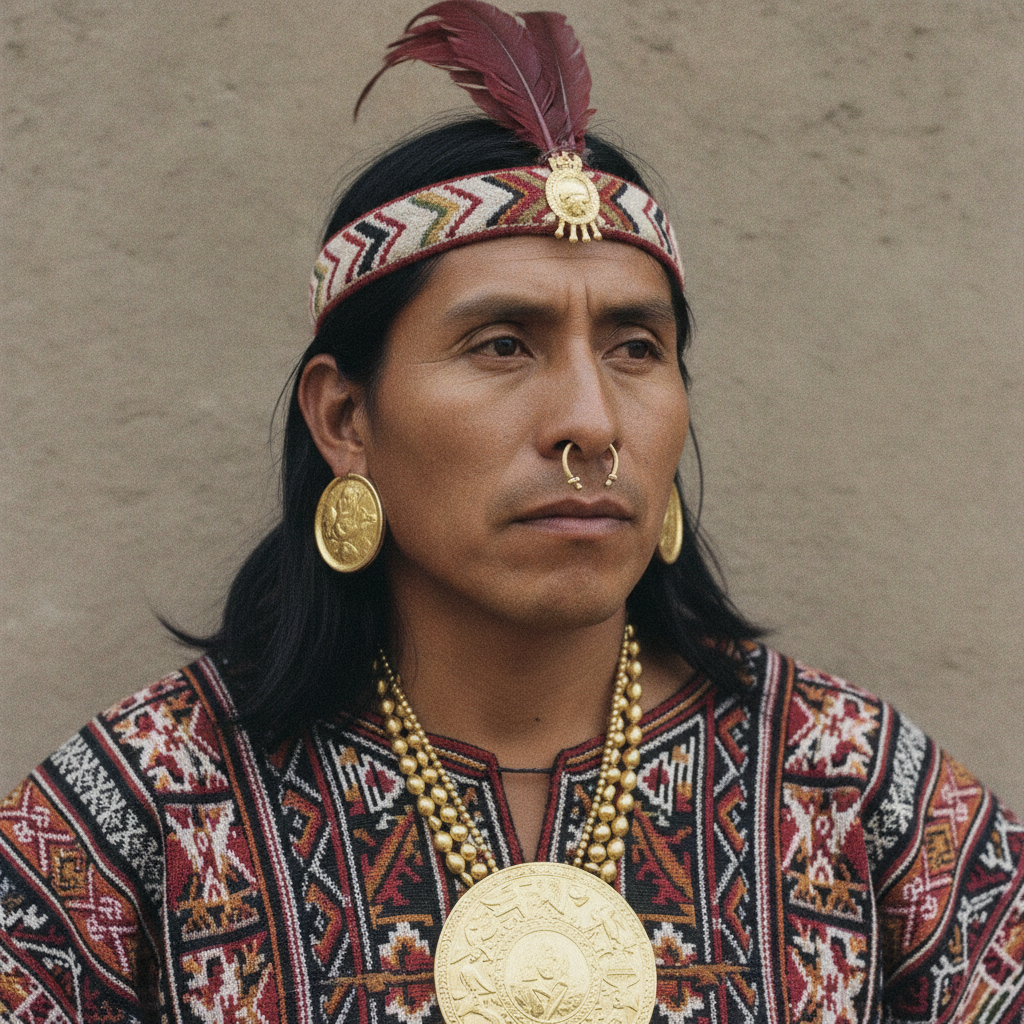
Face and hair: He most likely had straight, dark hair—common across the highlands—kept short or bound close to the head under a woven headband rather than loose flowing locks; he was probably clean‑shaven or bore only very light facial stubble, as noble Inca men often presented a neat face. His skin tone would have been medium brown with highland features—prominent cheekbones and a firm jaw—expressing health and command. Build and bearing: As a ruler raised in the highlands and accustomed to ceremonial life, Atahualpa would have appeared solidly built and compact rather than lanky—broad shoulders, muscular frame and an upright, confident posture that made him appear imposing. Contemporary witnesses remark on his commanding presence more than delicate features, so think of a compact, powerful figure who carried authority even when seated or bound. Clothing and visible regalia: The most arresting parts of his appearance were his clothing and ornaments: a richly patterned uncu (tunic) and a mantle, a tight woven llautu or mascapaicha headband signifying royalty, large gold earrings or ear spools, pectoral and chest ornaments of beaten gold, and featherwork accents. Colors, geometric patterns and worked metal would have caught the sun and drawn immediate attention to his status.
Height / build
Likely average height (~160–165 cm / ~5'3"–5'5") · Likely solid, muscular/stocky
Hair
Likely black · Likely straight · Likely full; hair worn long and bound
Eyes
Likely dark brown
Complexion
Likely medium to dark brown
Face
Likely broad face with high cheekbones · Likely broad to moderately straight/aquiline bridge
Notable features
Gold and silver jewelry (ear spools, nose/ear ornaments), llautu headband, richly patterned tunic (uncu), possible facial paint or ritual marks
Grooming
Probably clean‑shaven or minimal facial hair · Likely well‑groomed for a ruler: long hair tied or banded (llautu), body and face possibly oiled or painted for ceremonies, and wearing distinctive jewelry.
Dress / presentation
Royal Inca attire: finely woven uncu tunic, llautu headband, feather and metal ornaments, and conspicuous gold/silver jewelry
height build
Height
Likely average height (~160–165 cm / ~5'3"–5'5")
Bioarchaeological data for highland Andean adult males around the period show averages in this range; elite nutrition could raise but not dramatically alter stature.
height build
Build
Likely solid and muscular / stocky
Highland physical labor patterns and descriptions of Inca elites indicate a compact, powerful body rather than a lanky frame.
eyes
Eye color
Likely dark brown
Common trait among Quechua‑speaking Andean populations; no contemporary report of light eyes.
hair
Hair color
Likely black
Typical among Andean highland peoples and consistent with descriptions of Inca nobility; later portraits show dark hair.
hair
Hair style/texture
Likely straight and worn long, bound by a llautu
Inca noble men traditionally wore long hair tied with a llautu headband; Spanish observers remark on clothing and hair styles of nobles.
skin
Complexion
Inca rulers projected power through textiles, metalwork, and ritual presentation more than through physical height. The llautu headband, fine uncu tunics, and conspicuous gold and feather ornaments marked sacred kingship. Atahualpa’s visual authority came from these symbols—richly woven cloth, polished gold, and court protocol—so his regality was about signifiers as much as anatomy.
Atahualpa was likely born and raised in the northern highlands (Quito region), part of the Inca elite. Physically he would match northern Andean cranial and pigmentary patterns—dark hair and eyes, medium to dark brown skin—reflecting generations of high‑altitude adaptation and local ancestry.
Modern images often dress him in exaggerated feathered headdresses, Europeanized facial features, or beards; the real Atahualpa would have looked characteristically Andean, with local dress and minimal facial hair.
Movies and popular art often give Atahualpa European facial features, large feather crowns, or full beards—these are largely imaginative. Authentic Inca royal dress emphasized textiles and metalwork rather than towering feathered headdresses, and native Andean men typically had minimal facial hair.
Probably not unusually tall; he was likely around average height for highland Andean men (~160–165 cm / ~5'3"–5'5").
Likely dark brown.
Likely straight black hair, worn long and bound with a llautu headband as an Inca nobleman.
Probably not; he was likely clean‑shaven or had only sparse facial hair.
His royal textiles and glittering gold ornaments—ear spools, nose/ear ornaments, and a llautu headband—would have made him unmistakably the ruler.
By combining Spanish eyewitness descriptions, later Inca accounts, Andean archaeological evidence for clothing/jewelry, and bioarchaeological population data to form the most likely visual portrait.
Cieza de León — Crónica del Perú
Pedro Cieza de León · 1553 (mid-16th c.)
Spanish chronicle describing Inca rulers' appearance, dress, and courtly display; emphasizes jewels, textiles and impressive bearing.
Juan de Betanzos — Narrative of the Incas
Juan de Betanzos · c. 1551
Provides ethnographic detail on Inca court life and royal dress; used here for hair styles, headbands, and regalia descriptions.
Francisco de Xerez / Pizarro letters and eyewitness accounts
Conquistador accounts (Xerez, Pizarro, Pedro Pizarro) · 1530s
Contemporary Spanish reports focusing on Atahualpa’s capture, his wealth, and the impression made by his dress and presence; useful for noting jewelry and ceremonial appearance.
Post‑conquest portraits and prints of Inca rulers
Various 16th–17th century artists · 16th–17th century
Later images show Inca dress and jewelry filtered through European conventions; useful for clothing cues but not facial-faithful portraits.
Archaeological textile and metalwork studies
Andean archaeologists and museum collections · 20th–21st century scholarship
Material evidence of Inca royal clothing, llautu headbands, gold ornaments and featherwork that attest to the visual markers of rulership.
Bioarchaeological studies of pre‑Columbian Andean stature and craniofacial traits
Anthropological studies of Andean skeletal collections · 20th–21st century research
Provides population averages for height, build, and cranial form used to estimate likely physical traits.
Inca Garcilaso de la Vega — Royal commentaries of the Incas
Likely medium to dark brown
Fits highland Andean population pigmentation and contemporary chroniclers' general descriptions of indigenous peoples.
grooming
Facial hair
Probably clean‑shaven or minimal facial hair
Many Native Andean men had sparse facial hair; Spanish notes rarely emphasize beards among Inca rulers.
clothing
Regalia
Elaborate Inca royal dress: uncu tunic, llautu headband, gold and feather ornaments
Primary and archaeological sources describe Inca rulers wearing finely woven textiles, headbands, and conspicuous metalwork and feather decorations.
face
Facial features
Likely broad face with high cheekbones and a broad nose
Typical craniofacial traits in Andean highland populations and echoed in chronicler descriptions and later Inca portraits.
other
Notable ornamentation
Wore prominent gold jewelry and ear spools indicating rank
Spanish accounts emphasize Atahualpa’s gold and jewelry; archaeological finds show ear spools and nose/ear ornaments for elites.
cultural
Overall bearing
Commanding and regal rather than overtly 'handsome' by European standards
Chroniclers report his impressive presence and the symbolic power of his dress and jewelry that signalled sovereignty.
Inca Garcilaso de la Vega · 1609
Later Inca-descended chronicler providing cultural context, descriptions of court life, and comments on noble appearance and regalia.