height build
Height
Likely average to slightly tall for his time
Contemporary and near-contemporary writers emphasize his commanding presence and physical sturdiness rather than extreme height; steppe leaders tended to be solidly built riders.
Portrait reconstruction
0–0 · Eurasian Steppe / Pannonian Basin (central-eastern Europe) · 5th century (late Roman / Migration Age)
Attila likely appeared as a dark-haired, stocky steppe ruler—tough, well-dressed in Hunnic finery, and immediately commanding in person.
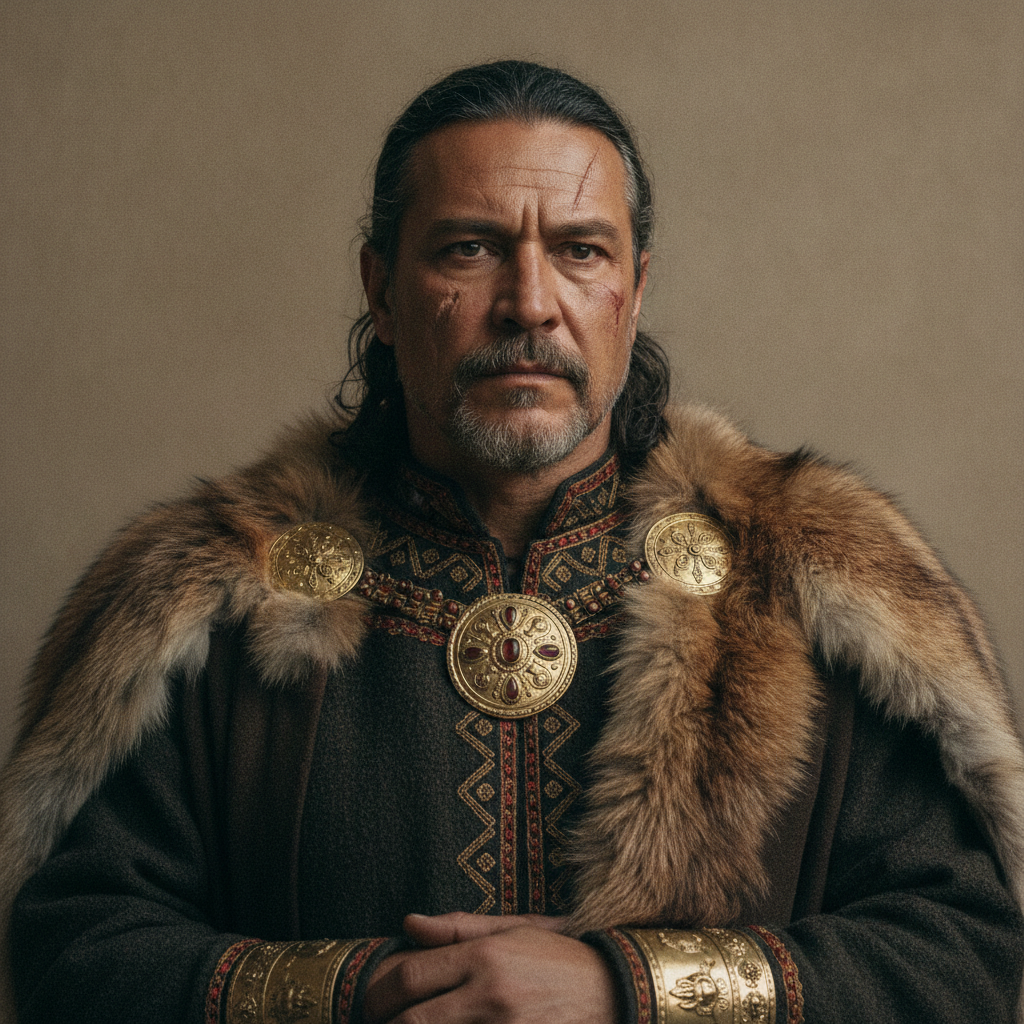
Face and hair: He was probably dark-haired with dark eyes, a weathered olive-to-tanned complexion from constant outdoor life, and firm, angular features—high cheekbones and a strong jaw that read as practical rather than ornate. His hair was likely kept short or cropped for riding and warfare; facial hair was modest—either closely trimmed or clean-shaven—presenting a controlled, martial look rather than a wild mane. Build and bearing: Expect a compact, muscular frame made by years on horseback—broad shoulders, a sturdy chest and a low center of gravity rather than the towering giant of legend. Movements would be economical and authoritative: upright in posture, quick in gesture, with the narrowed, intent gaze of an experienced commander. Clothing and jewelry: For ceremonial occasions he wore bright, richly worked steppe clothing—an embroidered tunic or caftan, tailored trousers and high riding boots—finished with a broad, decorated belt loaded with gold mounts and fittings. Fur or embroidered cloaks, gold or garnet jewelry, and finely worked horse trappings signaled wealth; he might wear a felt or leather cap or a simple jeweled headband rather than a heavy crown. Weapons and riding gear—ornate bow, quiver, and a decorated saddle—would be visible parts of his ensemble. Expression and impression: Up close he would project controlled intensity: alert, diplomatic in court settings yet ready for violence. The overall image is of a practical, well-groomed steppe aristocrat who used high-quality dress and precious metalwork to display power rather than theatrical excess.
Height / build
Likely average to slightly tall for his time · Likely robust / stocky
Hair
Likely dark to graying · Likely straight to coarse · Likely receding or high forehead
Eyes
Likely dark
Complexion
Likely olive to tanned
Face
Likely broad, strong-jawed · Likely prominent or strong nose
Notable features
Commanding, hawk-like face; battle scars; richly decorated clothing and jewelry when in public
Grooming
Probably a trimmed moustache and short beard or stubble · Practical, neat grooming for a warrior-leader: short hair or tied back, trimmed facial hair, and visible battle scars expected.
Dress / presentation
Steppe elite dress: embroidered tunic, furs, boots, gold/metal adornments; sometimes Roman-style cloak or trappings for diplomatic occasions
height build
Height
Likely average to slightly tall for his time
Contemporary and near-contemporary writers emphasize his commanding presence and physical sturdiness rather than extreme height; steppe leaders tended to be solidly built riders.
height build
Build
Likely robust and muscular
Life as a mounted warrior-leader implies a strong, compact body; chroniclers note forceful bearing and stamina.
face
Face shape
Likely broad with a strong jaw
Descriptions and later portrayals emphasize a powerful, hawk-like face suited to a commanding temperament.
eyes
Eye color
Likely dark
Dark eyes were common in steppe and regional populations; classical writers describe fierce, penetrating eyes without mentioning light-colored irises.
hair
Hair color
Likely dark to graying
Contemporary accounts and depictions of Hunnic elites suggest dark hair; leaders in middle age often shown with some greying.
hair
Hair style / texture
Power, martial readiness and visible wealth mattered more than classical Roman notions of beauty. A leader’s look emphasized capability—horse-riding fitness, practical grooming, furs, decorated weapons and metalwork—plus the ability to adopt Roman luxury when it served diplomacy.
Attila belonged to a multi-ethnic steppe confederation; his appearance likely combined steppe (Central/East Eurasian) and local European traits—dark hair and eyes, olive-to-tanned skin, and a compact, sturdy physique formed by life on horseback.
Modern films and fantasy art often turn Attila into a monstrous 'barbarian' with exoticized Asian features or horned helmets; the historical picture is of a polished, fearsome steppe ruler who used Roman luxury as well as steppe dress.
Films and high fantasy often portray Attila as a hulking, exoticized monster with anachronistic helmets, wild hair, or entirely Mongoloid features. Historically, he was more a polished, strategic ruler who used both steppe display and Roman ceremonial trappings to project power.
Likely average to slightly tall for his time — sources stress his commanding presence more than exceptional height.
Likely dark.
Likely dark to graying in middle age.
Probably he wore a moustache with a trimmed beard or stubble.
His commanding bearing, richly decorated steppe garments and jewelry, and a fierce, intense face—more charisma and authority than classical handsomeness.
By combining the 5th-century eyewitness account of Priscus, later descriptions (Jordanes), and archaeological evidence of Hunnic dress and elite burials to form the most likely image.
Priscus — Embassy to Attila (eyewitness fragments)
Priscus of Panium / fragments preserved in later works · mid-5th century (c. 448–449 CE)
The mid-5th-century Roman diplomat Priscus described an embassy to Attila’s court and gives the best contemporary picture of Attila’s manners, dress and the opulence of his surroundings; used as primary evidence for his appearance and display.
Jordanes — Getica (later summary of Gothic and Hunnic history)
Jordanes · 6th century (c. 551 CE)
Jordanes provides descriptions of Attila’s personality and appearance in a later Gothic-oriented history; useful for interpretive details though written a century later.
Byzantine chroniclers and diplomats' reports
Various Byzantine sources (5th–6th c.) · 5th–6th centuries
Several Byzantine authors record impressions of Attila and Hunnic dress, often noting ceremonial garments, gifts and the ruler’s commanding presence.
Archaeological evidence: Hunnic elite burials and grave goods
Archaeological studies (Central/Eastern Europe) · excavations 19th–21st centuries
Grave finds show typical Hunnic elite attire—embroidered tunics, metalwork, gold fittings, and horse-gear—informing clothing, jewelry and display practices for leaders like Attila.
Medieval and early modern portraits and legends of Attila
Various (12th–16th century illustrations and chronicles) · 12th–16th centuries
Later images shaped European memory of Attila (often demonized or stylized); these inform medieval reception rather than historical appearance.
Comparative population studies of the Eurasian steppe
Modern anthropological and genetic syntheses (scholarly literature) · 20th–21st centuries
Scholarly work on steppe populations helps place likely phenotypes (dark hair/eyes, mixed ancestry) in context for leaders of Attila’s confederation.
Likely short or tied back; straight to coarse
Steppe practicality favored short, manageable hair or tied styles for horsemen; archaeological finds show similar grooming among elites.
grooming
Facial hair
Probably a moustache and trimmed beard or stubble
Steppe men and many contemporary peoples commonly wore moustaches; chroniclers portray Hunnic leaders with facial hair rather than clean-shaven faces.
skin
Complexion
Likely olive to tanned
A life outdoors on the steppe and mixed Eurasian regional ancestry point to an olive-to-tanned skin tone.
clothing
Typical attire
Steppe-elite garments with rich decoration and occasional Roman luxury
Contemporary embassy accounts describe Attila’s hall and gifts combining steppe costume, furs, and gold with Roman-style silk and luxury adopted for diplomacy.
other
Jewelry and insignia
Likely gold and metal adornments indicating rank
Hunnic elite burials show high-status use of metalwork, and historical accounts note visible displays of wealth and gifts.
face
Notable features
Commanding presence, possibly battle scars
Warlord status and chroniclers’ stress on intimidating presence make scars and a fierce bearing plausible distinctive marks.