hair
Signature hairstyle
Forward-combed fringe with 'comma' locks
Numerous busts and statues show short hair combed forward with distinct strands over the forehead; coins echo this motif.
Portrait reconstruction
63 BCE–14 · Rome / Italian peninsula · Late Roman Republic / Early Roman Empire (Principate)
Augustus likely looked like a youthful, clean-shaven Roman with dark, forward-combed hair, an idealized calm face, and an upright, military-bearing posture.
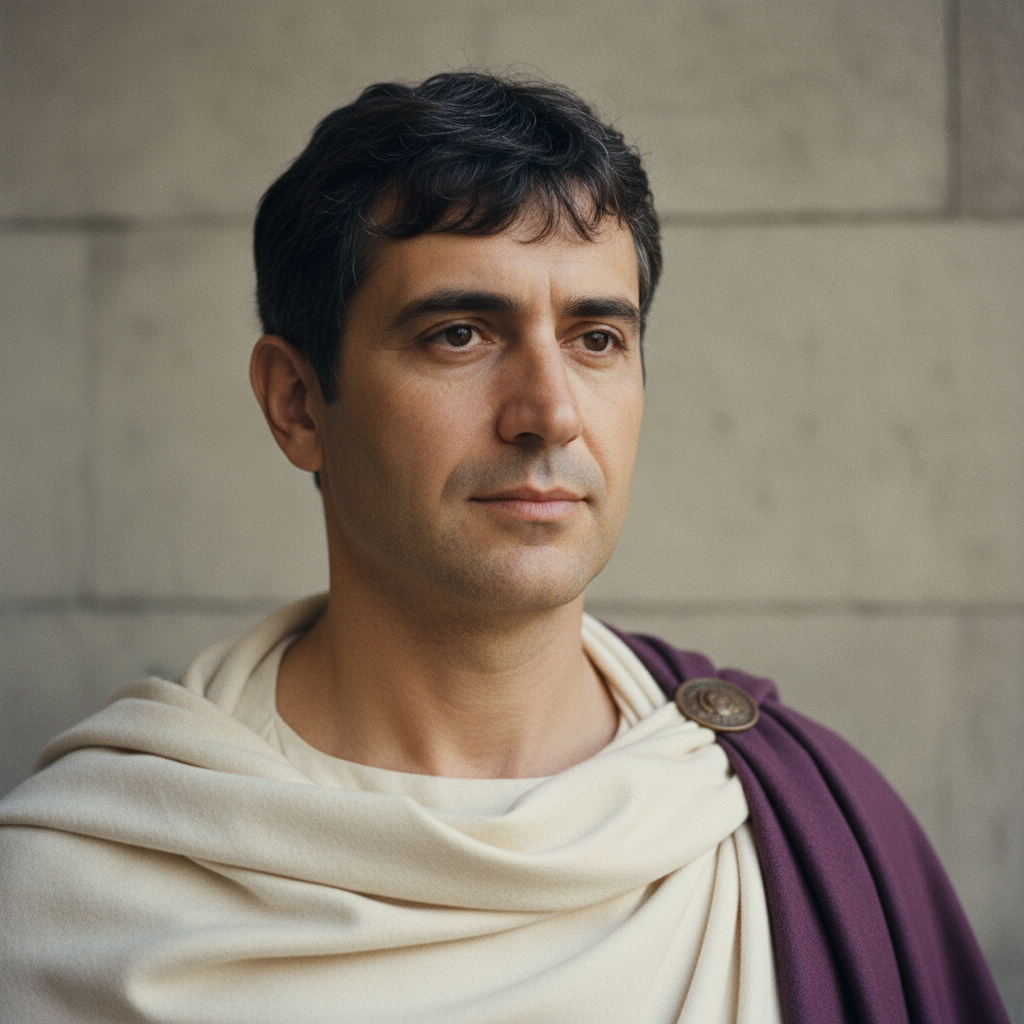
Face: He is best imagined with an even, oval face shaped by classical idealizing—smooth skin, a composed expression, and balanced features: a straight nose, clear jawline, and a small to medium mouth set in a controlled, slightly reserved expression. The eyes appear large and attentive in portraits, giving a steady, authoritative gaze rather than a fierce glare. Hair and grooming: The signature detail is the forward-combed hair — short, dark hair arranged in small locks or a fringe over the forehead — paired with a clean-shaven jaw. Grooming was neat and restrained: hair kept short and carefully styled, no beard, and a civilian-military neatness that signaled elite status. Body and bearing: Portraits show him with a fit, athletic silhouette rather than massive bulk: an upright posture, square shoulders, and a lithe, disciplined frame. He is often shown wearing a decorated military cuirass as commander or a plain, well-draped toga as statesman, projecting controlled strength and civic dignity rather than rough physicality.
Height / build
Likely average height · Likely slender to moderately lean
Hair
Likely dark to graying in later life · Likely wavy · Full hair with signature forward-combed fringe ('comma' locks) rather than receding/bald
Eyes
Likely dark
Complexion
Likely Mediterranean complexion
Face
Likely oval to slightly long · Straight to gently aquiline
Notable features
Prominent chin, calm reserved expression, distinctive forward-combed forelock, straight aquiline nose
Grooming
Probably clean-shaven · Consistently well-groomed and styled to convey youth, authority and Roman elite status.
Dress / presentation
Elite Roman civic and triumphal dress — togas for civic occasions; cuirass and paludamentum in victory imagery
hair
Signature hairstyle
Forward-combed fringe with 'comma' locks
Numerous busts and statues show short hair combed forward with distinct strands over the forehead; coins echo this motif.
other
Facial hair
Probably clean-shaven
Contemporary Roman elite custom was to be clean-shaven; all major portraits and coins of Augustus show no beard.
face
Nose
Straight to gently aquiline
Busts and statues consistently show a straight, slightly aquiline nose as a defining facial element.
eyes
Eyes
Likely dark, large and calm
Sculptural eyes are rendered large and forward-looking; Mediterranean ancestry and typical Roman portrait conventions point to dark eyes.
skin
Complexion
Likely Mediterranean (olive-toned)
Born and raised in central Italy, portraits and the broader population context indicate an olive Mediterranean complexion.
height build
Height
Likely average height
Roman elite ideals prized restraint, disciplined grooming, and a youthful public face that signaled vigor and moral authority. Augustus's portraits emphasize these values: clean-shaven, composed expressions and a hairstyle that became a recognizable badge of his rule.
Augustus came from an Italian aristocratic family (gens Octavia). Picture a central Mediterranean man: olive-toned skin, dark eyes and dark wavy hair — features common among Rome's ruling class and visible in contemporary portraits.
Modern films often show Augustus as either a frail old man or a generic toga-wearing type; actual portraits emphasize a composed, idealized youthful ruler with a distinctive hairstyle and refined features.
Movies frequently depict Augustus as either frailly old or as a cartoonish tyrant; surviving images instead show a carefully managed, broadly attractive public persona — neither an aristocratic caricature nor a grotesque elder, but a composed, ageless ruler.
Likely average height for a Roman man of his era.
Likely dark — Roman portraits and regional ancestry point to brown/dark eyes.
Likely dark, turning to dark-gray in later life; portraits show dark wavy hair.
Probably clean-shaven; all major portraits and coins show him without facial hair.
No — portraits show a full head of hair styled forward with a distinctive fringe.
His composed, youthful-looking face and distinctive forward-combed hairstyle, together with fine official dress marking his rank.
Augustus of Prima Porta (full-length statue)
Musei Vaticani / Prima Porta statue · early 1st century AD (copy of an Augustan original)
A life-size statue showing Augustus as youthful, clean-shaven, with a forward-combed fringe and wearing a decorated cuirass — a key model for his imperial image.
Capitoline bust of Augustus
Capitoline Museums · late 1st century BC - early 1st century AD
Marble bust emphasizing a composed, idealized face, distinctive haircut and clean-shaven jaw — one of the canonical portrait types for Augustus.
Tusculum portrait (head of Augustus)
Museo Archeologico di Napoli / Tusculum type · late 1st century BC
A portrait head that shows the familiar facial proportions and hairstyle echoed across other official images of Augustus.
Augustan denarii and coin portraits
Roman coinage (Augustus) · 27 BC – 14 AD
Small, widely circulated portraits that repeat Augustus's facial type and hairstyle, crucial for visual consistency across the empire.
Suetonius, Lives of the Twelve Caesars (on Augustus)
Suetonius · c. AD 121
A near-contemporary literary source that reports details of Augustus's public life and gives indirect testimony about his public image and grooming habits.
Res Gestae Divi Augusti (Augustus's own funerary inscription)
Res Gestae · published ca. 14 AD
Augustus's official record of achievements showing how he wished to present himself; useful for understanding why portraits were idealized.
Cassius Dio, Roman History (on Augustus)
No source claims unusual height; statues maintain proportions consistent with average male stature of the period.
height build
Build
Likely slender to moderately lean
Sculptural types and imperial iconography favor a toned but not heavily muscled body for leaders who embodied civic virtue.
clothing
Typical dress
Toga for civic life; cuirass in imperial/propaganda imagery
State portraits and coinage show him in togas for official contexts and in military cuirass on triumphal monuments.
face
Expression
Calm, composed, slightly idealized youthfulness
Portraits intentionally smooth signs of age and present a serene, controlled expression as a political statement.
other
Distinctive portrait device
Youthful, classical features used as propaganda
Augustus's portraits combine realistic traits with idealizing elements to present continuity with classical (Hellenistic) ideals.
Cassius Dio · 3rd century AD (history)
Later historical account containing anecdotes and descriptions that help contextualize Augustus's public appearance and behavior.
Modern art-historical syntheses and reconstructions
Scholarly reconstructions and museum catalogues · 20th–21st century
Modern scholars synthesize busts, coins and texts to produce reconstructions showing the probable real appearance combined with idealizing trends.