hair
Hair color
Likely dark to graying
Persian populations and late portraits depict dark hair; accounts of his life and images of older scholars show graying in later years.
Portrait reconstruction
980–1037 · Persia (born near Bukhara; active in Khurasan, Isfahan, Hamadan) · Islamic Golden Age / Medieval
Avicenna most likely looked like a dark‑haired Persian scholar—turbaned, bearded, and clad in layered scholarly robes.
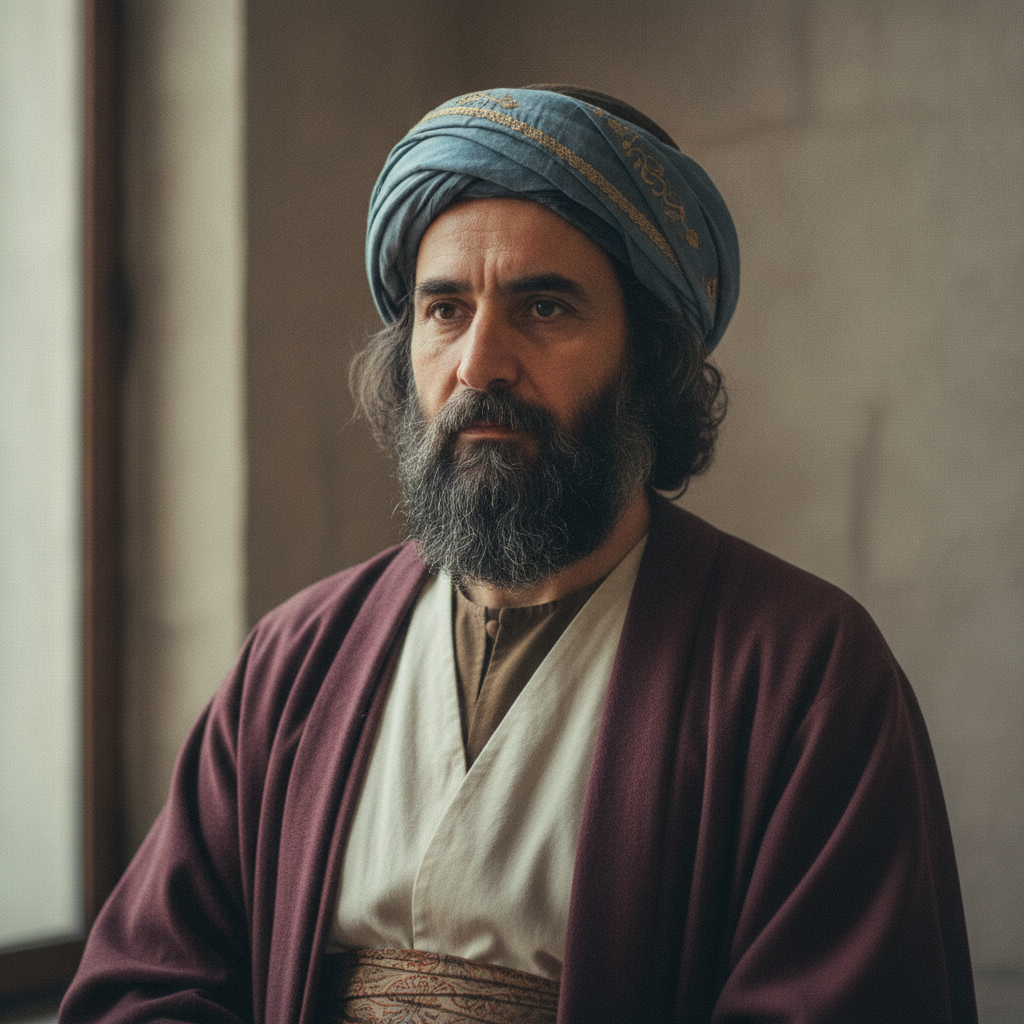
Facially, Avicenna is best imagined with dark hair and dark eyes, a warm olive to light‑brown complexion typical of the Khurasan‑Persian region, and an intelligent, composed expression. Surviving miniature portraits consistently show him with a full but neatly kept beard—so a bearded face is the clearest single visual trait to picture. He probably wore a wrapped turban and long robes typical of a learned man and court physician: layered, flowing garments in fine fabrics, often with a mantle over the shoulders. Miniatures and later memorials depict him holding books or scrolls, so think of him framed by manuscripts and writing implements rather than armor or heavy jewelry. In posture and bearing he would appear calm and authoritative—an instructor or clinician at work. Many images show him in the act of teaching, pointing to a text or consulting a volume, suggesting a habitual pose: thoughtful, steady, and engaged with books and pupils.
Height / build
Likely average height · Likely slender to average build
Hair
Likely dark to graying · Likely straight to wavy · Likely moderate/receding in later life
Eyes
Likely dark (brown)
Complexion
Likely olive to light brown (Mediterranean/West Asian)
Face
Likely oval to slightly long · Likely straight to slightly aquiline
Notable features
Dark eyes, full scholar's beard, turban and layered scholarly robes; a composed, commanding scholarly presence.
Grooming
Probably a full beard · Beard neatly kept; hair usually wrapped under a turban—presentation would be tidy and scholarly.
Dress / presentation
Persian scholarly robes and a turban; as a court physician he likely wore fine fabrics and cloaks appropriate to elite status.
hair
Hair color
Likely dark to graying
Persian populations and late portraits depict dark hair; accounts of his life and images of older scholars show graying in later years.
eyes
Eye color
Likely dark (brown)
Brown/dark eyes predominate in the region; literary and pictorial traditions of Persian scholars present dark eyes.
other
Beard
Probably a full beard
Islamic scholarly culture prized beards; later portraits and statues show Avicenna with a full beard typical of learned men and physicians.
clothing
Typical dress
Persian scholarly robes and turban, with court-quality fabrics
As a court physician and elite scholar he would wear layered robes and a turban; miniatures and textual references to elite dress support this.
skin
Complexion
Likely olive to light brown
Regional population traits of Khurasan/Persia point to an olive-to-light-brown complexion; later portraits are consistent with West Asian coloring.
height build
Height
In medieval Persian elite culture, visible signs of learning and status mattered: a well-kept beard, tidy hair hidden under a turban, and layered robes of quality fabrics signaled authority. Avicenna would present himself in a manner that emphasized dignity, learning, and access to courts—more like a respected physician than a showy noble.
Avicenna came from the Persian cultural milieu of Khurasan—an ethnically Iranian region where people typically had olive to light-brown skin, dark hair and eyes, and a range of straight-to-wavy hair textures. This regional profile helps form a plausible picture of his complexion and features.
Modern Western images often orientalize or Europeanize him; Persian miniatures stylize facial features and later statues idealize him—real appearance was likely plainer and more typical of a learned Persian man.
Many modern portrayals either Europeanize Avicenna or exaggerate exotic 'Orientalist' features. They also sometimes show him as dramatically aged or stylized; a more honest image is of an ordinary-looking, dignified Persian scholar rather than a caricatured mystic.
Probably not notably tall—likely about average height for a medieval Persian man.
Likely dark brown.
Likely dark, becoming grayer with age.
Yes—probably a full, neatly kept beard typical of scholars and physicians of his time.
Layered Persian scholarly robes and a turban; as a court physician he likely wore fine fabrics appropriate to his status.
There are no photographs or contemporary likenesses; the likely image is synthesized from later Persian manuscript portraits, medieval biographical context, and regional population traits.
Persian miniature portraits of Avicenna
Various Persian manuscripts (14th–17th centuries) · 14th–17th c.
Multiple manuscript miniatures depict Avicenna as a turbaned, bearded man holding or teaching from books; features are stylized but consistently show dark hair, beard, and scholarly dress.
Ibn Abī Uṣaybiʿa — biographical entries referencing Avicenna
Ibn Abī Uṣaybiʿa, Uyūn al-Anbāʾ fī Ṭabaqāt al-Aṭibbāʾ · 13th century
A medieval biographer of physicians summarizes Avicenna's life, career, and reputation; such texts give context for his social rank and dress though they rarely offer detailed physical descriptions.
Al-Qifti — entries in Tarīkh al-ḥukamāʾ
Al-Qifti, Tarīkh al-Ḥukamāʾ · 13th century
Another medieval historian who records Avicenna's career and honors; useful for status and likely attire as a court physician.
Avicenna Mausoleum and modern statues
Avicenna Mausoleum, Hamadan (20th century memorial) · 20th century
Modern memorial architecture and statues portray Avicenna as a bearded, turbaned Persian scholar; these are 20th‑century imaginings influenced by national memory and artistic conventions.
European and modern portraits of Avicenna
19th–20th century Western/educational portraits · 19th–20th c.
Later Western images vary widely and often project Orientalist or European dress; useful to show how modern imagination reshapes his likeness but low reliability for actual appearance.
Likely average height
No accounts claim unusual stature; average male height in medieval West Asia suggests typical stature.
other
Build
Likely slender to average
A scholarly, itinerant physician's life favored lean or average build rather than heavy musculature; miniatures show a relatively slender figure.
hair
Hair texture
Likely straight to wavy
Regional phenotypes and miniature depictions usually show straight to slightly wavy hair under a turban.
grooming
Grooming style
Neat and purposeful — beard trimmed, hair covered by turban
Courtly and scholarly etiquette emphasized tidy grooming; images and descriptions of physicians show tidy beards and turbans.
face
Face shape & nose
Likely oval/long face with a straight to slightly aquiline nose
Miniature portraits and West Asian facial norms support an oval face and a prominent but straight nose shape typical in Persian portraiture.