eyes
Eye color
Likely dark (brown)
Dark brown eyes are overwhelmingly common in ancient Levantine populations and fit textual implications of striking, expressive features.
Portrait reconstruction
0–0 · Jerusalem / Kingdom of Judah (Levant) · Iron Age Israel (prob. 10th century BCE, period of King David)
Bathsheba would most likely have been a dark-haired, olive-skinned Levantine woman of average Iron Age stature, well-groomed and adorned with oils, kohl, and modest court jewelry.
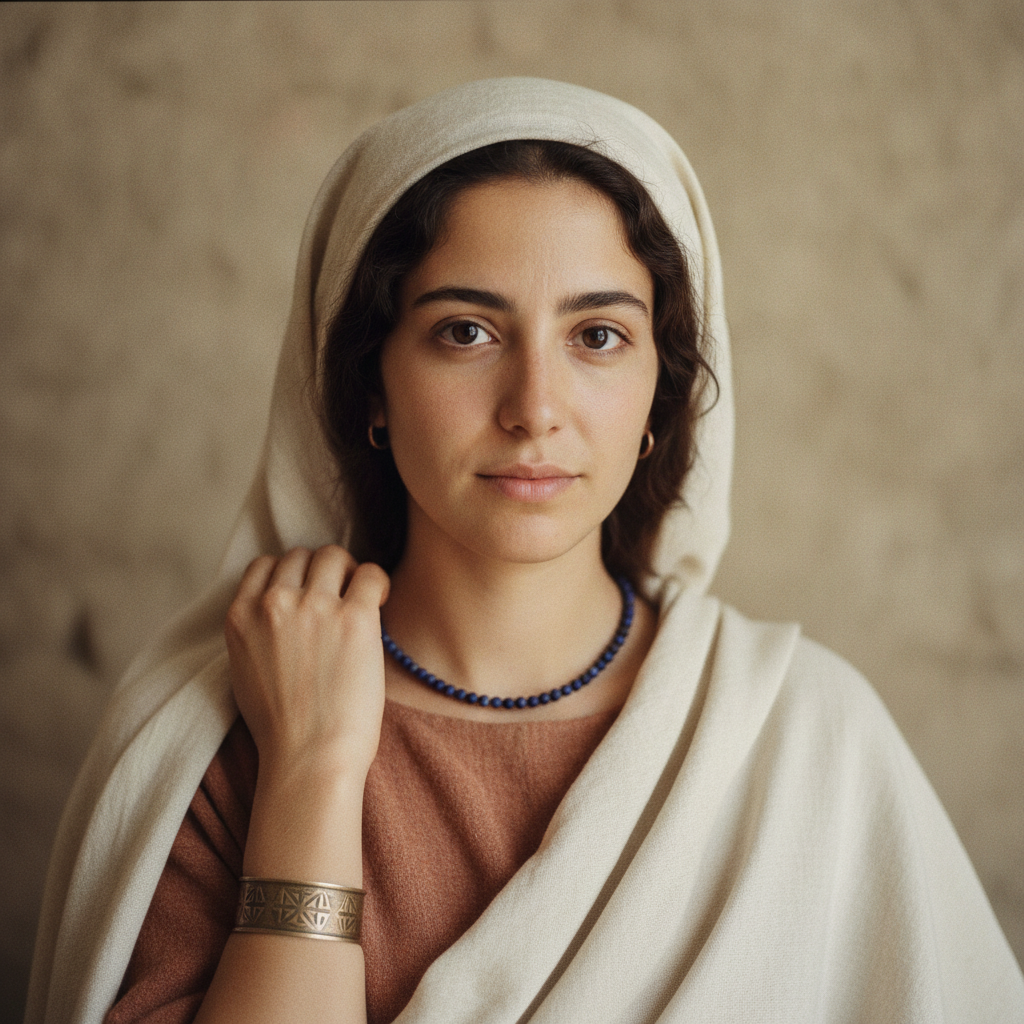
Face and skin: Picture an olive to warm-brown complexion common in the southern Levant, a smooth skin subtly highlighted by fragrant oils. Facial proportions would be Mediterranean: a straight or gently curved nose, full brows framing dark eyes, and a softly rounded jawline—features that read as classically attractive in her cultural context. Hair and eyes: Hair was likely dark brown to black, long and often styled—braided, coiled, or swept up and secured with pins and hair ornaments. Eyes would have been dark brown and accentuated with kohl liner, which created a striking, luminous gaze under sunlight. Body, height, and bearing: Her build was probably what we now call average for Iron Age Levantine women—neither especially tall nor short (roughly around 1.5–1.6 m or about 4'11"–5'3"). Her posture and manner would reflect household training and court etiquette: composed, deliberate movements and an appearance kept tidy through oils, simple grooming, and well-fitted garments. Clothing and adornment: She would have worn a linen or wool tunic layered with a mantle for warmth and modesty; court garments could be trimmed or dyed for a touch of color. Jewelry—simple gold or bronze earrings, bead necklaces, and finger rings—and small cosmetic containers for kohl and scented oils completed a polished, refined look.
Height / build
Likely average height · Likely average to slightly rounded
Hair
Likely dark (dark brown to black) · Likely wavy to curly · Likely full, with hair worn long and often arranged (braids, tied, or covered)
Eyes
Likely dark (brown)
Complexion
Likely olive to light brown
Face
Likely oval to rounded · Likely straight to slightly aquiline (Mediterranean type)
Notable features
Described as 'very beautiful' in Scripture—likely clear skin, expressive dark eyes, and well-kept hair; presence of domestic jewelry or modest adornment possible.
Grooming
None (female) · Likely used oil, perfumes, and eye cosmetics (kohl); hair and nails kept tidy and styled according to household norms.
Dress / presentation
Likely common-elite Israelite dress of linen/wool tunic and mantle, head covering or veil indoors/when appropriate, and modest household jewelry.
eyes
Eye color
Likely dark (brown)
Dark brown eyes are overwhelmingly common in ancient Levantine populations and fit textual implications of striking, expressive features.
hair
Hair color
Likely dark (dark brown to black)
Levantine populations overwhelmingly had dark hair; cultural depictions and archaeological figurines show dark-haired women.
hair
Hair texture & style
Likely wavy to curly, long and styled (braids or tied back)
Regional hair types are usually wavy/curly; women commonly wore long hair in braids or bound and sometimes covered in domestic settings.
skin
Complexion
Likely olive to light brown
Typical Levantine complexion and consistent with archaeological and anthropological data for Jerusalem populations.
height build
Height
Likely average height
Skeletal data from the region suggest women’s average statures around mid- to low-150 cm; Bathsheba likely fit the regional norm.
height build
Build
In Iron Age Israel, beauty combined clear skin, well-kept hair, and modest, dignified dress. Women’s attractiveness was often described in terms that emphasize expressive eyes and proper grooming; cosmetics like oils and kohl were normal. Public modesty balanced with private domestic presentation made a woman both respected and admired.
Bathsheba belonged to the Levantine (Semitic) population centered in Jerusalem: think Mediterranean proportions — olive skin, dark hair and eyes, and a face shaped by regional ancestry rather than northern European features. This regional context gives a concrete visual frame beyond abstract 'biblical' labels.
Modern art and film often render Bathsheba as European (blond/fair-skinned) or as overtly sexualized — less consistent with an ancient Jerusalemite woman's likely dark Mediterranean features and modest dress.
Western paintings and films often remake Bathsheba as pale-skinned or blonde and overtly sexualized. These portrayals reflect later artistic tastes, not the likely Mediterranean features or the modest household dress she would have worn in ancient Jerusalem.
Likely average height for an Iron Age Levantine woman.
Likely dark brown.
Likely dark (dark brown to black), wavy to curly, worn long and often braided, tied back, or covered.
Yes — the biblical text describes her as 'very beautiful.'
Household garments typical for a married Israelite woman: a linen/wool tunic and mantle, possibly a head covering or shawl, and modest jewelry.
No identified portrait or human remains are attributable to Bathsheba; reconstructions rely on text plus regional archaeological context.
2 Samuel 11 (Biblical narrative)
Hebrew Bible / Old Testament · traditionally dated to the Iron Age / compiled later (text source)
Describes Bathsheba as 'very beautiful' and narrates the roof-bathing episode that defines her visual image; provides the primary textual basis for attractiveness and setting.
2 Samuel 12 & 1 Kings / 1 Chronicles references
Hebrew Bible / Old Testament · textual tradition
Later biblical references identify Bathsheba as mother of Solomon and a member of David’s household — suggesting household status and ongoing court presence.
Archaeological evidence for Iron Age Levantine dress and cosmetics
Archaeological surveys and publications (e.g., textile and cosmetic finds from Jerusalem and regional sites) · Iron Age (c. 1200–586 BCE) / modern excavations
Finds of kohl tubes, oil jars, jewelry, and figurines indicate common use of cosmetics, oils, jewelry, and typical tunic/mantle garments for women in Bathsheba’s milieu.
Bioarchaeological stature data from the ancient Near East
Bioarchaeological studies of human remains from the Levant · modern scholarly studies
Skeletal analyses indicate average female heights in the region consistent with an 'average height' estimate for Bathsheba.
Renaissance and later paintings of Bathsheba
Various European artists (e.g., Rembrandt, Raphael-inspired scenes) · Renaissance–19th century
These works popularized a Europeanized, often pale and sometimes sexualized Bathsheba; important for understanding modern misconceptions but not for historical appearance.
Likely average to slightly rounded
A married urban woman's diet and life in Jerusalem would most likely produce an average, not athletic or emaciated, body type.
grooming
Grooming and cosmetics
Likely used oils, perfumes, and eye cosmetics (kohl)
Cosmetics and perfumes were widely used by women in the ancient Near East; biblical bathing episode implies concern for appearance and accessibility of grooming.
clothing
Clothing
Likely linen/wool tunic with mantle and modest jewelry
Iron Age Israelite dress for married women included tunics, mantles, head coverings, and simple jewelry; Bathsheba’s household setting implies access to such garments.
other
Facial hair
None
As a woman, she would have no male facial hair; grooming would emphasize smooth skin.
face
Overall facial impression
Likely clear-skinned, expressive eyes and balanced features
The biblical text explicitly calls her 'very beautiful,' which suggests notable facial attractiveness within cultural standards.
cultural
Status cues in appearance
Likely modest indicators of household status (simple jewelry, quality fabrics)
Bathsheba’s ability to bathe on a roof and be noticed by the king implies an urban household with some standing and access to quality clothing and grooming items.