height build
Height
Likely tall for his time
Contemporary narratives describe him as an imposing, large man—language implying greater-than-average height versus early-18th-century norms.
Portrait reconstruction
1680–1718 · English Caribbean and American eastern seaboard · Early 18th century (Golden Age of Piracy)
Blackbeard looked like a tall, broad‑shouldered English seaman with a huge braided black beard, dramatic dress, and many pistols ready at his belt.
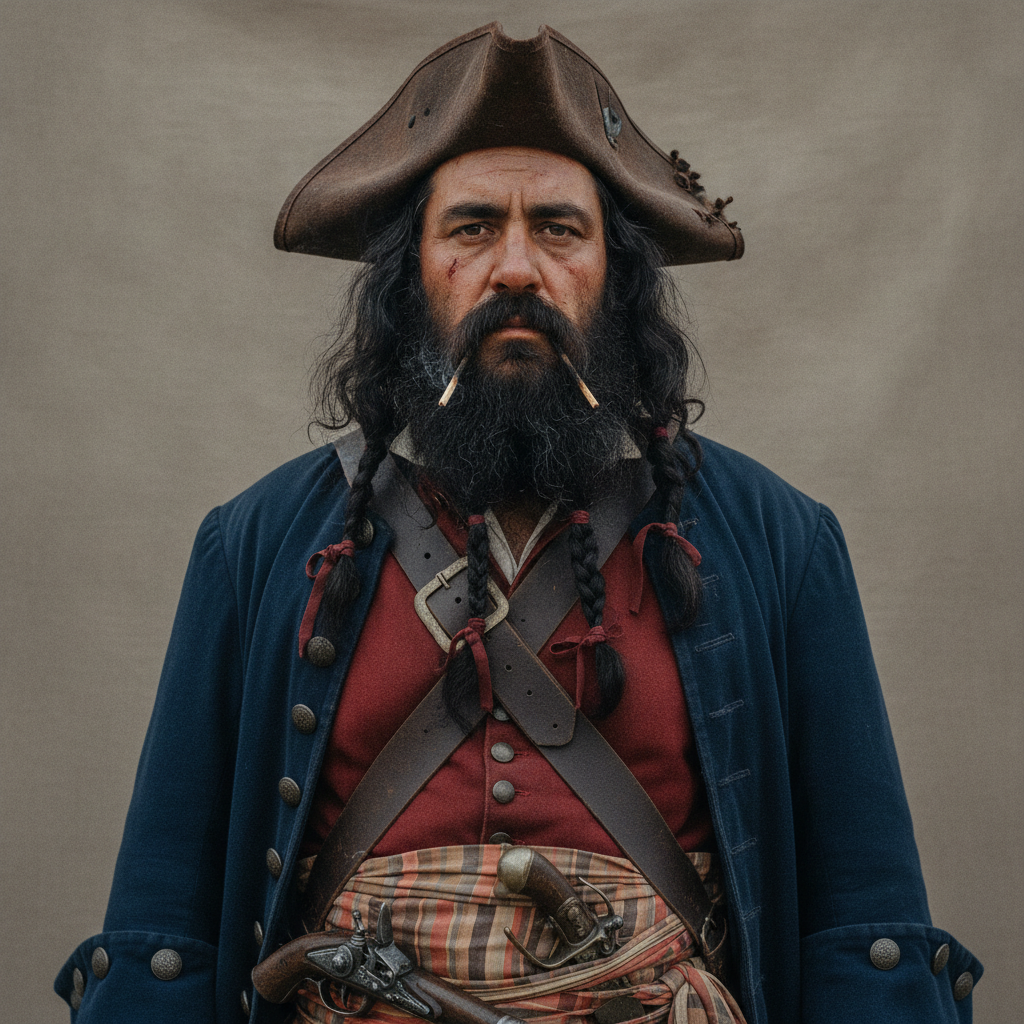
His silhouette was probably imposing: tall with a broad, heavyset frame that read both seaworn and powerful—exactly the kind of build that made him both a formidable fighter and a memorable presence in port. Agewise he was in the late 30s to early 40s at his death, with a weathered, sun‑leathered complexion and a face hardened by long months at sea. The defining feature was the beard: very large, black, and often braided or tied with ribbons. Contemporary reports describe him stringing slow‑burning fuses into his beard and under his hat to produce smoke and sparks in battle, so he would have appeared intentionally fearsome—smoke curling around a dark, bristling beard and moustache, giving him a near‑mythic look. His hair beyond the beard was likely dark and kept rough or tied back like other seamen of the era. He dressed like an ostentatious sea captain: a long heavy coat or greatcoat over a waistcoat, a wide sash, breeches and high boots, and often a broad‑brimmed hat or tricorn. He routinely carried multiple pistols—sometimes tucked across his chest or in his sash—as well as a cutlass, and he favored layers and accessories that announced wealth and danger: belts, occasional jewelry, and the practical accoutrements of a fighting sailor.
Height / build
Likely tall for his time · Likely broad / stout
Hair
Likely black to dark brown (possibly graying at the temples) · Likely coarse, possibly wavy · Likely full hair (no solid evidence of baldness)
Eyes
Likely dark
Complexion
Weathered, ruddy to medium-light (sea-exposed English complexion)
Face
Broad / square · Prominent, straight
Notable features
Huge black beard (braided, with slow matches), multiple visible pistols and knives, commanding presence / scarred or battle-worn face likely
Grooming
Very large black beard, frequently braided and reportedly fitted with slow-burning matches or ribbons · Grooming appears deliberately theatrical—beard and hair arranged to intimidate; facial hair kept long and distinctive rather than neatly trimmed.
Dress / presentation
Practical seafarer clothing with ostentatious touches—long coat, waistcoat, wide sash, tricorne or cap, and many visible weapons; sometimes described as wearing fine cloth uncommon among ordinary sailors.
height build
Height
Likely tall for his time
Contemporary narratives describe him as an imposing, large man—language implying greater-than-average height versus early-18th-century norms.
height build
Build
Likely broad / stout
Sources call him 'stout' or 'large' and his lifestyle (heavy weapons, ship labor) supports a solid, muscular frame.
hair
Hair color
Likely black to dark brown
Nickname 'Blackbeard' and contemporary descriptions emphasize a very dark beard and hair.
other
Beard
Very large black beard, frequently braided and fitted with slow-burning matches
Johnson and several near-contemporary reports describe a braided black beard with slow-burning fuses used theatrically in combat.
grooming
Grooming style
Deliberately wild and theatrical
Accounts emphasize an intentionally fearsome appearance—lit fuses in beard, ribbons and unkempt hair—designed to intimidate foes.
eyes
Eye color
In the Golden Age of Piracy, a captain's authority was partly theatrical: a commanding physical presence, weapons displayed openly, and an intimidating hairstyle or beard could deter boarding actions and maintain crew discipline. Blackbeard used appearance as a weapon—his beard, clothing, and visible pistols broadcasted menace and success.
Teach was English—likely from the West Country—and would have shared the common features of northern European sailors of the period: dark hair (often), dark eyes, and a fair-to-medium complexion that quickly bronzed from extended sea service. His look fits the practical, weathered face of an experienced mariner rather than exotic foreign types.
Modern films and fantasy art often over-exaggerate fantasy elements (horns, impossibly long beards, monstrous facial features) or standardize a single 'look'; Blackbeard was theatrical but human-sized and consistent with an early-18th-century English sailor's build and dress.
Movies and fantasy art often turn Blackbeard into a caricature—an impossibly long beard, supernatural features, or historically implausible heavy armor. In reality, his theatrics were simpler and tactical: a dark, bushy, braided beard, lit fuses for dramatic effect, and ordinary but high-quality clothing for the period.
Yes — Likely tall for his time; contemporary accounts call him an imposing, large man.
Likely dark.
Likely black to dark brown, possibly with some graying.
Yes — a very large black beard, often braided and reportedly fitted with slow-burning fuses or ribbons to intimidate.
His huge black beard (possibly smoking), multiple visible pistols and knives, and an unusually large, commanding presence and clothing richer than ordinary sailors.
By combining near-contemporary written accounts (official reports, newspapers) and later histories that repeat consistent details; no authenticated painted portrait or life mask survives.
A General History of the Pyrates
Charles Johnson (pseud.), 1724 · 1724
Contains the most influential near-contemporary description: a tall, stout man with a large black beard braided and often decorated, using slow-burning fuses to appear demonic in battle; lists clothing and armament.
Lieutenant Robert Maynard's report
Official report to Admiralty, 1718 · 1718
Maynard's official account of the battle with Blackbeard describes the violent encounter and identifies Blackbeard by physical means (head presented to prove death); it supports a fearsome, well-armed appearance though details are terser than Johnson's narrative.
Governor Alexander Spotswood's correspondence
Spotswood report and letters, 1718 · 1718
Spotswood described the operation against Blackbeard and exhibited his severed head in Virginia as proof; correspondence and reports imply a notorious, threatening appearance used in propaganda against piracy.
Contemporary colonial newspapers and broadsheets
Various newspapers (Boston, London, 1718) · 1718
Short reports that repeat vivid details—black beard, fearsome conduct, weapons—helped fix a public image of Blackbeard quickly after his death.
Early and later portraits and prints of Blackbeard
18th–19th-century prints and paintings · 18th–19th c.
Imagined portraits show a consistent theme (big beard, heavy coat, pistols) but are artistic reconstructions and often derive from Johnson's narrative rather than eyewitness sittings.
Modern historical syntheses
Angus Konstam, David Cordingly, others (modern historians) · 20th–21st c.
Contemporary historians synthesize reports, giving weight to repeated descriptive elements (beard, weapons, imposing size) while noting later embellishment; useful for context and era-typical appearance.
Likely dark
No direct contemporary record of eye color; dark eyes are common in English population and fit eyewitness descriptions of 'black' features.
skin
Complexion
Weathered, ruddy to medium-light
Long periods at sea in sun and weather cause tanned, wind-creased skin; accounts mention a battle-hardened, grim visage.
clothing
Clothing style
Practical seafarer dress with flamboyant touches (coat, sash, many weapons)
Narratives and later portraits present him as a captain who dressed above ordinary crew—fine coat, sashes, pistols—both practical and ostentatious.
other
Weapons and display
Frequently wore multiple pistols and knives visibly
Descriptions of Blackbeard list several pistols and blades across his chest and belt—part of a deliberate intimidation strategy.
face
Scars / battle-worn features
Probably scarred or rugged-looking
Engagements in close combat and eyewitness accounts of a fearsome visage suggest a weathered, possibly scarred face.