height build
Height
Likely tall for her time
Tacitus explicitly describes Boudica as physically tall and imposing compared with the crowd.
Portrait reconstruction
0–0 · Iceni (East Anglia), Roman Britain · 1st century CE
Boudica likely stood tall and imposing, with long tawny hair, a fierce expression, and bold Celtic jewellery set over functional warrior dress.
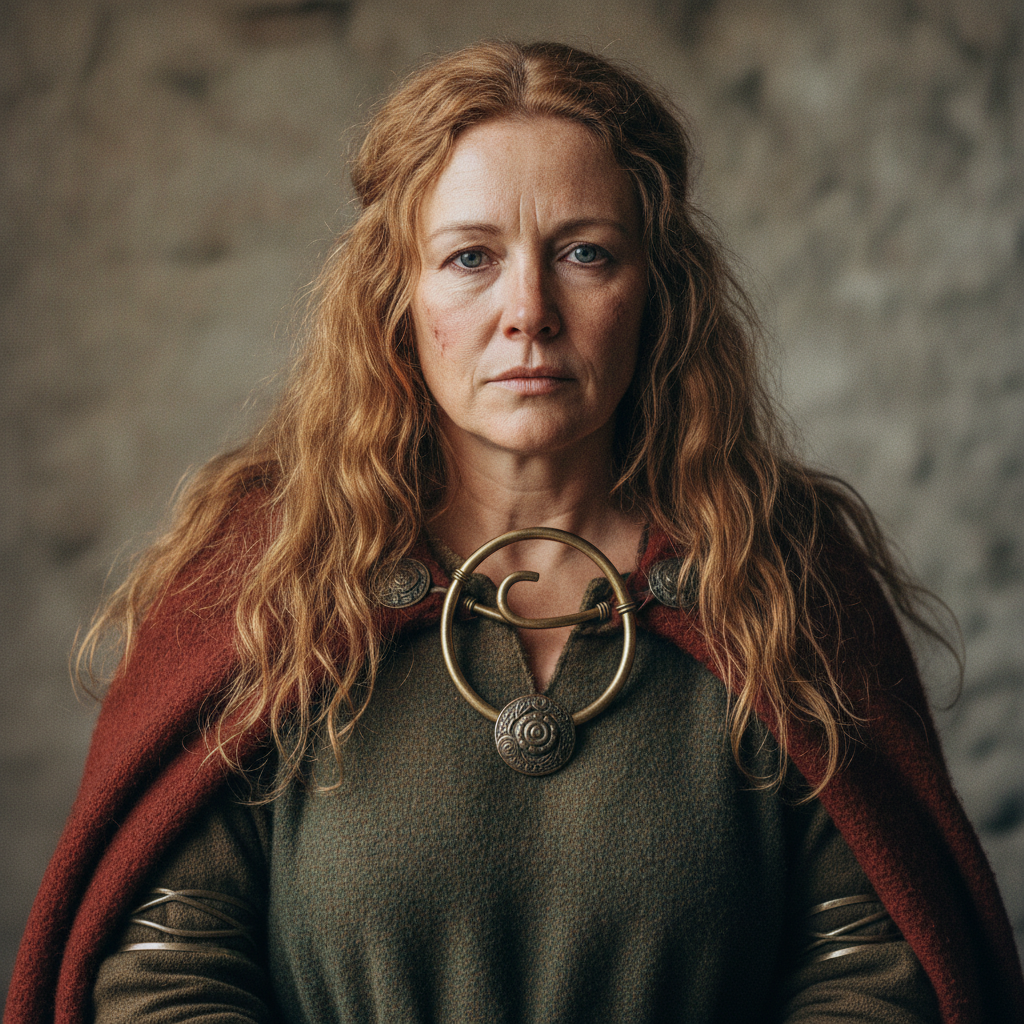
Height and bearing: Imagine a woman noticeably taller than the people around her—broad‑shouldered, muscular from riding and leadership, moving with the coiled energy of a seasoned commander. Her posture was upright and authoritative, the sort that made her presence itself into a rallying point for warriors. Hair and face: Her hair was likely tawny—golden to reddish—and worn long, either loose or pulled into braids for battle, so it would stream out when she rode a chariot. Her face would be strong‑boned with a hard, commanding expression and a projecting, forceful voice; skin tone ranged from fair to sun‑weathered with a ruddy flush from outdoor life. Dress and accoutrements: She wore bright, conspicuous jewellery—torcs, arm rings and brooches—displayed as markers of rank, layered over a wool or leather tunic and a heavy cloak fastened at the shoulder. For war she favored mobility: leather fittings, practical boots, possibly a shield or spear at hand, and quick access to the reins of her chariot rather than heavy Roman‑style armour.
Height / build
Likely tall for her time · Likely robust / strong
Hair
Likely tawny (reddish–blond) · Likely thick and wavy · Likely full hairline with long hair worn loose or partly braided
Eyes
Likely dark to blue‑gray
Complexion
Likely fair to medium, weathered from outdoor life
Face
Likely long or angular, with a commanding jawline · Likely straight to prominent
Notable features
Tall stature, tawny long hair, commanding expression/voice, large gold torc/neck jewelry, possible signs of physical trauma
Grooming
None (female) · Long hair worn prominently (a status symbol among Celts); likely well‑maintained and styled for public display and battle—possibly braided or tied when campaigning.
Dress / presentation
Celtic noble dress: long tunic, woolen cloak fastened with brooch, heavy torc and arm‑rings, practical riding/war garments
height build
Height
Likely tall for her time
Tacitus explicitly describes Boudica as physically tall and imposing compared with the crowd.
hair
Hair color
Likely tawny (reddish–blond)
Roman accounts use a term translated as 'tawny' or 'yellowish' to describe her hair—commonly rendered as reddish‑blond or auburn in modern translations.
hair
Hair length & style
Long, worn prominently (often loose or displayed)
Roman narratives emphasize her long hair as part of her fierce appearance; long hair was a Celtic noble status marker and battle display.
face
Expression / presence
Fierce, commanding, and severe
Ancient writers stress her harsh voice, commanding gestures, and imposing countenance used to rally and intimidate.
clothing
Dress
Celtic noble dress: long tunic, cloak, torc and arm‑rings
Descriptions mention conspicuous jewelry (large neck torque) and the likely use of typical Iceni noble garments for public display and riding.
other
Jewelry
Among Iron Age British elites, long hair, fine metalwork (torcs, armlets), and conspicuous dress signaled rank and martial readiness. For a queen like Boudica, physical display — unbound hair, a heavy neck‑torque, and a loud, uncompromising voice — would communicate authority and inspire followers.
The Iceni lived in East Anglia and were part of the broader Celtic population of Iron Age Britain. Phenotypes could range from fair to medium complexions and include both light and dark hair/eyes. As a tribal aristocrat Boudica's appearance would combine local physical traits with conspicuous jewelry and dress that marked elite identity.
Modern images often turn her into a Nordic Valkyrie or a bare‑chested Amazon; contemporary sources emphasize Celtic dress, jewelry, and striking hair rather than Viking armor or sexualized nudity.
Victorian and cinematic portrayals often recast Boudica as a Nordic or Viking‑type figure (heavy furs, horned motifs, bare‑breasted Amazons) or give her uniformly red hair and warrior clichés. Contemporary sources point instead to Celtic dress, torcs, long conspicuous hair, and a leaderly, almost regal bearing rather than fantasy armor.
Yes — Roman sources describe her as tall and physically imposing, so 'Likely tall for her time' is the best estimate.
Likely tawny — ancient descriptions use a word translated as 'tawny' or 'yellowish', often rendered as reddish‑blond or auburn.
Likely dark to blue‑gray — eye color is not recorded; regional population traits make either possible, so a range is the best estimate.
Yes — she is described as wearing a large neck‑torc and would have worn the long tunic and cloak of a Celtic noblewoman, with visible metalwork.
She was described as striking and commanding rather than classically 'beautiful' — her forceful presence and status made her memorable.
Moderately confident — key traits (tall stature, tawny hair, commanding presence, and jewelry) come from Roman descriptions and regional archaeology; many other details are inferred from context.
Tacitus — Annals (Book 14)
Tacitus, Annals · c. 98 CE
Primary near‑contemporary description: describes Boudica as tall, with a harsh voice and 'tawny' hair; mentions her riding in a chariot and wearing conspicuous jewelry.
Cassius Dio — Roman History
Cassius Dio, Roman History · c. 3rd century CE
Later Roman account that repeats and amplifies elements of Boudica's appearance (fierce, hair color often given as yellowish) and dramatizes her public role and dress.
Iceni metalwork and torcs (archaeology)
Iceni archaeology / Iron Age Britain finds · Iron Age (pre‑Roman and Roman periods)
Archaeological finds in East Anglia include torcs, arm rings and high‑status metalwork that match Roman descriptions of Celtic elite dress and jewelry.
Thomas Thornycroft statue of Boadicea (Victorian)
Thornycroft's Boadicea and Her Daughters (Westminster Bridge statue) · installed 1902 (19th-century work)
Influential Victorian visual image that shaped modern ideas of Boudica as an Amazonine charioteer; useful for modern reception but not as historical evidence.
Later classical and medieval retellings
Later writers (various) · post‑Roman / medieval
Later authors and chroniclers repeat elements from Tacitus and Dio while adding legendary details; these inform medieval and modern imagery but are lower weight for appearance facts.
Large gold torc and metal jewelry
Tacitus notes a large neck ornament and contemporary Iceni finds show torcs and arm‑rings as elite markers.
skin
Complexion
Likely fair to medium, weathered
Population context for East Anglia plus outdoor, campaign life suggests a fair to medium natural tone with sun/weathering.
grooming
Grooming
Well‑kept long hair used as status and rallying feature
Long hair was a visible aristocratic and martial marker in Celtic culture and emphasized in Roman descriptions of Boudica.
other
Facial hair
None (female)
As a woman and queen she would not be depicted with facial hair; Roman texts make no mention of it.
other
Signs of trauma
Possibly visible scars or distress marks
Tacitus reports she had been publicly flogged; such events can leave marks, and Roman storytelling emphasizes the physical indignities that sparked her revolt.
comparison
How she stood out
Tall, loud‑voiced, and heavily jewelled compared with typical local population
Ancient sources focus on height, voice, and torc as distinguishing characteristics in public rallies.