height build
Height
Likely average height
Regional and period averages for adult males plus no literary claim of extraordinary stature indicate an average height estimate.
Portrait reconstruction
563–483 · Lumbini / Kosala–Shakya region (modern Nepal / northern India) · c. 6th–5th century BCE (Ancient India)
Buddha likely looked like a medium‑brown skinned North Indian man with dark hair (shaved or in a small topknot), clean‑shaven, elongated earlobes, and a serene, rounded face.
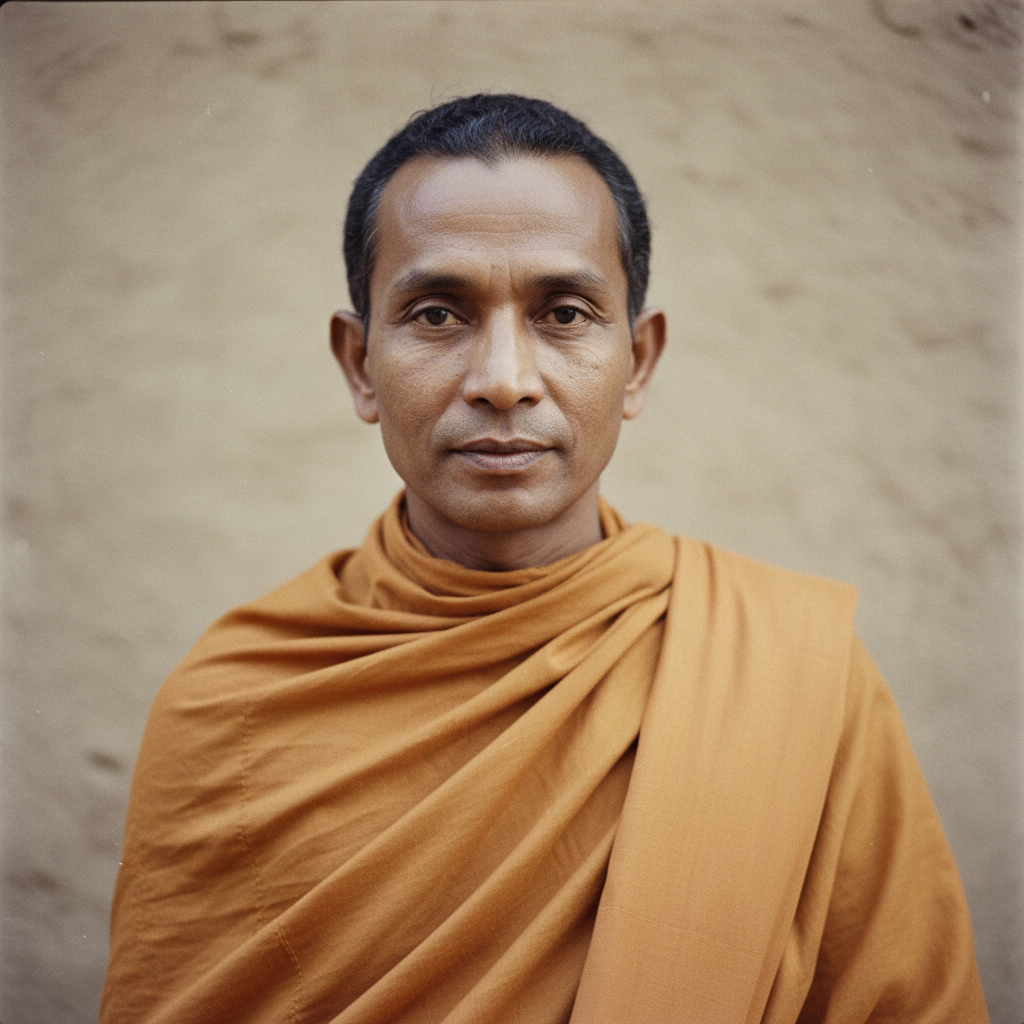
Skin tone: probably medium to dark brown, consistent with populations of the northern Indian / southern Nepali plain. Complexion would have been that of an ordinary north‑South Asian person rather than a markedly pale or unusually dark hue. Hair and grooming: likely dark—black to deep brown—and as a renunciant either closely shaved or gathered into a compact topknot (the small hair knot later stylized as the ushnisha). He was probably clean‑shaven in keeping with early monastic tonsure practices, giving an open, smooth jawline. Facial features and expression: a calm, rounded face with gentle, downcast eyes and a soft, composed mouth. His nose would have been proportionate and his brows neither extreme nor gaunt—overall an even, approachable look. Elongated earlobes are a distinctive feature in later portraits and reflect his princely youth (from wearing heavy jewelry) combined with the plainness of his later appearance. Body and posture: descriptions emphasize a well‑proportioned, graceful build—neither very broad nor frail—shifting from princely robustness in youth to a leaner, ascetic frame after years of renunciation; posture in portraits is upright and composed, reflecting meditative steadiness.
Height / build
Likely average height · Likely lean to medium build
Hair
Likely dark (black to very dark brown) · Likely straight to wavy · Probably tonsured / shaven as a monk (pre‑renunciation would have had a normal hairline)
Eyes
Likely dark (brown)
Complexion
Likely medium to dark brown
Face
Likely oval to medium‑broad · Likely straight to slightly aquiline/strong‑bridged, typical of North Indian populations
Notable features
Often shown with elongated earlobes (from princely earrings), a cranial protuberance/topknot (ushnisha), and a calm, serene expression.
Grooming
Probably clean‑shaven (monastic tonsure common) · After renouncing, he would have followed monastic grooming: shaved head or close crop and minimal ornamentation; pre‑renunciation he likely wore princely jewelry.
Dress / presentation
Simple saffron/ochre monastic robes (early Buddhist sanghati style)
height build
Height
Likely average height
Regional and period averages for adult males plus no literary claim of extraordinary stature indicate an average height estimate.
height build
Build
Likely lean to medium build
Raised as a prince but later ascetic lifestyle and long periods of walking/meditation favor a lean, wiry adult body in descriptions and monastic tradition.
skin
Complexion
Likely medium to dark brown
Born in the Shakya region of northern South Asia; population context and later textual descriptions suggest a South Asian complexion.
eyes
Eye color
Likely dark (brown)
Dark brown eyes are overwhelmingly common in the region and are the simplest historical likelihood.
hair
Hair color
Likely dark (black to very dark brown)
Consistent with North Indian populations and all early artistic traditions.
hair
Hairline / hairstyle
Probably tonsured / shaven in monastic life; earlier full hair
In the Shakya/Kshatriya culture, youthful princes were expected to be well‑groomed and ornamented; spiritual authority later prized restraint, shaved heads, and simple robes. The Buddha's transformation from princely finery to austere monk visually signaled his changed values and authority.
Siddhartha came from a North‑Indian foothill population (Shakya clan). Picture a South Asian man with medium–dark brown skin, dark eyes and hair, and features consistent with Indo‑Gangetic and Himalayan‑foothill peoples rather than the later East Asian Buddha images.
Modern images often mix regional styles (East Asian, Southeast Asian, South Asian) and exaggerate symbolic features into literal traits — e.g., always bald with an enormous topknot or uniformly golden skin — which flattens historical nuance.
Modern depictions often blend styles from many Asian traditions (e.g., East Asian faces, Southeast Asian robes) or turn symbolic markers into literal anatomy (enormous topknots or golden skin). The historical figure would have looked like a South Asian man, not a pan‑Asian stereotype.
Probably not unusually tall — likely around the regional average for men (roughly 160–170 cm / 5'3"–5'7").
Likely dark brown, consistent with North Indian populations.
He was probably tonsured or closely shaven as a monk; earlier in life he would have had a normal head of hair.
Probably clean‑shaven — shaving was typical for Buddhist monastics.
Simple folded saffron/ochre monastic robes (the sanghati) that marked his renunciation.
Sculptures reflect later visual conventions and symbolic marks (ushnisha, elongated earlobes) that shaped how generations pictured him rather than a contemporary photograph.
Lakkhaṇa Sutta / 32 Marks of a Great Man
Pāli Canon (Lakkhaṇa Sutta) / early Buddhist texts · compiled centuries after life (early centuries BCE–CE)
Lists idealized physical marks (e.g., protuberant head, long earlobes, well‑proportioned limbs) that influenced later images and how Buddhists imagined his appearance.
Biographical sutras (Lalitavistara, Buddhacarita)
Lalitavistara Sūtra; Buddhacarita · early centuries CE (textual traditions)
Narrative biographies that describe Siddhartha's princely youth, renunciation, and physical attributes in ways that became templates for artistic depiction.
Gandhara sculptures
Gandhara school (northern Pakistan / Afghanistan) · 1st–5th century CE
Some of the earliest figural Buddhas: Greco‑Roman stylistic features fused with Indic iconography—shows topknot/ushnisha, robe style, serene face.
Mathura Buddha images
Mathura school (northern India) · 1st–3rd century CE
Indian sculptural tradition emphasizing native facial types, robes, and the canonical marks; important for South‑Asian visualization of the Buddha.
Ashokan aniconic symbols
Ashoka's monuments and edicts · 3rd century BCE
Ashokan sites favor symbolic representations (wheel, footprint) rather than human images—indicates early reluctance to make portraits and the later development of anthropomorphic images.
Pāli Canon (Suttas and Vinaya)
Pāli Canon (various suttas, Vinaya) · oral tradition compiled centuries after events
Contains fellow disciples' descriptions, monastic rules about appearance and tonsure, and narrative elements used to infer later-life grooming and dress.
Monastic rules and later depictions show a shaved head or tightly arranged hair/topknot (ushnisha) while princely youth would have had normal hair.
grooming
Facial hair
Probably clean‑shaven
Buddhist monastic practice favored shaving; textual references and monastic codes support this.
other
Notable symbolic features
Long earlobes and topknot/ushnisha (symbolic)
Long earlobes reflect princely jewelry in stories; the cranial protuberance/topknot appears early in Buddhist iconography as a mark of enlightenment.
clothing
Clothing
Simple saffron/ochre monastic robes (sanghati)
Monastic codes and early art consistently portray the Buddha and monks in simple folded robes dyed ochre/ saffron.
face
Expression / bearing
Calm, composed, mildly handsome / commanding
Textual praise (32 major signs) and artistic tradition present a serene, compassionate visage intended to convey authority and attractiveness.
Pan‑Asian Buddhist statuary and paintings
Chinese, Tibetan, Southeast Asian Buddhist art · from 3rd century CE onward
Shows how the Buddha was visualized differently across cultures (facial types, robes, skin color), illuminating modern misconceptions and the spread of iconography.
Regional anthropological context
Studies of ancient South Asian populations · modern scholarship (20th–21st c.)
Population and anthropological data support likely complexion, hair and eye color consistent with northern South Asian populations of the period.