height build
Height
Likely average height for his time
No source highlights unusual stature; typical Northern Indian male average fits best.
Portrait reconstruction
0–0 · Takshashila (Taxila) origin; active in Magadha (northern India / present Pakistan–India border region) · Ancient India, Mauryan period (c. 4th century BCE)
Chanakya probably presented as a lean, sharp‑featured Brahmin: dark hair tied in a small shikha, a shaved face, intense dark eyes, medium‑brown skin, and plain, austere robes marked by the sacred thread.
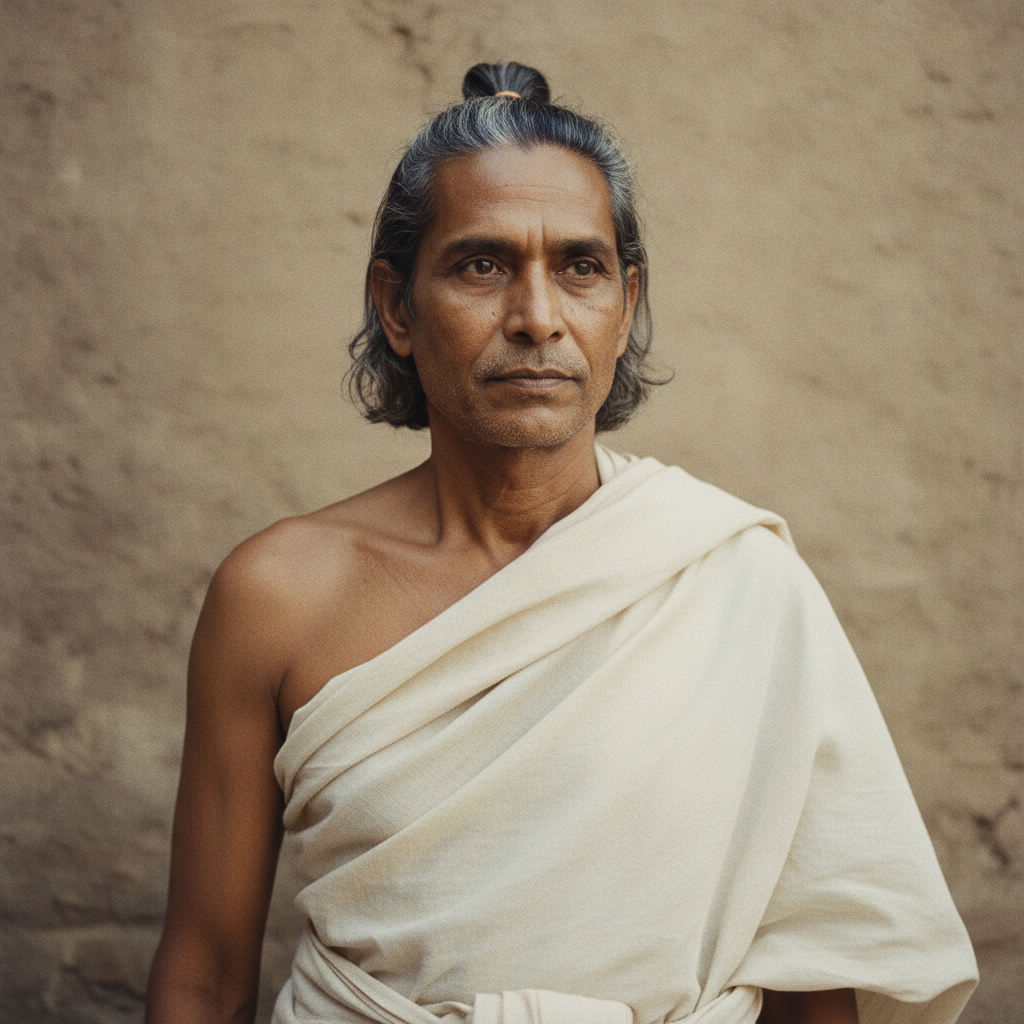
Overall impression: a spare, purposeful figure—lean and wiry rather than corpulent—carrying the calm authority of a teacher and strategist. His posture would have been upright and alert, with deliberate, economy-of-motion gestures befitting a scholar accustomed to debate and courtly counsel. Face and hair: likely medium‑brown skin typical of the northwestern subcontinent, with dark hair gathered into a small shikha (a Brahmin tuft) at the crown. He was probably clean‑shaven or closely trimmed, with a high forehead, a keen, slightly hooked nose, thin lips and a firm jaw; his eyes would have been dark and penetrating, projecting intensity and focus more than softness. Grooming and attire: he would have worn plain, practical Brahmin dress—dhoti and an upper cloth or angavastram in muted whites, ochres or undyed shades—plus the sacred thread (yajnopavita) draped across his chest and possibly a simple tilaka mark on the brow. Jewelry and ornamentation would have been minimal; simplicity and ritual markers signaled his learned, ascetic status rather than wealth.
Height / build
Likely average height for his time · Likely slender / wiry
Hair
Likely dark, becoming graying · Likely straight to slightly wavy · Likely receding or thinning with age
Eyes
Likely dark brown
Complexion
Likely medium to dark brown
Face
Likely long, angular/lean face with sharp cheekbones · Likely straight to slightly prominent nose
Notable features
Sharp, hawk-like features; penetrating gaze; shikha tuft; austere scholar's posture
Grooming
Probably clean-shaven or with minimal facial stubble · Likely kept traditional Brahmin grooming: shaved or closely cropped head with a shikha (tuft), forehead mark (tilaka), and neat, austere appearance.
Dress / presentation
Simple Brahminic garments—dhoti, angavastram/upper cloth, possibly a shawl; not adorned with royal jewelry
height build
Height
Likely average height for his time
No source highlights unusual stature; typical Northern Indian male average fits best.
height build
Build
Likely slender / wiry
A scholar and ascetic lifestyle with political activity rather than soldiering suggests a lean frame often associated with Brahmin teachers.
skin
Complexion
Likely medium to dark brown
Origin in the northwestern Indian subcontinent makes a medium–dark brown skin tone the most plausible.
eyes
Eye color
Likely dark brown
Dark brown is overwhelmingly the common eye color in the region historically and today.
hair
Hair color
Likely dark, becoming graying
Dark hair with age-related graying fits written descriptions of an elder adviser and widespread hereditary traits.
hair
Hair style (shikha)
Likely shaven or cropped with a shikha (Brahmin tuft)
In Chanakya's milieu, visible markers of priestly learning—neat grooming, the shikha (tuft), a tilaka, and modest yet correct dress—were as important as facial looks. Authority came from austerity, ritual correctness, and intellectual bearing; an austere, severe face reinforced perceptions of moral and political seriousness.
Chanakya hailed from the northwestern Indo-Gangetic world (Taxila / Magadha region). That population typically displayed darker brown skin, dark brown eyes, and straight to wavy dark hair—traits that help picture him as a South Asian man rather than a later exoticized image.
Modern films and paintings often dramatize him as either a wizened wizard or a turbaned royal conspirator; more likely he appeared as an austere Brahmin scholar—lean, simply dressed, and severe-looking.
Films and popular art often turn Chanakya into either a white-bearded mystic or a turbaned schemer in ornate robes. The historical picture is more prosaic: an austere, scholarly Brahmin in simple ritual dress, not a fantastical wizard or quasi-royal conspirator.
Likely average height for his time.
Likely dark brown.
Likely dark (turning gray with age), straight to slightly wavy.
Probably clean-shaven or with minimal stubble rather than a long beard.
Simple Brahminic garments: dhoti, upper cloth (angavastram), and possibly a shawl; ritual marks (shikha, tilaka) likely present.
No authenticated contemporary portrait survives; reconstructions rely on texts, regional art, and later portrayals.
Arthashastra (attributed to Kautilya / Chanakya)
Arthashastra · c. 4th century BCE (attributed)
The treatise establishes Chanakya's role as a learned Brahmin teacher and statesman; it supplies cultural context (class, role, and expected ritual dress) but contains no contemporary physical portrait.
Mudrarakshasa (Play describing Chanakya's political role)
Mudrarakshasa by Vishakhadatta · Classical/medieval period (text preserved from c. 7th century CE onward)
A later dramatic portrayal that emphasizes Chanakya's cunning, temper, and austere personality—this shaped many later visualizations of his sharp, severe face.
Temple and popular statues / paintings (medieval–modern)
Later Indian art and popular portraits · medieval to modern eras (post-1st millennium CE onward)
Numerous later sculptures and paintings depict Chanakya with a shikha, austere robes, and a severe face; these inform popular image but postdate him by many centuries.
Mauryan-era sculpture and dress conventions
Mauryan art (pillars, reliefs) · 3rd century BCE (Mauryan period)
Contemporary Mauryan art reveals clothing styles, grooming norms, and facial-stylistic conventions that help reconstruct how an educated man might have dressed and carried himself.
Puranic and regional biographies
Puranas and later chronicles · medieval compilations (post-1st millennium CE)
Later retellings expand Chanakya’s biography and physical traits; useful for understanding evolving iconography though late in date.
Modern scholarship on Kautilya/Chanakya
Modern historians and translations (e.g., R. P. Kangle, Romila Thapar) · 20th–21st centuries
Scholarly work synthesizes textual and archaeological context to infer social role and probable appearance markers (dress, ritual marks), guiding responsible visual reconstructions.
Traditional Brahmin grooming preserved in classical sources and later depictions shows the shikha as a ritual marker for learned Brahmins.
grooming
Facial hair
Probably clean-shaven or lightly stubbled
Early Indian sculptural convention and brahminical grooming often favored a clean face for priests/scholars.
face
Facial expression / features
Sharp, hawk-like features with penetrating eyes
Literary tradition emphasizes Chanakya's sharp intellect and severity—later portraits translate that into thin, keen facial features.
hair
Hair texture & line
Likely straight to slightly wavy; receding/thinning with age
Common regional hair textures and expected age-related thinning make this likely.
clothing
Clothing
Simple Brahminic robes (dhoti, upper cloth/angavastram, possible shawl)
As a teacher and ascetic-advisor, he would favor ritual and functional Brahmin dress rather than royal finery.
cultural
Distinctive ritual marks
Likely wore a tilaka and maintained ritual symbols of a Brahmin (shikha)
Brahmin identity in classical India was expressed through visible marks; later tradition applies these to Chanakya.
comparison
How he'd stand out in a room
Commanding presence from a lean, severe face and intense gaze rather than colorful dress
Sources stress Chanakya's intellect and temperament; visual tradition emphasises severity over ornament.