height build
Height
Likely average height
Greek reports about Indians indicate medium/average stature and Mauryan rulers are not singled out as especially tall in surviving texts.
Portrait reconstruction
340 BCE–297 BCE · Magadha (present-day Bihar, India) · Ancient India, Maurya period (4th–3rd century BCE)
Chandragupta Maurya likely had dark hair, medium-to-dark brown skin, a solid, broad-shouldered frame, and—after abdication—a shaved head and austere robes.
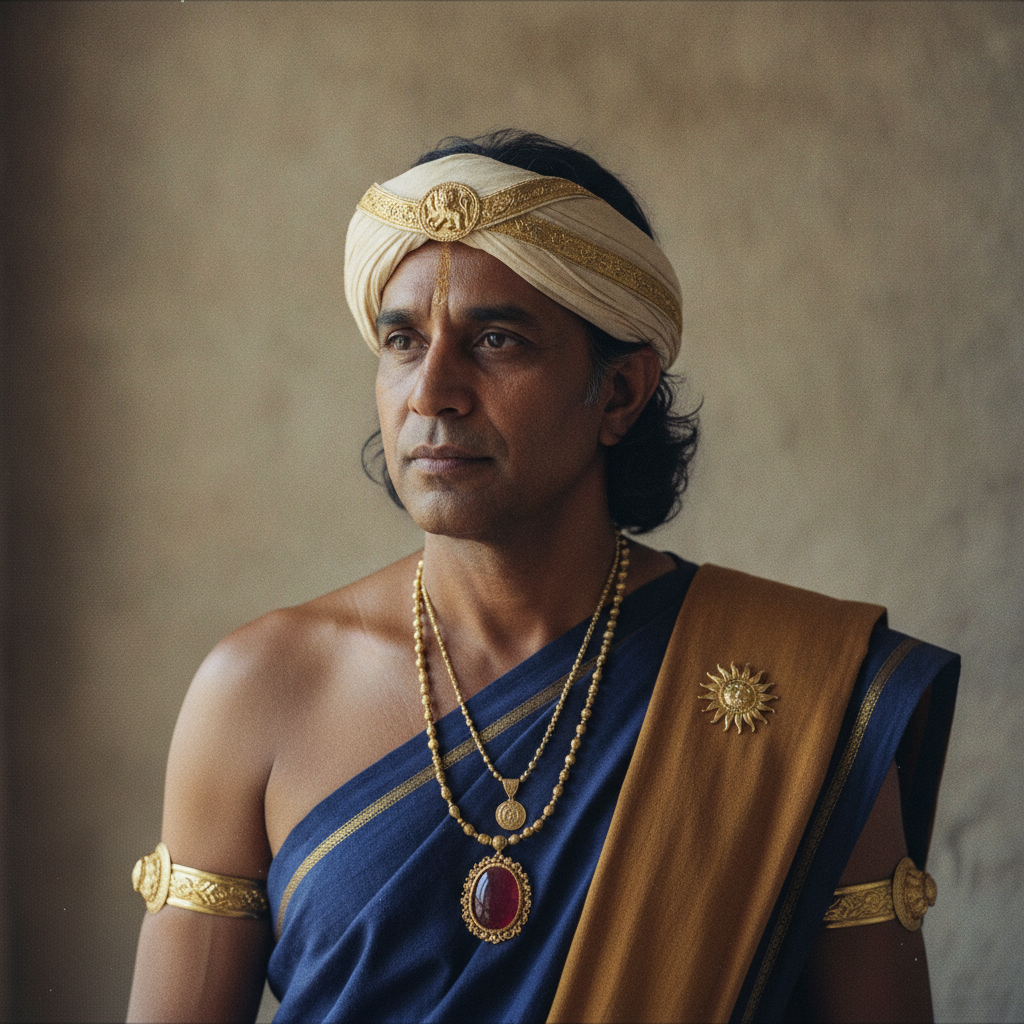
His skin tone would most likely have been medium to dark brown, matching the peoples of the Magadha region; his hair dark, worn short and well groomed in his years as king. Portrait conventions of the Mauryan era emphasize large, alert eyes and a resolute, broad face rather than delicate features, so imagine a strong, expressive face with clear, steady eyes. As a ruling figure he probably carried a solid, athletic build—broad shoulders and a commanding posture suited to a warrior-administrator. Royal grooming norms favored a neat appearance, so he was likely clean-shaven or closely cropped in facial hair while on the throne, projecting disciplined authority rather than long flowing hair or heavy beards. In day-to-day court appearance he would have worn finely draped garments of cotton or muslin, a wrapped lower garment and an upper drape or shawl, often arranged to show rank; gold or beaded necklaces, armlets, and a signet or simple diadem signaled kingship without full-figure portraiture. Accessories were measured and stately—ornamentation that announced power and wealth rather than ostentation. In later years, after abdication and conversion to Jain asceticism, he would have looked very different: head shaved, wearing plain, pared-down robes, and adopting an austere, almost ascetic bearing that contrasted with his earlier royal presentation.
Height / build
Likely average height · Likely solid/stocky or average build
Hair
Likely dark to black · Likely straight to wavy · Likely full in youth, later receding or graying (later shaved as monk)
Eyes
Likely dark
Complexion
Likely medium to dark (South Asian)
Face
Likely oval to broad · Likely straight to slightly aquiline
Notable features
Regal bearing, authoritative posture; likely worn royal jewelry (necklaces, armlets) and a visible diadem or turban in court dress
Grooming
Probably clean-shaven or with a trimmed moustache · Royal grooming: well-kept hair tied or styled for court; later in life a shaved head and ascetic simplicity as recorded by Jain sources.
Dress / presentation
Draped Indian court garments (antariya/uttariya), heavy jewelry, possibly a diadem or royal insignia; practical warrior gear in battle
height build
Height
Likely average height
Greek reports about Indians indicate medium/average stature and Mauryan rulers are not singled out as especially tall in surviving texts.
height build
Build
Likely solid/stocky or average build
As a military leader and active ruler he would have had a robust, practical physique rather than slender courtly fragility.
skin
Complexion
Likely medium to dark
Regional population of Magadha and descriptions of Indians by ancient writers point to darker South Asian skin tones.
hair
Hair color
Likely dark to black
Typical pigmentation of north-Indian populations and consistent depictions in Mauryan art favor dark hair.
hair
Hair texture
Likely straight to wavy
Regional hair textures in the Indo-Gangetic plain are generally straight to wavy, and Mauryan sculpture shows such hair treatments.
grooming
Facial hair
Probably clean-shaven or trimmed moustache
Mauryan royal ideals favored a balance of martial vigor and kingly dignity: well-groomed hair, visible royal jewelry, a composed posture, and garments that signaled status without excess. Kings were expected to look capable in battle yet fit for courtly ritual.
Chandragupta’s appearance should be imagined within the Indo-Gangetic population: medium-to-dark skin tones, dark hair and eyes, and physiognomy typical of north-eastern Indian groups—distinctly South Asian rather than Mediterranean or Central Asian.
Modern films and art often give him Europeanized facial features, flamboyant medieval armor, or fantasyized looks; historically he would have worn traditional Indian drapery and jewelry and looked broadly South Asian.
Films and paintings frequently give Chandragupta Europeanized facial features, elaborate medieval armor, or fantasyized hairstyles; historically he would have worn draped Indian garments, respectable but practical royal jewelry, and (if portrayed late in life) the austerity of a Jain monk.
Likely average height—ancient sources do not single him out as notably tall and regional averages point to medium stature.
Likely dark—typical for north-Indian populations of his region.
Likely dark to black; later in life he likely shaved his head as a Jain ascetic.
Probably clean-shaven or with a trimmed moustache; high-status grooming tended toward a neat face, and records say he later adopted monastic shaving.
Draped court garments (antariya and uttariya), heavy jewelry like necklaces and armlets, and a diadem or turban to mark kingship.
No contemporary portrait survives; this reconstruction is based on period art, textual descriptions, and cultural context.
Megasthenes — Indica (fragments)
Megasthenes (Greek envoy), preserved in later writers · late 4th–early 3rd century BCE (fragments preserved later)
Greek fragments describe Indian peoples and court life—useful for broad physical and cultural context, though they do not provide a portrait of Chandragupta himself.
Arthashastra (Kautilya) — prescriptions for royal appearance
Arthashastra (attributed to Kautilya/Chanakya) · 3rd–2nd century BCE (textual formation debated)
Contains advice on grooming, dress, and kingly presentation that reflects elite Mauryan-era norms for royal appearance and conduct.
Jain chronicles about Chandragupta’s later life
Jain tradition (e.g., Parishishta/other medieval summaries) · compiled later (centuries after Chandragupta)
Narratives record Chandragupta’s abdication and conversion to Jain asceticism—descriptions emphasize shaved head and austere clothing in his later years.
Mauryan punch-marked coins and seals
Mauryan numismatic material · 4th–3rd century BCE
Punch-marked coins carry no portraits but reflect a material culture of symbols and are consistent with a non-portrait royal representation in the period.
Mauryan sculpture and Ashokan pillars (style and regalia)
Mauryan-period art and architectural sculpture · late 4th–3rd century BCE
Sculptural style from the Mauryan period shows fashion in drapery, jewelry, and physiognomic cues that inform how a ruler would be depicted even when not individually portrayed.
Buddhist chronicles (e.g., later texts referencing Mauryan rulers)
Buddhist texts and later chronicles · compiled centuries later
Later Buddhist sources praise Mauryan rulers and describe court life; they contribute to an image of regal austerity combined with royal ornament.
High-status Mauryan images and inscriptions emphasize clean, well-groomed faces; Jain sources describe Chandragupta later shaving his head as monk.
clothing
Court dress
Draped robes (antariya/uttariya), jewelry, diadem or turban
Contemporary texts prescribe draped garments and jewelry for kings; Mauryan-era sculpture and seals show draped clothing and ornaments.
other
Later monastic appearance
Likely shaved head and austere robe as a Jain monk
Jain chronicles record Chandragupta’s abdication and later life as a Jain ascetic at Shravanabelagola with a shaven head and simple dress.
face
Notable facial features
Regal, authoritative features—strong jaw and prominent nose
Rulers are traditionally described and depicted with strong, commanding facial features in Mauryan and later Indian art; textual praise for his kingly presence supports this.
cultural
Adornments
Likely wore necklaces, armlets, and a royal diadem or emblem
Mauryan court culture and sculptural reliefs show kings and elites wearing substantial jewelry and regalia.