height build
Height
Likely tall for his time
Einhard and other contemporary annals describe him as tall and long-limbed compared with peers.
Portrait reconstruction
742–814 · Frankish Kingdom / Western Europe (centered on modern-day France and Germany) · Early Middle Ages (Carolingian)
Charlemagne likely appeared as a tall, broad-shouldered man with long hair (later streaked with gray), a ruddy complexion, and generally clean-shaven.
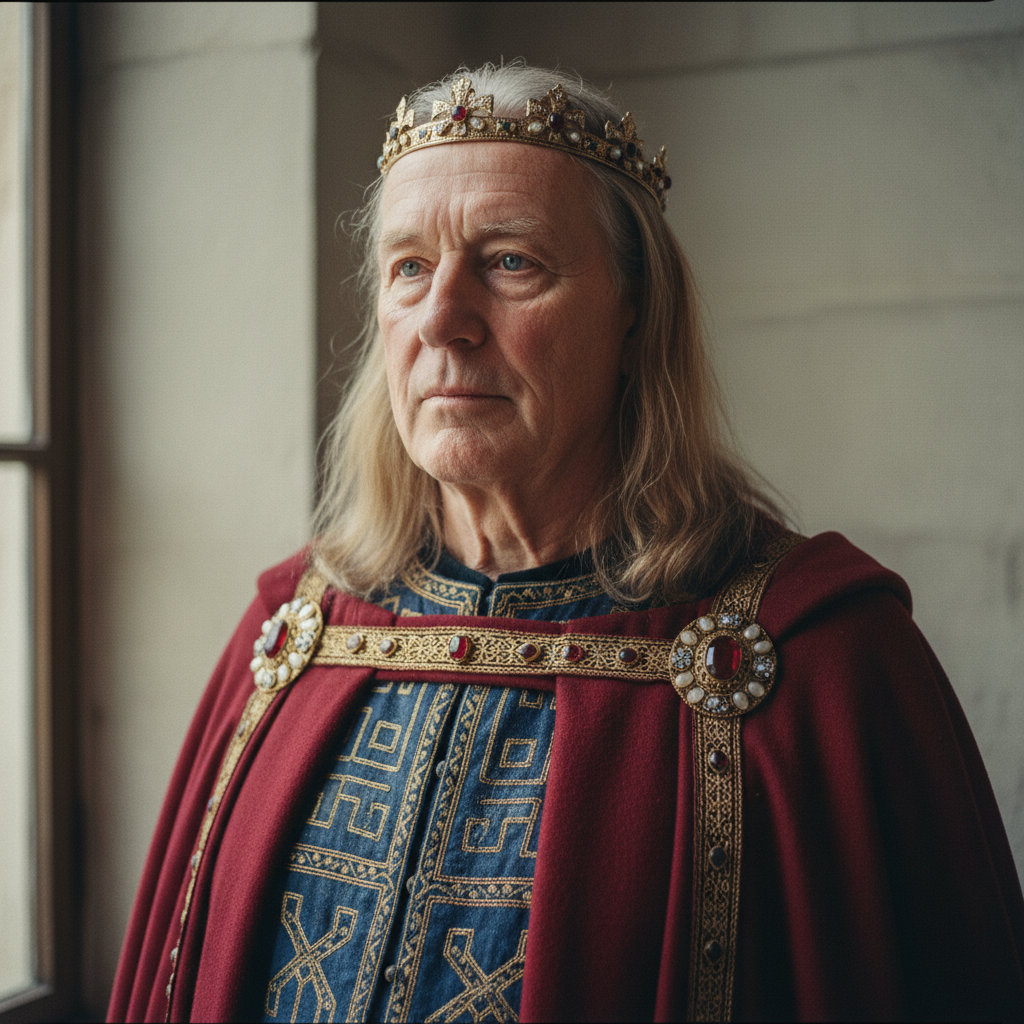
Physique: He would have looked imposing in person — tall for his time, broad-chested and spare rather than bulky, with long arms and a wiry, endurance-ready build from campaigning and riding. The overall silhouette is that of a military leader: upright, long-limbed, and purposeful. Face and hair: His hair was worn long in the fashion of Frankish nobility and recorded as greying with age; it was probably dark or brown. Complexion was likely ruddy from outdoor life and frequent travel. Unlike later medieval kings portrayed with flowing beards, he was generally clean-shaven, giving a more angular, exposed jawline. Dress and bearing: In public and ceremonial settings he would have worn the visible marks of rule — a circlet or crown, a decorated tunic and cloak fastened at the shoulder, and a sword or belt — all presented with the straightforward, martial bearing of a campaigning monarch rather than ostentatious Roman dress.
Height / build
Likely tall for his time · Likely broad-shouldered and spare/muscular
Hair
Likely light — blond to reddish, later graying · Likely straight to slightly wavy · Full hair worn fairly long to about shoulder length
Eyes
Likely light (blue-gray or light)
Complexion
Likely fair with a ruddy (rosy) cast
Face
Likely long/rectangular with a strong jaw · Likely aquiline/strong nose
Notable features
Tall stature, long hair, piercing light eyes, aquiline nose, ruddy complexion, commanding presence
Grooming
Probably clean-shaven · Kept hair long and well-kept while typically shaving the face in a Roman fashion favored by courtly elites.
Dress / presentation
Royal Carolingian court dress blending Germanic tunics and cloaks with Roman-imperial regalia (crown, jeweled brooches, richly trimmed robes and boots)
height build
Height
Likely tall for his time
Einhard and other contemporary annals describe him as tall and long-limbed compared with peers.
other
Build
Likely broad-shouldered and spare/muscular
Descriptions emphasize a wide chest, long arms and a spare but powerful body shaped by campaigning.
hair
Hair color
Likely light — blond to reddish, later graying
Einhard notes his hair's color and later graying; regional Frankish traits favor lighter hair shades.
hair
Hair length/style
Worn fairly long, to about shoulder-length
Einhard and Carolingian portraits show long hair as a common elite style and specifically describe his long hair.
other
Facial hair
Probably clean-shaven
Einhard reports Charlemagne typically shaved, following a Roman courtly preference rather than a full beard.
eyes
Eye color
Likely light (blue-gray)
Frankish elites prized physical strength, tall stature, and martial readiness; at the same time, ruling as Roman-style emperor meant adopting courtly grooming—neat hair, shaved faces, and ornate dress. Charlemagne embodied both: the warrior-king's size and stamina together with Romanized, dignified clothing and clean grooming to fit imperial authority.
Charlemagne belonged to the West Germanic Frankish aristocracy operating in a Gallo-Roman environment; biologically and culturally this area tended toward lighter hair and eyes and fairer complexions than Mediterranean populations. That regional background makes light hair and eyes and a fair, ruddy complexion plausible.
Modern images often show Charlemagne as a shaggy, bearded 'barbarian' or a Romantic long-haired ideal; contemporaries describe a cleaner, more Romanized appearance—tall, long-haired but usually clean-shaven.
Popular images often show Charlemagne as a shaggy, bearded barbarian or as a Romantic long-haired giant. Near-contemporary testimony emphasizes that he was usually clean-shaven and deliberately Roman in presentation; his long hair was groomed and part of a regal appearance, not wild or unkempt.
Yes—contemporary accounts describe him as tall and long-limbed, so he was probably noticeably taller than average for his time.
Likely light—blue-gray or light-colored—based on descriptions of bright, piercing eyes and regional population traits.
Likely light (blond to reddish) hair, worn fairly long to about shoulder length and graying in later life.
Probably not—Einhard reports that Charlemagne typically shaved his face, favoring a clean-shaven, Romanized look.
He was seen as commanding and striking—physically impressive and authoritative rather than classically beautiful.
They reflect how later generations wanted to remember him; the most reliable physical details come from near-contemporary texts like Einhard, while images are often stylized or idealized.
Vita Karoli Magni (Life of Charlemagne)
Einhard · c. 829
Near-contemporary biography giving a detailed physical description: tall, broad-chested, long-armed, spare but strong, ruddy complexion, long hair which later grayed, and generally clean-shaven.
Royal Frankish Annals (Annales Regni Francorum)
Royal Frankish Annals · late 8th–9th century
Contemporary/near-contemporary annals that report events and occasional descriptive notes about the king's presence and deeds—supporting the depiction of an active, campaigning ruler with public stature.
Carolingian coinage with imperial busts
Early 9th-century Carolingian deniers and medals · c. 800–814
Contemporary coins show highly stylized frontal busts; not photographic but they indicate royal iconography (crown, tunic) and give a sense of intended regal image rather than precise facial realism.
Carolingian manuscript portraits and illuminations
Various early 9th-century Gospel books and manuscripts · early 9th century
Illuminated portraits and court imagery show conventions of hair length, dress, and an emperor's bearing—useful for style and grooming but often idealized.
Aachen shrine effigy and later medieval depictions
Karlsschrein (Shrine of Charlemagne) and medieval statues · 12th–13th centuries (later medieval)
Later visual traditions (shrines, statuary) present an idealized emperor—useful for understanding medieval memory but reflecting later fashions and ideology rather than contemporary likeness.
Einhard describes 'bright/piercing' eyes; combined with Frankish population traits, light eyes are probable.
face
Complexion
Likely fair with a ruddy/rosy cast
Einhard explicitly uses terms implying a ruddy face; northern European complexion and outdoor life explain rosiness.
face
Nose
Likely aquiline/strong nose
Contemporary description and many medieval portraits emphasize a prominent, strong nose.
clothing
Clothing style
Imperial Carolingian court dress (tunics, cloaks, regalia)
As king and emperor he wore richly decorated tunics, cloaks and regalia mixing Germanic and Roman-imperial symbols.
grooming
Grooming
Well-groomed hair, courtly presentation
Einhard highlights personal grooming and the Romanizing, courtly presentation of Charlemagne.
other
Overall presence
Commanding and formidable presence
Descriptions stress an imposing physicality and authoritative bearing suited to a ruler and general.