height build
Height
Likely slightly above average height
Contemporary descriptions emphasize a commanding presence; above-average stature would be consistent with that impression.
Portrait reconstruction
1451–1506 · Genoa (Republic of Genoa); active in Spain and the Atlantic · Age of Discovery, Early Modern (late 15th–early 16th c.)
Christopher Columbus likely had a long, angular face with a prominent aquiline nose, dark hair, and a short trimmed beard.
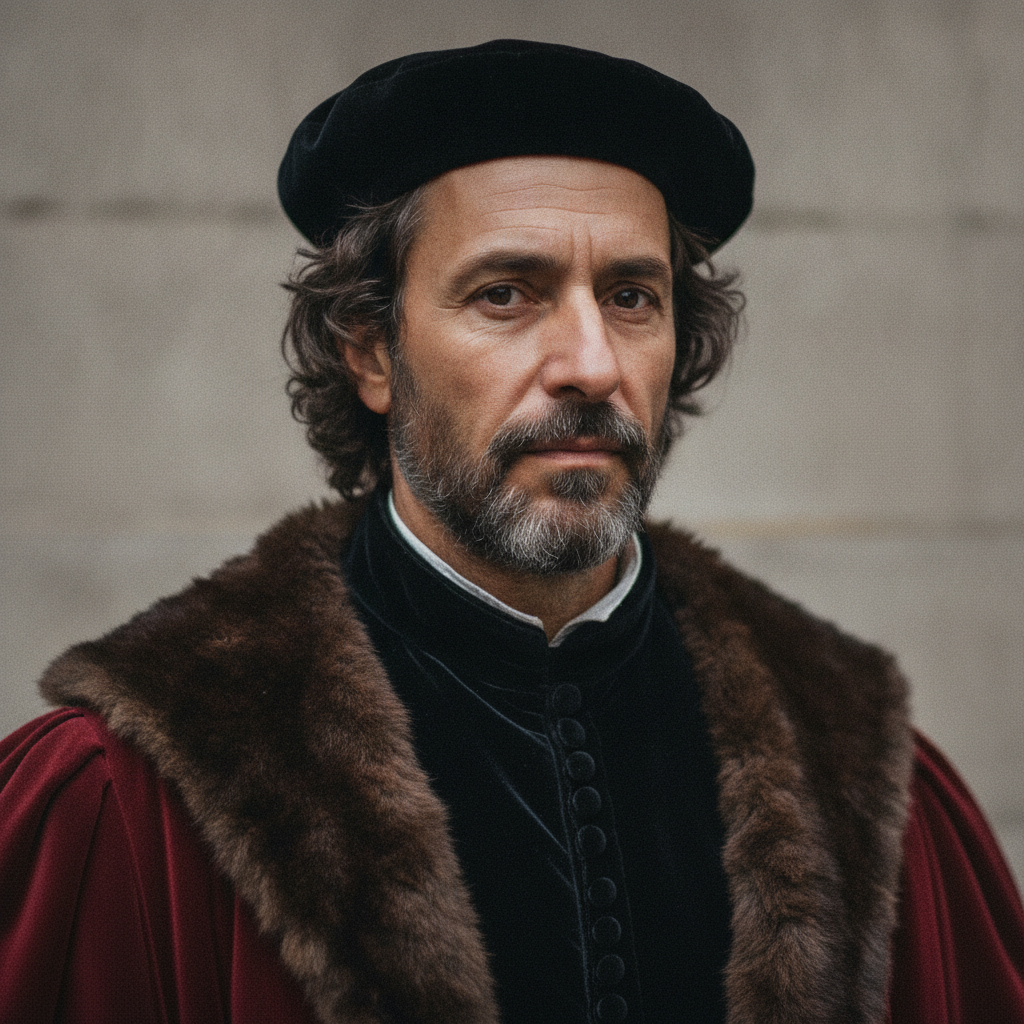
His face was probably long and lean rather than round, with a high forehead and a strong, slightly hooked (aquiline) nose that becomes the most striking feature in nearly every early likeness. Eyes were likely dark and set under pronounced brows; the overall expression is often described as severe, deliberate and reserved. Hair was likely dark—brown to black—and portraits and medals commonly show a modest, neat hairstyle that may have thinned or receded with age; later images and reconstructions suggest a modest hairline rather than a full mane. Facial hair in the period’s portraits is typically a short, trimmed beard and mustache rather than a heavy or bushy beard, giving a groomed, controlled look. Skin tone and texture reflect a Mediterranean mariner: an olive complexion, sun‑darkened and weathered by years at sea, with fine lines around the eyes and a hardened complexion from wind and salt. He is most often shown wearing plain, dark, high‑collared robes or a simple doublet and soft cap—functional, authoritative dress appropriate to a Genoese navigator serving the Spanish court.
Height / build
Likely slightly above average height · Likely slender to wiry
Hair
Likely dark to graying · Likely wavy · Likely slightly receding
Eyes
Likely dark (brown)
Complexion
Likely Mediterranean / olive-toned, weathered
Face
Likely long/oval face · Likely prominent / aquiline
Notable features
Prominent aquiline nose, high forehead, weathered skin, penetrating gaze
Grooming
Probably short, neatly trimmed beard and mustache · Likely kept tidy facial hair and short-to-medium hair appropriate to a respected mariner and court-facing commander.
Dress / presentation
Late 15th-century Genoese/Spanish elite civilian dress—dark doublet, fur- or velvet-lined cloak, and a flat cap or beret
height build
Height
Likely slightly above average height
Contemporary descriptions emphasize a commanding presence; above-average stature would be consistent with that impression.
height build
Build
Likely slender to wiry
A lifetime at sea and active command point to a lean, resilient body rather than heavy build.
eyes
Eye color
Likely dark (brown)
Genoese Mediterranean ancestry and descriptions in family accounts favor dark eyes.
hair
Hair color
Likely dark to graying
Most portraits show dark hair that lightens with age; textual references and later images indicate graying at the temples.
hair
Hair texture
Likely wavy
Portraits and Mediterranean regional traits commonly depict/describe slightly wavy hair.
hair
Hairline
Likely slightly receding
Later portraits and descriptions portray a higher forehead and thinning at the temples.
In late 15th-century Mediterranean culture, masculine authority for leaders came from age, dignity, and visible experience—sun-browned skin, a reserved demeanor, and modest, well-made clothing signaled a capable commander more than youthful beauty.
Columbus was Ligurian by birth: imagine regional Mediterranean traits—dark hair, brown eyes, and olive skin—tempered by a mariner’s life of wind and sun. That mix produced a blunt, weathered look that carried authority in both ports and royal courts.
Modern images often show an idealized young heroic figure or wildly romanticized beards; the historical Columbus was older, weathered, and less theatrical than many movie or textbook portraits.
Popular culture often shows Columbus as a young, heroic ideal or gives him an exaggerated, cinematic beard and heroic posture. The historical Columbus was typically older-looking—with gray at the temples, a smaller, neatly trimmed beard, and the plain but authoritative clothing of a court official and seaman.
Likely slightly above average height for his time, giving him a commanding presence.
Likely dark (brown).
Likely dark, with graying at the temples in later life.
Probably a short, neatly trimmed beard and mustache, as shown in most period portraits.
Commanding and dignified—his appearance emphasized authority and experience rather than youthful handsomeness.
By combining family descriptions, contemporary chroniclers, posthumous portraits and medals, plus forensic studies of attributed remains.
Historia del Almirante (Biography by Ferdinand Columbus)
Ferdinand Columbus · early 16th century (written c.1530s; published later)
Son’s biography and collected papers include family descriptions and influenced later portraits; provides personal context and some descriptive notes that inform facial and age impressions.
Letters and reports by contemporary chroniclers (Peter Martyr d'Anghiera, Bartolomé de las Casas)
Peter Martyr d'Anghiera; Bartolomé de las Casas · late 15th to early 16th century
Contemporary narrative sources that describe Columbus’s demeanor, age, and public presence—useful for reconstructing the social image and likely weathering from voyages.
Posthumous portraits traditionally identified as Columbus (Museo Naval, Madrid and others)
Various 16th–17th century artists (attributed works) · 16th–17th centuries
Multiple posthumous painted images share consistent facial motifs (long face, aquiline nose, trimmed beard) that helped form the modern image of Columbus.
Medals and engravings bearing Columbus’s likeness (16th–17th c.)
Various medallists and printmakers · 16th–17th centuries
Small-format portrait images (medals, engravings) circulated an authoritative profile—prominent nose, high forehead, trimmed beard—and reinforced a consistent visual type.
Forensic study of remains attributed to Columbus (Seville and Santo Domingo studies, early 2000s)
University and forensic teams (various) · 2003–2006 (and related analyses)
Human remains claimed to be Columbus’s were analyzed and compared; reconstructions provided a plausible facial form consistent with portrait tradition, though attribution debates continue.
Spanish court and Genoese portrait conventions
Art-historical surveys of late 15th-century portraiture · scholarly literature (20th–21st c.)
grooming
Facial hair
Probably a short trimmed beard and mustache
Most period portraits and medals depict him with modest facial hair consistent with late-15th-century elite male fashion.
skin
Complexion
Likely Mediterranean / olive-toned, weathered
Genoese origin implies olive skin; years exposed to sun and wind at sea would give a weathered, tanned look.
face
Nose and forehead
Prominent aquiline nose and high forehead
Consistent features across the portrait tradition and contemporary textual impressions emphasize a long face with a strong nose.
clothing
Typical dress
Late 15th-century Genoese/Spanish elite civilian dress (dark doublet, cloak, cap)
As an admiral operating at court, he’d wear dignified civilian attire of his rank rather than military armor in formal contexts.
comparison
Age appearance
Middle-aged, often appearing older than his years
Voyage stress, sun exposure, and contemporary depictions show a man in his 40s–50s with graying hair and weathered skin.
Contextual evidence about typical clothing, grooming, and pose for men of Columbus’s status that informs likely dress and grooming in portraits.