face
Face shape
Likely long to oval with a prominent chin
Coin portraits and several marble heads show an elongated face and pronounced chin taken as a consistent motif of her likeness.
Portrait reconstruction
69 BCE–30 BCE · Ptolemaic Egypt (Alexandria) · Hellenistic Egypt / Late Roman Republic
Cleopatra likely presented a striking, sculpted profile—prominent nose and chin, heavy-lidded eyes, and braided dark hair gathered under a diadem.
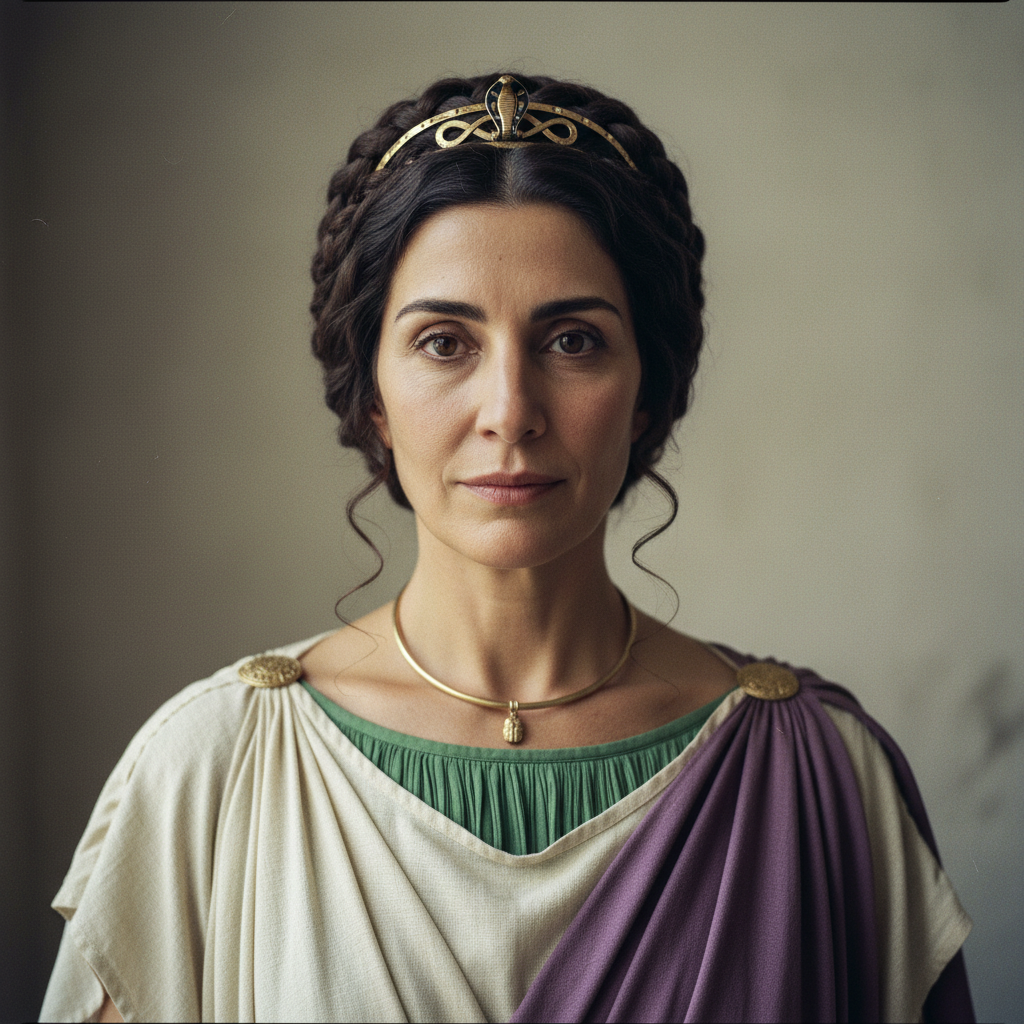
Her face: Cleopatra’s portraits show a long, narrow face with a strong, projecting nose and a definite chin — a sculpted, easily recognizable profile that became her visual signature. Heavy eyelids and a slightly full upper cheek give her a measured, authoritative expression rather than a soft, delicate countenance. Hair and headgear: She probably wore dark hair arranged in Greek-style braids and a low bun, often topped with a royal diadem and sometimes with Egyptian-style wig elements. Hairpieces and elaborate braiding were common among Hellenistic queens, so Cleopatra’s public images likely combined sleek, braided styling with visible royal ornamentation. Eyes, skin and adornment: Cleopatra would have emphasized her eyes with kohl and dark pigments, creating deep, outlined eyes that read powerfully in person and on coins and sculptures. Jewelry, richly patterned garments and ceremonial regalia — including elements that echoed Isis — completed a look designed to communicate status, command attention, and shape perception.
Height / build
Likely average height · Likely slender
Hair
Likely dark (brown to black) · Likely wavy to curly · Likely a normal to low hairline, usually concealed by braids, wigs, or royal headdress
Eyes
Likely dark (brown)
Complexion
Likely Mediterranean complexion
Face
Likely long to oval with a prominent chin · Likely straight to slightly aquiline (projecting bridge)
Notable features
Prominent nose and chin; heavy‑lidded, almond-shaped eyes in portraits; regal bearing and stylized hair/headdress.
Grooming
None · Regular use of cosmetics, kohl-lined eyes, elaborate braids or wigs, diadems and jewellery as royal insignia.
Dress / presentation
Hellenistic royal dress blended Greek and Egyptian elements: diadems, cloaks/togas for formal portraiture, and Egyptian-style kalasiris or nemes in some imagery.
face
Face shape
Likely long to oval with a prominent chin
Coin portraits and several marble heads show an elongated face and pronounced chin taken as a consistent motif of her likeness.
face
Nose
Likely straight to slightly aquiline
Silver and bronze coin profiles repeatedly depict a projecting nasal bridge and prominent nose shape.
eyes
Eyes
Likely dark brown, almond-shaped
Hellenistic portrait conventions and Egyptian-style eye makeup in surviving depictions suggest dark, emphasized eyes; Mediterranean populations typically had brown eyes.
hair
Hair color
Likely dark (brown to black)
Portraits and coin imagery show dark hair, and Macedonian-Greek elites in Egypt were typically dark-haired; depicted styles use braids or wigs.
hair
Hair style
Likely braided or wearing royal wig/diadem
Coins and sculptures frequently show her with a braided bun, diadem, or Egyptian-style headdress, consistent with royal iconography.
skin
Complexion
Hellenistic royal appearance valued recognizable insignia—diadems, stylized hairstyles, and a strong profile on coins—while Egyptian cult imagery added divine attributes (e.g., Isis associations). For a queen like Cleopatra, being visually legible as a monarch mattered more than conforming to a single beauty canon: regal symbols, deliberate coiffure, and striking facial features communicated power.
Cleopatra belonged to the Macedonian Greek Ptolemaic dynasty that had ruled Egypt for centuries but lived in a cosmopolitan Alexandria mixing Greeks, Egyptians, and other Mediterranean peoples. That context favors a Mediterranean appearance—dark hair, brown eyes, olive skin—while court fashion could add wigs, dyed hair, and Egyptian makeup to shape public presentation.
Modern films and adverts often render Cleopatra as very fair-haired, hyper-glamorous, or uniformly Egyptianized—whereas surviving portraits and coins present a darker-haired, strongly featured Hellenistic queen with deliberately stylized royal attributes.
Films and popular images often turn Cleopatra into a Hollywood brunette/ blonde hybrid with cinematic glamor or an exotically Egyptian stereotype; surviving coins and busts, by contrast, show a darker-haired, strongly featured Hellenistic queen whose visual power comes from presence and royal styling rather than contemporary film-style glamour.
Likely average height for a Mediterranean woman of her time.
Likely dark (brown), consistent with eastern Mediterranean populations and how her eyes are emphasized in portraits.
Likely dark (brown to black), often shown in braids or wearing a wig/diadem in portraits.
Probably considered striking and charismatic; ancient writers stress her personality and presence more than conventional beauty.
No—images and descriptions show her as a clean‑shaven woman who used hair styling and regalia to assert authority.
Yes—coins consistently show a recognizable profile (strong nose, chin, diadem) and several busts reflect similar motifs, making coins the principal visual anchor for her appearance.
Silver tetradrachm portraits of Cleopatra VII
Ptolemaic coinage (various museum collections) · c. 51–30 BC
Multiple silver and bronze coins struck in Cleopatra's name show a consistent profile: diademed head, braided hair/bun, pronounced nose and chin—key visual evidence for her facial features.
Marble head in the Vatican Museums (often associated with Cleopatra)
Musei Vaticani (Vatican) · late 1st century BC – 1st century AD (Roman-era portrait)
A Roman-era marble head long associated with Cleopatra shows heavy eyelids, a strong chin and stylized hair; scholars use it as a possible likeness though Roman idealization may be present.
Berlin portrait head (so-called 'Cleopatra' type)
Altes Museum / Staatliche Museen zu Berlin (attributed type) · 1st century BC – 1st century AD
Another Hellenistic/Roman portrait type with similar facial motifs—long face, prominent nose—that aligns with numismatic images attributed to Cleopatra.
Plutarch — Life of Antony
Plutarch · c. early 2nd century AD
Plutarch emphasizes Cleopatra's charm, voice and presence more than physical beauty, noting she could change her appearance and manner to suit the moment—suggesting charisma and deliberate presentation.
Cassius Dio — Roman History (on Cleopatra and Antony)
Cassius Dio · 3rd century AD (compilation)
Roman historians record Cleopatra's political theater and regalia; their narratives reinforce the image of a ruler deploying appearance and ceremony to project power.
Ptolemaic royal iconography and Hellenistic portrait conventions
Art-historical studies of Hellenistic Egypt · scholarly synthesis (modern)
Studies of royal imagery show how Greek and Egyptian elements combined in portraiture (diadems, Isis imagery, stylized hair), providing context for interpreting Cleopatra's depictions.
Likely Mediterranean (olive to light brown)
Dynastic Macedonian Greek ancestry combined with Alexandrian environment implies a Mediterranean skin tone typical of eastern Mediterranean elites.
height build
Height
Likely average height
No direct measurement exists; elite Mediterranean women of the period typically fell near average regional heights.
height build
Build
Likely slender
Court life, portrait conventions, and elite nutrition suggest a well‑nourished but comparatively slender figure in statuary and coin iconography.
grooming
Makeup and grooming
Probably used kohl, perfumed oils, and cosmetics
Egyptian and Hellenistic elite cosmetic practices and portraits showing kohl-lined eyes indicate routine use of eye makeup and perfuming rituals.
clothing
Dress
Hellenistic royal dress with Egyptian regal elements
Official images mix Greek diadems and Hellenistic styles with Egyptian symbols (e.g., Isis associations) to communicate dual legitimacy.
other
Overall presence
Commanding and charismatic rather than conventionally ‘perfect’
Literary sources emphasize charm and presence; portraits accentuate features suggesting personality and authority over idealized beauty.