height build
Height
Likely average for his time
Regional osteological and demographic studies indicate male heights in ancient northern China clustered in the mid‑160s cm; nothing suggests Confucius was unusually tall.
Portrait reconstruction
551 BCE–479 BCE · State of Lu (modern Shandong, China) · Spring and Autumn period (Zhou dynasty)
Confucius most likely had dark hair, a calm scholarly face, and—particularly in later life—a long beard, wearing ritual robes and a tall scholar’s cap.
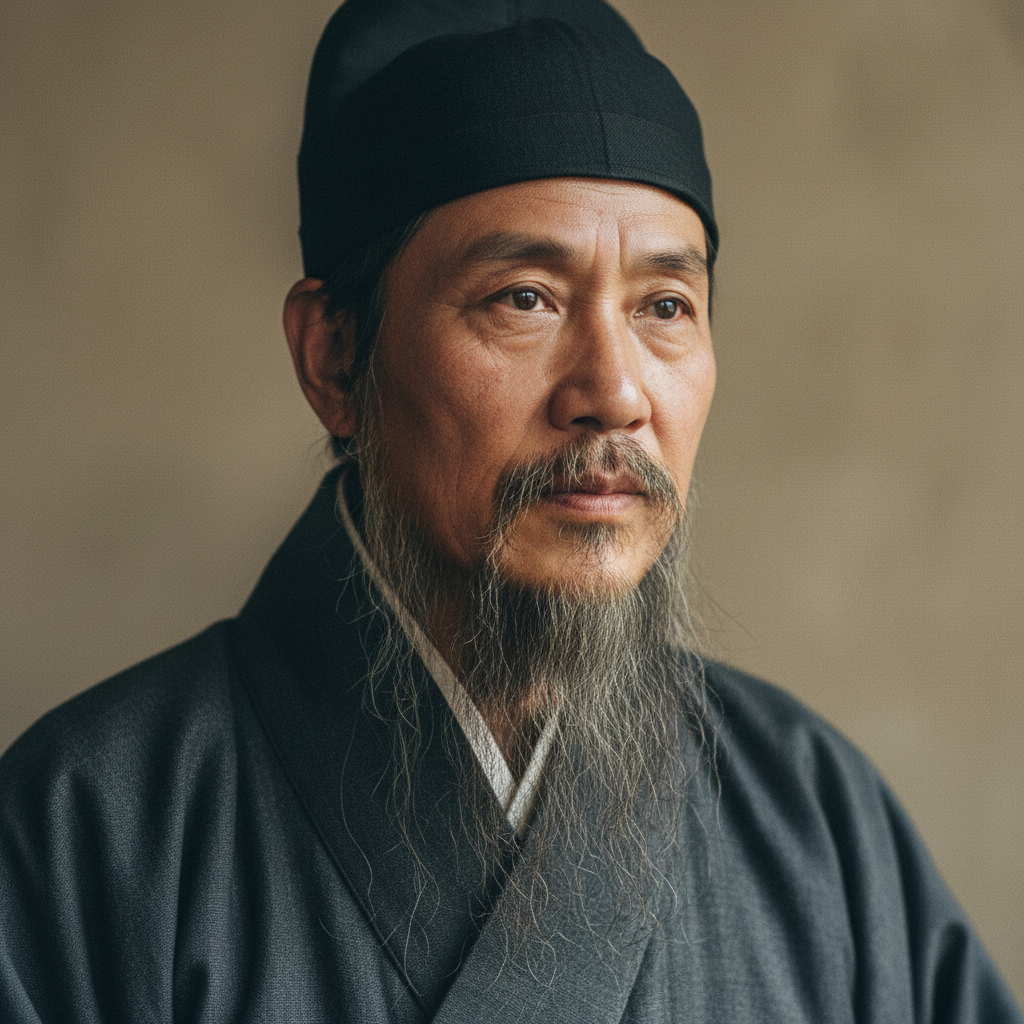
Hair and face: He most likely had dark, straight hair worn long and bound—often gathered up under a cap—typical of men of his era. His eyes were probably dark brown and almond‑shaped; his face would read as composed and measured rather than flamboyant, with a relatively high forehead and an honest, plain dignity. Facial hair and grooming: As an elder and ritual authority he probably wore a full beard: long, neatly kept, and a mark of seniority and respect. Grooming would have been careful and deliberate—hair tied, beard brushed, and an overall tidy, ritual-appropriate appearance. Build and dress: He was likely of moderate height and a sturdy, lean build for a northern Chinese man of the Spring and Autumn period. Clothing would have been layered ritual robes with wide sleeves and a tall guan (scholar’s cap), in restrained colors and elegant, formal lines that emphasized propriety and status rather than ornament.
Height / build
Likely average for his time · Likely slender or lean
Hair
Likely dark to graying with age · Likely straight · Likely moderate to receding with age; hair arranged in a topknot
Eyes
Likely dark (brown/black)
Complexion
Likely medium East Asian complexion
Face
Likely oval to long · Likely straight, medium in proportion
Notable features
Long, well‑kept beard; composed, authoritative expression; scholar’s cap and layered ritual robes.
Grooming
Probably a full long beard and mustache (well kept) · Neat, deliberate grooming: hair tied up and covered by a scholar’s cap (guan), beard combed—reflecting ritual propriety.
Dress / presentation
Ritual scholar‑official robes of the Zhou tradition (long, layered robes with a cap/guan)
height build
Height
Likely average for his time
Regional osteological and demographic studies indicate male heights in ancient northern China clustered in the mid‑160s cm; nothing suggests Confucius was unusually tall.
height build
Build
Likely slender/lean
As a lifelong scholar, administrator, and teacher rather than a manual‑laborer or soldier, he likely had a leaner physique typical of literati.
hair
Hair color
Likely dark to graying
East Asian populations in Shandong typically have dark hair; portraits and later iconography show Confucius with dark hair that greys with age.
hair
Hair style
Topknot with a scholar’s cap (guan)
Zhou ritual dress and later portrait tradition show scholars wearing hair tied up and covered by a formal cap.
other
Beard
Probably long and well‑kept
Confucius is consistently depicted in later portraits and statuary with a long beard, reflecting elite male fashion and the association of beards with wisdom.
eyes
Eye color
In Confucius’s world, outward appearance signaled moral order: neat hair, a trimmed beard, proper robes, and a composed bearing signaled ritual correctness and inner virtue. Physical modesty and dignified restraint mattered more than youthful prettiness or military display.
Confucius came from Lu (modern Shandong) in northern China; the regional population historically had dark hair and eyes and moderate heights by global standards. Picture him as a typical northern Chinese literatus of his era rather than an exotic caricature.
Modern images often orientalize or idealize Confucius (extremely long flowing hair, hyper‑exaggerated beard, or anachronistic costumes); the historically likely look is simpler and more restrained.
Modern paintings and films tend to romanticize Confucius—giving him ultra‑long, flowing white hair, exaggeratedly mystical features, or lavish imperial robes. Historically he would have appeared far more restrained, with ritual scholar’s dress and a practical topknot under a cap.
Likely average for his time—there’s no indication he was notably tall.
Likely dark (brown/black), typical of northern Chinese populations.
Likely dark that grayed with age; hair worn straight, tied in a topknot and covered by a scholar’s cap.
Probably—a long, well‑kept beard and mustache are standard in the portrait tradition and fit elite male grooming of his class.
He would have been seen as commanding and venerable—respected for dignity and propriety more than for conventional handsomeness.
Our image comes from later ritual portraits, ancient texts describing comportment and dress, and regional population context—not from contemporary photographs or masks.
Analects (Lunyu)
Analects (compiled sayings and stories attributed to Confucius and his disciples) · 5th–3rd century BCE (compiled)
Contains anecdotes about Confucius’s comportment, grooming, and ritual behavior that inform how he presented himself (emphasis on propriety and ritual dress), though it gives no modern physical measurements.
Records of the Grand Historian (Shiji) — Sima Qian
Shiji (Records of the Grand Historian) · c. 94 BCE
Provides an early biographical account of Confucius and helped shape later portrayals; emphasizes his moral stature and social role, which influenced later visual conventions.
Song dynasty ritual portraits of Confucius (canonical image)
Song dynasty portrait tradition / Palace Museum copies · Song dynasty (960–1279 CE) tradition; surviving copies later
Song court established a relatively standardized portrait type of Confucius—long beard, high forehead, scholarly robes—that became the template for later temple images and statuary.
Ming–Qing ritual statues and temple portraits
Ming and Qing dynasty temple iconography · 14th–20th centuries
Longstanding ritual images and statues perpetuate the standardized scholar‑sage look: beard, robes, and cap; useful for costume and grooming details though produced centuries later.
Regional anthropological and osteological studies
Archaeological height and population studies (northern China) · 20th–21st century research summaries
Provide population context for average male stature and build in northern China during the Zhou and later periods, supporting height/build estimates.
Palace Museum attributed portrait (canonical Confucius image)
Palace Museum (Beijing) — traditional portrait · attributed as copy of earlier portraits; present copy dated later
Likely dark (brown/black)
Typical eye color for Han Chinese populations; no sources suggest otherwise.
skin
Complexion
Likely medium East Asian complexion
Regional climate, lifestyle, and ancestry in Shandong point to a warm, yellow‑brown East Asian skin tone.
face
Face shape & expression
Likely oval to long face with composed, serious expression
Later canonical portraits present him with an elongated face and a calm, austere demeanor consistent with his role as teacher and moral exemplar.
clothing
Clothing
Ritual scholar‑official robes of the Zhou tradition
As a teacher and minor official, Confucius would wear layered ritual robes and a cap appropriate to his social role; this is how later ritual portraits depict him.
grooming
Grooming & presentation
Neat, ritualized grooming emphasizing propriety
Confucian ethics emphasize ritual correctness; portraits and textual context show a carefully maintained, modest appearance.
cultural
Public presence
Commanding and venerable rather than physically intimidating
His authority came from learning and moral stature; portrayals stress dignity and calm authority over martial or muscular display.
A widely reproduced portrait used in temple rites and education that shows the long beard, scholar's cap, and ritual robe associated with Confucius’s image.