height build
Height
Likely tall for his time
Elite leaders who engaged in hunting and warfare are typically described as imposing; Achaemenid reliefs portray kings as larger-than-average figures.
Portrait reconstruction
600 BCE–530 BCE · Persia (modern Iran) · Achaemenid Persia, 6th century BCE
Cyrus the Great likely wore dark wavy hair, a full curled beard, and the embroidered robes and rounded cap of an Achaemenid king.
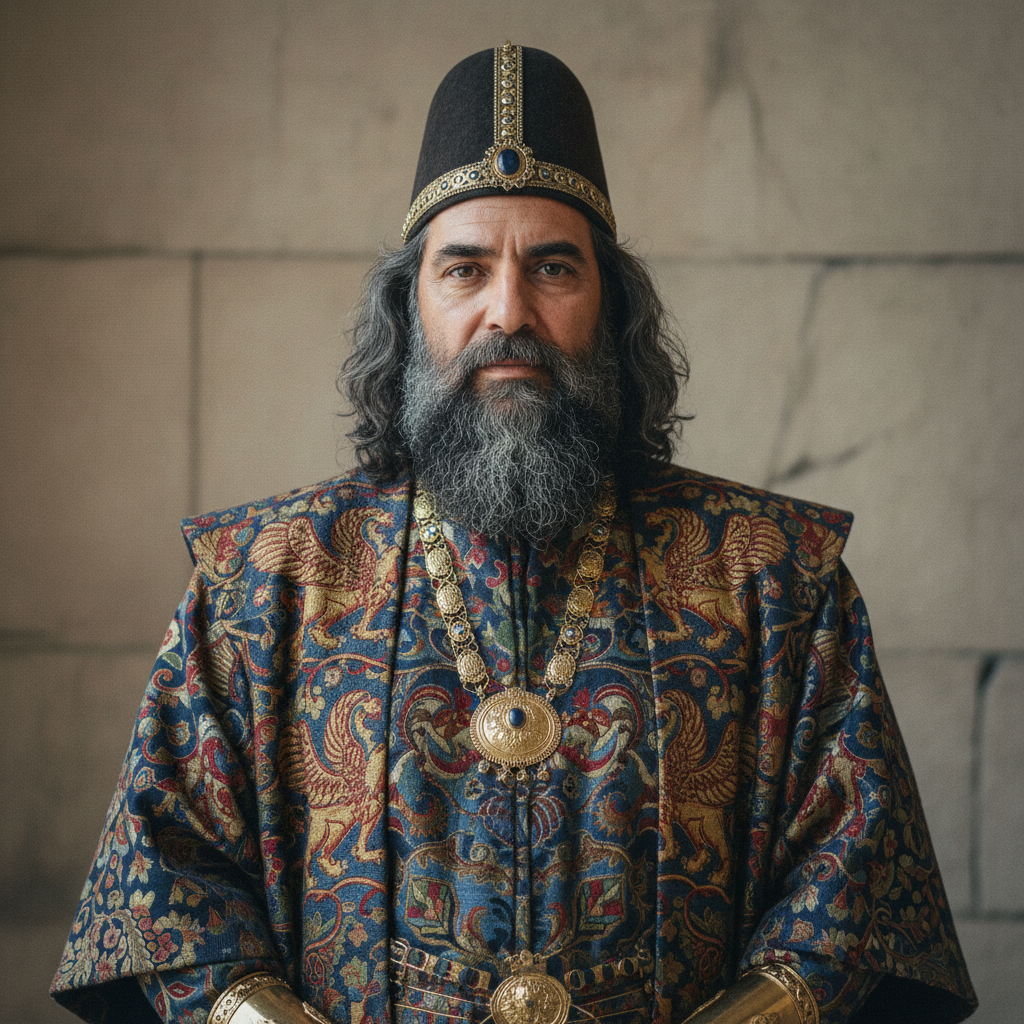
Face and complexion: Imagine a strong, broad face with a medium-olive complexion common on the Iranian plateau—warm-toned skin, defined cheekbones, and a straight, prominent nose that gives a composed, statuesque profile. Hair and beard: He likely had dark, wavy hair kept at collar length and a full, carefully arranged beard made of distinct curls; the beard would have been a clear mark of elite status, trimmed into regular ringlets rather than wild facial hair. A connected moustache blended into the beard, framing a steady mouth. Eyes, bearing and dress: Expect deep, dark eyes under a pronounced brow and a compact, muscular neck; he would typically be shown wearing ankle-length, patterned robes with a fitted belt, a richly embroidered cloak or shoulder sash, and a soft rounded cap or tiara—finely worked textiles and subtle jewelry completing the royal look.
Height / build
Likely tall for his time · Likely medium-to-robust build
Hair
Likely dark to graying · Likely wavy · Likely full (styled, not receding)
Eyes
Likely dark
Complexion
Likely Mediterranean to Middle Eastern complexion
Face
Likely oval to long face · Likely straight to slightly aquiline (prominent bridge)
Notable features
Full curled beard, wavy dark hair, aquiline nose, regal posture and richly patterned royal garments
Grooming
Likely full, carefully groomed and curled beard · Beard and hair would be styled and maintained, with curled locks and patterned trimming typical of Achaemenid royal iconography.
Dress / presentation
Royal Achaemenid dress: long patterned robe or coat, trousers, jewelry, and a Persian conical cap or diadem
height build
Height
Likely tall for his time
Elite leaders who engaged in hunting and warfare are typically described as imposing; Achaemenid reliefs portray kings as larger-than-average figures.
other
Build
Likely medium-to-robust
Royal duties, hunting and military command point to a solid, fit physique rather than a lean or frail build.
hair
Hair color
Likely dark to graying
Iranian plateau populations and Achaemenid depictions show dark hair; mature rulers are often shown with hints of gray in later life.
hair
Hair texture and style
Likely wavy, shoulder-length and styled
Achaemenid royal iconography shows layered wavy locks arranged at shoulder length and carefully combed.
other
Beard
Likely full, curled and carefully groomed
Persian royal images regularly show full, stylized beards as a status marker.
face
Nose
Likely straight to slightly aquiline
Achaemenid royalty prized visible markers of dignity: full, carefully curled beards, layered wavy hair, richly patterned robes and ornate jewelry. These features signaled authority, maturity and legitimacy; kings were meant to look both approachable in ritual and superior in status.
Cyrus came from the Iranian plateau and had close Median connections; imagine a West Asian elite appearance—olive to medium brown skin, dark eyes and hair, with cultural clothing different from Greek or Egyptian styles.
Modern art often westernizes his face or strips the beard and Persian dress; accurate portrayals should show Achaemenid beard styles, patterned robes and Persian headgear.
Modern film and painting often give Cyrus either a clean-shaven, Greco-Roman look or an anachronistic European face; accurate images should show an Achaemenid beard, Persian robes, and headgear rather than a Roman toga or bare face.
Likely tall for his time—portrayals and textual traditions present him as an imposing figure.
Likely dark.
Likely dark, wavy and shoulder-length, possibly showing gray in later life.
Probably a full, carefully curled and groomed beard typical of Persian kings.
Royal Achaemenid robes with patterned borders, trousers, jewelry and a Persian cap or diadem.
Many images reflect Achaemenid royal style; none can be proven as a contemporary, exact likeness of Cyrus, but they strongly indicate his likely look.
Achaemenid royal reliefs (Persepolis)
Persepolis reliefs and stairway carvings · ca. 5th century BCE (depicting earlier Achaemenid royal types)
Stylized images of Persian kings and nobles show wavy hair, full curled beards, long patterned robes and distinct Persian headgear; these form the visual vocabulary for Achaemenid royalty.
Cyrus Cylinder (Babylonian clay cylinder)
Cyrus Cylinder (British Museum) · 539 BCE (text)
An official proclamation of Cyrus as king preserved in Babylonian script; it confirms his historic kingship and cultural-political role though it contains no physical description.
Achaemenid cylinder seals and glyptics
Various Achaemenid seals · 6th–5th century BCE
Small-scale depictions used by elites showing dress, hair and beard styles consistent with royal iconography—useful for reconstructing typical Persian elite appearance.
Herodotus, Histories
Herodotus · 5th century BCE
Provides narrative portraits and anecdotes about Cyrus’s character and presence, describing him as a powerful and impressive leader; not a visual portrait, but influential on later images.
Xenophon, Cyropaedia
Xenophon · 4th century BCE
An idealized biographical novel portraying Cyrus as handsome, noble, and physically capable; heavily literary but important for later visual tradition.
Pasargadae architecture and tomb (attributed context)
Pasargadae (archaeological site) · 6th century BCE
The tomb believed to be Cyrus’s and surrounding monuments set the royal setting and material culture—useful for clothing and status reconstruction rather than facial specifics.
Many West Asian royal portraits and classical descriptions emphasize a prominent nose on Persian nobles and kings.
eyes
Eye color
Likely dark
Populations of the Iranian plateau overwhelmingly display dark eyes; classical sources do not single out light eyes for Cyrus.
skin
Complexion
Likely Mediterranean to Middle Eastern complexion
Regional ancestry and Achaemenid artwork point to olive-to-medium brown skin tones for Persian elites.
clothing
Clothing style
Royal Achaemenid robes, trousers, jewelry, and cap/tiara
Relief and seal imagery consistently show kings in long patterned garments, trousers and distinct Persian headgear.
grooming
Grooming
Careful and symbolic grooming (beard curls, hair locks)
Achaemenid visual language treated hair and beard styling as markers of rank and dignity.
cultural
Public bearing
Commanding and dignified
Ancient authors and royal art present Cyrus as a dignified, kingly presence rather than an obscure or humble figure.
comparison
How he compared to contemporaries
More richly dressed and bearded than most commoners, similar in style to other Achaemenid rulers
Royal costume and iconography uniformly distinguish kings from their subjects and satraps in reliefs and seals.
Classical and medieval portraits of Cyrus
Greek and later depictions · 4th century BCE onward
Later artworks and coinage often adapt Greek aesthetic norms to Persian subjects and influenced modern concepts of Cyrus, sometimes distorting authentic Persian features.