height build
Height
Likely average height for her society
No textual claim of unusual stature; average stature fits archaeological data for ancient Levantine women.
Portrait reconstruction
0–0 · Ancient Israel (Canaan) · Late Bronze / Early Iron Age (traditionally placed ~12th century BCE)
Deborah likely looked like a mature Israelite woman with dark hair, brown eyes, olive skin, and practical, modest clothing that conveyed authority.
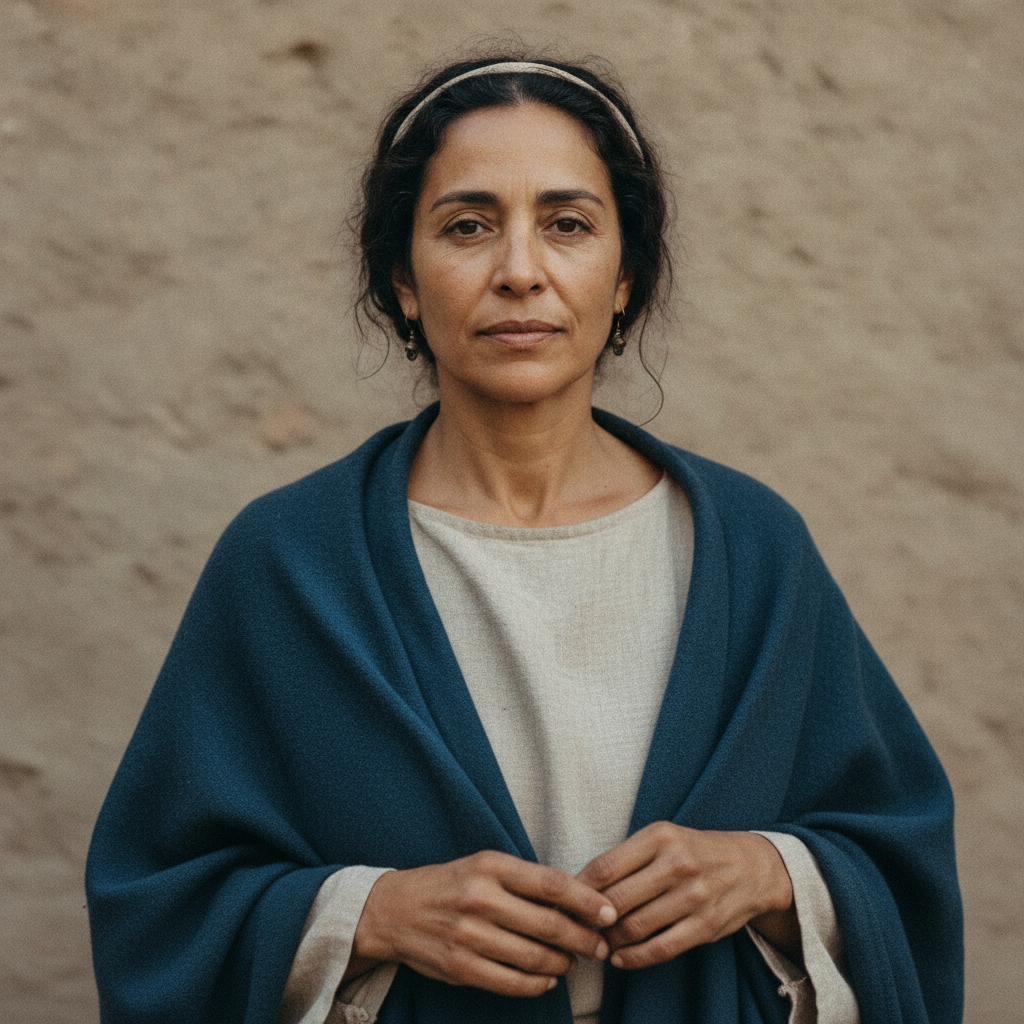
Face and hair: imagine a strong, weathered face shaped by sun and work—olive-toned skin, dark brown eyes, and high cheekbones. Her hair would most likely have been dark and long, worn braided or coiled and bound with a linen band or simple fillet; in public settings it may have been partially covered. Clothing and adornment: she would have worn an ankle‑length wool or linen tunic with a wrapped mantle (shawl) pinned or belted at the shoulder, and simple leather sandals. Colors were earthy—ochres, muted reds and blues—and ornament was modest: bronze or faience beads, simple earrings or a pendant, and a practical belt or fibula to fasten garments. Build, age, and bearing: portrayed as a mature leader, Deborah’s build would be sturdy and purposeful from travel and public duties; her hands and stance would show work and authority rather than ornament. Lines at the eyes and mouth and a steady, commanding gaze would mark her as someone accustomed to speaking and making decisions.
Height / build
Likely average height for her society · Likely average to sturdy build
Hair
Likely dark (brown to black) · Likely wavy to curly · Likely mature/normal hairline (possible graying at temples)
Eyes
Likely dark (brown)
Complexion
Likely olive to medium brown
Face
Likely oval · Likely straight to gently aquiline
Notable features
Commanding eyes and expression, lines of age/experience, practical hairstyle and the authoritative bearing of a community leader.
Grooming
Unlikely (typical for women) · Likely kept long hair arranged in braids or tied up for practicality; wore a head covering or mantle in public.
Dress / presentation
Ankle‑length linen/wool tunic (kethoneth) with a mantle (simlah); simple sandals; modest jewelry possible but not ostentatious.
height build
Height
Likely average height for her society
No textual claim of unusual stature; average stature fits archaeological data for ancient Levantine women.
height build
Build
Likely average to sturdy build
Active public role and daily life tasks imply a capable, practical physique rather than frailty.
eyes
Eye color
Likely dark (brown)
Population context: ancient Levantines overwhelmingly had brown eyes.
hair
Hair color
Likely dark (brown to black)
Regional population traits and common ancient Near Eastern depictions show dark hair as predominant.
hair
Hair texture & style
Likely wavy to curly; long and worn braided or pinned
Artistic evidence and cultural norms show women wearing long hair arranged for practicality; prophetic/leadership role would favor neat, modest styles.
skin
Complexion
Likely olive to medium brown
In ancient Israel, modesty, dignity, and visible signs of social role mattered more than youth or ornament. A judge or prophetess would emphasize sober, respectable dress and an unassuming yet authoritative posture—the look of someone used to public speech and decision‑making.
Deborah would resemble other local women: Mediterranean skin, dark hair and eyes, and clothing made from linen or wool. Think of a seasoned community figure rather than an imperial courtier—her look rooted in village or tribal life across Canaan.
Modern portrayals often recast Deborah as a medieval European queen or a fantasy blonde warrior; historically she would have looked like a local Levantine woman in practical ancestral dress.
Popular art often recasts Deborah as a European‑style queen in armor or a blonde Hollywood warrior. Historically she would not be armored in a medieval sense nor styled with Northern European features—her appearance and dress were local and practical.
Likely average height for her society.
Likely dark (brown).
Likely dark (brown to black), wavy to curly, kept long and braided or pinned up—often covered with a mantle in public.
Commanding and respected—her authority and gravitas were the defining traits, not conventional beauty.
Unlikely—female grooming norms did not include facial hair.
No—those are modern inventions; historically she would have been a local Levantine woman in practical attire, not a medieval European‑style armored queen.
Hebrew Bible — Judges 4–5 (Deborah narrative and Song)
Hebrew Bible (Judges 4–5) · traditionally 12th–11th century BCE (textual composition later)
Primary literary source describing Deborah as a prophetess and judge who 'judged Israel' beneath a palm tree and who led or inspired military action; presents her public leadership and mature social role.
Later Jewish tradition (Midrash, Talmudic references)
Midrashim and rabbinic writings · medieval (compiled earlier into oral traditions)
Later Jewish commentaries expand on Deborah’s role and character, often emphasizing her wisdom and maternal status in Israel; useful for how tradition pictured her socially.
Archaeological studies of Israelite dress and textiles
Scholarly syntheses on ancient Near Eastern clothing · 20th–21st century
Reconstruction of typical female garments (ankle‑length tunics, mantles, simple sandals) used for informed estimates of Deborah's clothing and public appearance.
Ancient Near Eastern female figurines and reliefs
Museum collections and archaeological reports · 2nd–1st millennium BCE (various)
Small-scale figurines and reliefs show common female hairstyles, long garments, and modest dress in the region, supporting reconstructions of Deborah’s likely hair and clothing style.
Population/anthropological studies of ancient Canaan/Israel
Archaeogenetic and osteological syntheses · late 20th–21st century
Regional population data indicate Mediterranean/near‑eastern features—dark hair, brown eyes, olive skin—forming the baseline phenotype for reconstructions.
Medieval and modern artistic depictions of Deborah
European paintings, prints, and modern art · medieval–modern
Typical Levantine pigmentation and sun exposure in Canaan produce an olive complexion.
grooming
Facial hair
Unlikely
Female grooming norms in the ancient Near East do not include facial hair; Deborah described and portrayed as a woman in all surviving texts.
clothing
Clothing
Ankle‑length tunic and mantle (kethoneth and simlah), sandals
Archaeological garments and textual references indicate women wore long tunics and a mantle; public figures dressed modestly and practically.
face
Face shape & nose
Likely oval face with a straight to gently aquiline nose
Common Levantine facial morphology; later Jewish tradition and regional iconography support these features as typical.
cultural
Presentation
Commanding and dignified, projecting authority
Biblical text repeatedly frames Deborah as a judge and prophetess who held court and issued rulings, implying an authoritative bearing.
other
Age indicators
Likely signs of maturity (lines, graying at temples possible)
Deborah is portrayed as an established leader and ’mother in Israel,’ language that implies maturity and experience.
These images reflect later cultural assumptions (European fashions, armor, and ideals) and are helpful to study how interpretation changed rather than as direct evidence of her looks.