height build
Height
Likely average to slightly tall for his time
Medieval sources stress his commanding presence as a mounted warrior; nobles who fought on horseback were often at least average height and robust.
Portrait reconstruction
1043–1099 · Castile (northern Iberia) · High Middle Ages (11th century)
El Cid likely looked like a sun‑browned, wiry Castilian knight with dark hair, a short beard, and practical mail and helmet.
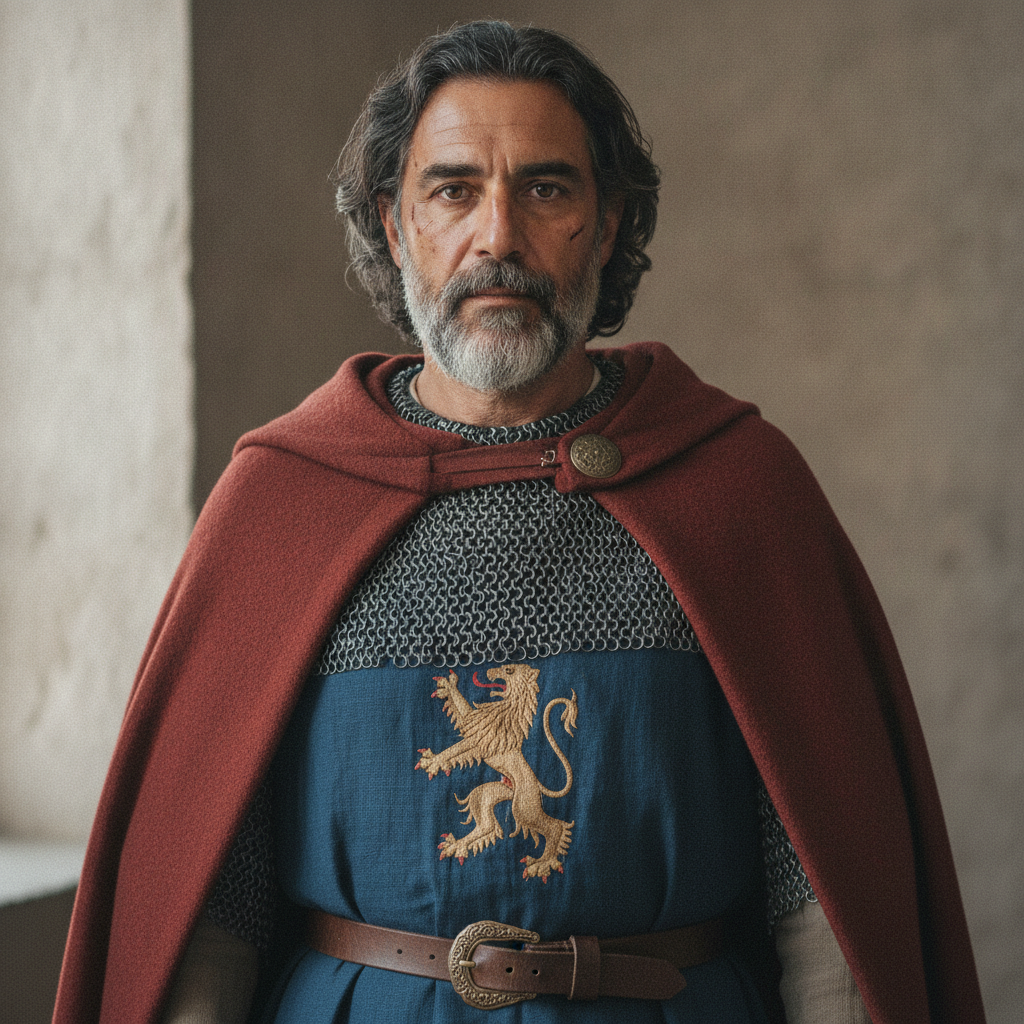
Physique: Hardened by years on horseback and in battle, he would have been lean and muscular rather than bulky—broad‑shouldered, with a compact, athletic frame adapted to mounted combat. His posture would read as alert and purposeful: a working warrior’s build more than a courtly ornament. Face and hair: He most likely had dark hair and brown eyes, a strong jaw and a prominent nose—features common in northern Iberia. Facial hair was customary for men of his rank, so a short, trimmed beard or moustache is the best visual guess; not long flowing locks but hair kept at short to medium length for practicality. Skin, marks and dress: Repeated campaigns under the sun would give him a weathered, ruddy‑olive complexion with visible lines and likely a few battle scars. On campaign he’d wear a mail hauberk and conical helmet with a nasal guard, a sturdy sword at his hip on a decorated belt, a round or kite shield, leather boots and a simple cloak fastened with a brooch—functional gear with modest status touches rather than ornate parade armor.
Height / build
Likely average to slightly tall for his time · Likely lean and muscular
Hair
Likely dark, dark to graying in later life · Likely wavy to straight · Likely slightly receding with age
Eyes
Likely dark (brown)
Complexion
Likely Mediterranean/olive-tanned from sun exposure
Face
Likely angular to oval — strong jawline associated with warrior portraits · Likely straight to slightly aquiline
Notable features
Commanding, weathered face; possible scars from battle; graying hair in later years
Grooming
Probably moustache with short/trimmed beard or stubble (especially later in life) · Noble martial grooming: functional and neat — trimmed facial hair, shoulder‑length or shorter hair, not elaborate.
Dress / presentation
Knightly noble dress: mail hauberk and surcoat in battle; embroidered tunics, cloaks and belts as a noble off the field
height build
Height
Likely average to slightly tall for his time
Medieval sources stress his commanding presence as a mounted warrior; nobles who fought on horseback were often at least average height and robust.
other
Build
Likely lean and muscular
A lifetime of riding and campaigning implies an athletic, durable frame rather than heavy or obese build.
hair
Hair color
Likely dark, dark to graying in later life
Regional population norms plus later images and textual references portray him as dark‑haired, often shown with graying hair in later life.
hair
Hair texture
Likely wavy to straight
Northern Iberian men of the period most commonly had straight to wavy hair; surviving medieval depictions show this texture.
hair
Hairline
Likely slightly receding with age
Later visual and literary traditions portray him as graying and mature; receding hairlines commonly appear in medieval effigies and portraits of elderly warriors.
eyes
Eye color
11th‑century Castilian culture prized martial fitness, visible rank, and a serious, authoritative demeanor in male leaders. Jewelry or a richly trimmed cloak signaled noble status, but practical military grooming and the scars of campaigns conveyed prestige as much as ornament.
Born in and tied to northern Castile, El Cid belonged to a population blending local Iberian and Visigothic lineages with regional variation; physically this typically meant dark hair and eyes, olive‑to‑light brown skin, and a Mediterranean build — not the northern European fair‑haired stereotype.
Modern films and paintings often romanticize him as either a clean‑shaven heroic ideal or an anachronistic flamboyant knight; historically he would have been more rugged, practical, and Mediterranean in look.
Cinema and Romantic painting often turn El Cid into anachronistic fantasy: spotless, overly stylized armor, or a generic 'clean‑cut hero.' Historically, he would have been more weathered, practical, Mediterranean in appearance, and marked by campaign life rather than polished glamor.
Likely average to slightly tall for his time — imposing enough as a mounted commander to stand out.
Likely dark (brown).
Likely dark, turning dark‑gray in later life.
Probably — most depictions show a moustache with short or trimmed beard or stubble.
A mail hauberk over a padded garment, a surcoat, shield and sword — typical 11th‑century knightly kit.
By combining near‑contemporary texts, medieval effigies and regional population context to give a most‑likely, not certain, image.
Historia Roderici (Historia Roderici de Vivar)
Historia Roderici · 12th century
A near‑contemporary Latin prose biography describing Rodrigo’s career and emphasizing his martial prowess and leadership; gives contextual cues about stature, bearing and status though not a full physical inventory.
Poema de mio Cid (The Song of my Cid)
Poema de mio Cid · late 12th–13th century (earliest manuscripts from later centuries)
Epic poem that shaped El Cid’s public image: emphasizes his honor, noble bearing, and battlefield reputation; includes incidental physical details used by later artists.
Tomb effigies of El Cid and Doña Jimena
Burgos Cathedral (medieval effigies, 14th century) · 14th century (effigies)
Medieval recumbent effigies showing contemporary medieval visual conventions: bearded/moustached male, crowned/armed kingly presentation; useful for how medieval artisans imagined him though created centuries after his death.
Medieval manuscript illuminations and later medieval portraits
Various medieval chronicles and manuscript illustrations · 13th–15th centuries
Illuminations and copies render El Cid with warrior attributes: mail, sword, sometimes dark hair and facial hair; these reflect evolving iconography rather than contemporary likenesses.
Romantic‑era paintings and statues
19th‑century historical art (e.g., Pradilla and others) · 19th century
Romantic artists reinterpreted El Cid as a national heroic figure; their depictions show idealized features and ornate armor that reflect 19th‑century tastes more than 11th‑century reality.
Population and costume studies for 11th‑century northern Iberia
Archaeological and anthropological syntheses · 20th–21st century studies
Likely dark (brown)
Dark eyes are typical of northern Iberian populations and are the likeliest estimate absent direct evidence.
skin
Complexion
Likely Mediterranean/olive-tanned
Northern Iberian medieval populations and the outdoor life of a soldier produce olive to tanned skin tones in contemporary descriptions/depictions.
grooming
Facial hair
Probably moustache with short/trimmed beard or stubble
Medieval warrior grooming and later artistic depictions commonly show El Cid with facial hair; contemporary knightly practice favored functional, trimmed facial hair.
clothing
Battle dress
Mail hauberk, padded gambeson, surcoat, shield and sword
11th‑century Castilian knights fought in mail and carried swords and shields; chroniclers and effigies associate El Cid with knightly accoutrements.
clothing
Civil/ceremonial dress
Embroidered tunics or cloaks with noble trim
As a high‑status noble, off‑field dress would include fine tunics, cloaks and belts signifying rank in medieval Castile.
face
Notable marks
Likely weathered, possibly scarred from combat
A lifetime of campaigns and chronicled battles makes weathering and battle scars plausible; many medieval depictions emphasize a rugged visage.
cultural
Presence
Commanding, martial bearing
Contemporary and near‑contemporary texts emphasise authority, leadership and a commanding presence — the primary visual takeaway.
Provide baseline expectations for likely hair, eye color, complexion, and clothing/armor types for a Castilian nobleman of the period.