height build
Height
Likely average to slightly tall
Noble nutrition and lifestyle usually produced women of average or a bit above average height for the period; no direct measurement survives.
Portrait reconstruction
1122–1204 · Aquitaine (southwestern France); later England and Normandy · High Middle Ages
Eleanor of Aquitaine most likely wore dark hair braided and coiled beneath a veil and circlet, with an oval face, dignified bearing and elegant, richly worked court dress.
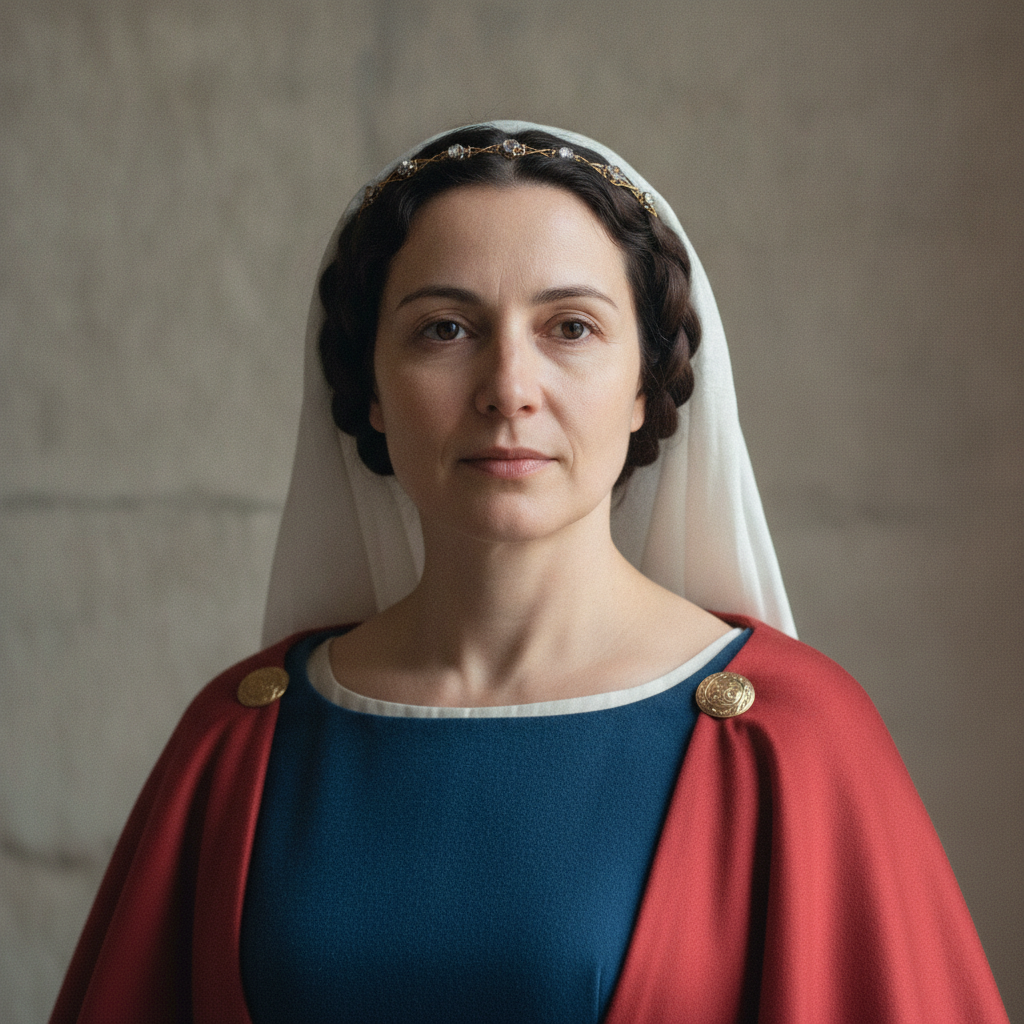
Her face: The Fontevraud effigy presents an oval, composed face—neither exaggeratedly young nor fragile but bearing the calm dignity of a powerful noblewoman; court texts praise her striking presence and refined looks. Facial features are best imagined as classically noble rather than exotic: an even complexion tended by elite beauty routines, clear skin, and a poised expression rather than theatrical glamour. Her hair and headwear: Contemporary seals and manuscripts show her wearing hair arranged in braids or coils, largely covered by a veil and secured with a fillet or narrow circlet; later memorial sculpture emphasizes this hairstyle. Think dark, glossy hair gathered into elegant plaits at the back or sides, largely hidden beneath fine linen veils and a jeweled band or crown when she sat in state. Clothing and jewelry: Eleanor’s public dress was richly tailored and highly structured—layered tunics and mantles of silk or brocade, long fitted sleeves, embroidered hems, and tasteful jeweled pins or brooches. When presented as duchess or queen she appears crowned or with a circlet, wearing garments that signal rank more than flamboyant sensuality: sumptuous, tasteful, and made to command respect. Presence and bearing: Beyond specific features, the strongest element of her appearance was her bearing—confident, courtly and charismatic. Troubadours and chroniclers celebrated her magnetism; imagine a woman who used posture, gesture and dress to project authority and cultural leadership as clearly as any crown or jewel.
Height / build
Likely average to slightly tall · Likely slender, fit
Hair
Likely dark (brown to dark brown) · Likely wavy · Likely regular; hair usually pulled back and braided under a veil or fillet
Eyes
Likely dark (brown)
Complexion
Likely fair-to-olive
Face
Likely oval · Likely straight to slightly aquiline
Notable features
Long braided hair, dark eyes, oval face, commanding posture and aristocratic bearing
Grooming
None · Well-groomed: long hair elaborately braided or coiled, veils and circlets, modest court cosmetics and jewelry
Dress / presentation
High-medieval noble dress: fitted gowns, mantles, jewelled circlet or crown, veil/fillet; practical riding clothes when mounted
height build
Height
Likely average to slightly tall
Noble nutrition and lifestyle usually produced women of average or a bit above average height for the period; no direct measurement survives.
height build
Build
Likely slender, fit
Courtly activities, frequent riding and active public life suggest a lithe, athletic build rather than heavyset.
hair
Hair color
Likely dark (brown to dark brown)
Regional ancestry and contemporary descriptions/imagery of Aquitainian nobility favor dark hair; medieval seals and effigies show dark hair conventions.
hair
Hair style
Long, braided and often veiled or covered with a fillet/circlet
Tomb effigy and contemporary seals/illuminations show long hair arranged in braids or coiled, usually partly covered by a veil or circlet.
eyes
Eye color
Likely dark (brown)
Contemporary descriptions praise her dark, expressive eyes; regional phenotype supports dark eyes as most probable.
skin
Complexion
In 12th-century Aquitaine and the broader Capetian/Plantagenet courts, beauty meant long hair, a refined slender figure, pale (but not alabaster) skin, and an expressive face framed by veils and circlets. For a ruling duchess like Eleanor, these traits were combined with symbols of power—crowns, mantles and an upright, confident posture—which made appearance an instrument of authority as well as attractiveness.
Eleanor came from southwestern France (Aquitaine), a region with a mix of Gascon/Occitan and broader West-European ancestry. The regional population commonly displayed dark hair and eyes with fair-to-olive complexions—features that fit surviving images and contemporary praise.
Modern films and paintings sometimes make her anachronistically glamorous (blonde, modern makeup, or revealing costumes); period sources and surviving art point to dark hair, veils, and formal medieval dress.
Films and later paintings often turn Eleanor into either a blonde romantic heroine or a fashionably modern beauty; they also show implausibly low necklines or medievalized modern clothes. Contemporary evidence points to dark hair, substantial veils or fillets, and stately medieval gowns rather than modern glamour.
Likely average to slightly tall for a noblewoman of her time.
Likely dark (brown).
Likely dark brown hair, long and commonly braided or coiled, usually partly covered by a veil or fillet.
Yes—she was widely described as very attractive, charismatic and striking by contemporaries.
Her regal bearing: fine textiles, a circlet or crown, long braided hair framed by a veil, and a commanding, composed presence.
By combining contemporary seals and written praise with her Fontevraud effigy and studies of 12th-century court dress.
Tomb effigy of Eleanor at Fontevraud Abbey
Fontevraud Abbey effigy · c. 1214 (early 13th century)
Funerary effigy shows Eleanor crowned, hair arranged in braids/coils and partially veiled, an oval face and formal court dress; later and idealized but the main physical visual legacy.
Ducal and royal seals of Eleanor of Aquitaine
Eleanor's seals (mid-12th century) · 1150s–1160s
Contemporary seals depict Eleanor enthroned or standing in formal robes, often veiled or with fillet/circlet—useful for hairstyle and costume conventions during her lifetime.
Medieval illuminations and genealogical rolls
13th-century illuminations (various manuscripts) · 13th century
Later manuscript images show her in court dress with long hair and veils; these are not contemporary portraits but reflect medieval visual traditions about noblewomen.
Contemporary and near-contemporary written praise
Troubadour songs and 12th-century chronicles · 12th century
Troubadours and chronicles praise Eleanor's beauty, charisma and courtly presence—verbal evidence that she was regarded as striking and fashionable in her day.
Modern scholarly syntheses
Modern biographies and studies (e.g., Amy Kelly; W.L. Warren; modern historians) · 20th–21st century
Historians synthesize seals, effigies and texts to reconstruct Eleanor's appearance and public image, emphasizing dark hair, courtly dress and commanding bearing.
Likely fair-to-olive
Aquitaine nobles typically had lighter skin tones than southern Mediterranean populations but could show olive undertones; funerary art tends toward pale rendering.
clothing
Court dress
High-medieval noble gowns, mantle, veil and a circlet or crown
As duchess and queen she would wear luxury fabrics, edged mantles and a circlet or crown for state occasions—depicted on seals and effigies.
grooming
Grooming
Careful grooming: braided hair, modest cosmetics, jewelry
Noblewomen used hair styling, veils and controlled cosmetics; Eleanor's rank implies meticulous presentation.
face
Face shape & nose
Oval face; straight to slightly aquiline nose
Effigy and later images show an elongated, oval face with a straight-to-prominent nose shape common in medieval portraiture of elite women.
cultural
Presence
Commanding, aristocratic bearing
Contemporary accounts emphasize her charisma, authority and courtly leadership—traits expressed visually through posture, dress and gaze.