height build
Height
Likely average height
Contemporary comparisons with courtiers and the proportions seen in portraits imply she was not unusually short or tall for a Tudor woman.
Portrait reconstruction
1533–1603 · England (Tudor court) · Tudor / Early Modern
Elizabeth I presented herself as a pale, high‑foreheaded queen with reddish‑gold hair, dark eyes, and a narrow, stately face.
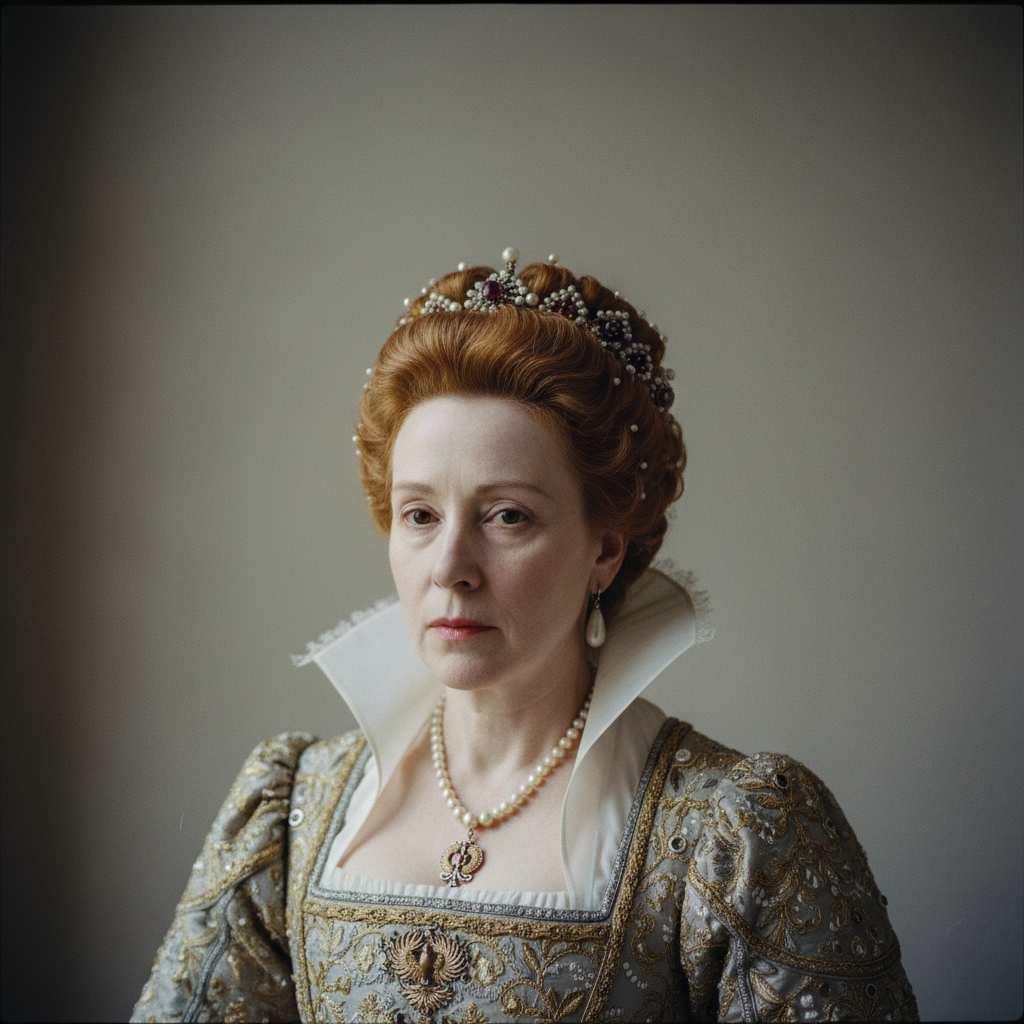
Face and hair: Portraits and court miniatures consistently show Elizabeth with a long, narrow face, a high forehead and a straight, prominent nose; her hair is best described as reddish‑gold or auburn in tone, often arranged or augmented to suit formal fashions. Miniatures and workshop portraits suggest dark brown eyes that read as intense against her pale skin. Complexion and cosmetics: The public image is of very pale, almost white skin—achieved in life with heavy white cosmetics—and small, often carefully formed lips. She appears to have plucked or shaped her hairline and brows to emphasize a broad forehead, a fashionable sign of learning and nobility in Tudor court style. Stature and bearing: Portraits and medals stress a statuesque, erect presence more than a naturalistic body type; sumptuous gowns, high ruffs and layered farthingales create a tall, formal silhouette. Jewels, embroidered motifs and emblematic costume were central to how she looked as sovereign, turning personal appearance into political display.
Height / build
Likely average height · Likely slender to medium build
Hair
Likely reddish–golden (often dyed or worn as a wig) · Likely straight to slightly wavy · High/receding hairline (often enhanced by plucking to create a larger forehead)
Eyes
Likely dark
Complexion
Very pale (intentionally whitened with cosmetics)
Face
Likely oval to long · Likely straight and relatively narrow
Notable features
High forehead, very pale skin, reddish-golden hair (often powdered), elongated neck, small mouth and arched brows
Grooming
None (typically clean-shaven face; some makeup could accentuate stray hairlessness) · Extremely high-maintenance court grooming: powdered faces, plucked hairlines, wigs, dyed hair, and elaborate jewelry.
Dress / presentation
Elaborate Tudor court dress — embroidered gowns, wide ruffs, farthingales, heavy jewelry and symbolic emblems
height build
Height
Likely average height
Contemporary comparisons with courtiers and the proportions seen in portraits imply she was not unusually short or tall for a Tudor woman.
height build
Build
Likely slender-to-medium
Court clothing, corsetry and portraits present a narrow torso and elongated silhouette consistent with a slender to medium upper-class build.
hair
Hair color
Likely reddish–golden (often dyed or worn as a wig)
Miniatures and later portraits show red/golden hair tones; recorded use of dyes and wigs made that a dominant public look.
hair
Hairline
High / receding (enhanced by plucking)
Portraits emphasize an enlarged forehead and contemporary fashion (plucking the hairline) was commonly practiced by Tudor queens and ladies.
skin
Complexion
Very pale (whitened with cosmetics)
Portraits and contemporary accounts document heavy white makeup (lead-based) creating an alabaster complexion associated with status.
eyes
Eye color
In Elizabeth’s court, whitened skin signalled aristocratic leisure and purity; plucked hairlines produced a high forehead associated with learning and nobility. These beauty choices were deliberate public signals of rank and authority.
Elizabeth belonged to a predominantly English aristocratic pool with Norman and continental ties through dynastic marriage. Her features fit an early-modern English royal type — not exotic, but shaped by court fashions and continental influences.
Modern images often exaggerate a bright theatrical red wig or sanitize her face into a flawless mask; real-life portraits and accounts show a mixture of deliberate artifice (white lead, wigs) and strong, sometimes severe facial features.
Modern portrayals often freeze Elizabeth as a single image — the flaming red-haired, heavily powdered caricature — ignoring that she was shown at different ages and that wigs, dyes and makeup were part of an intentionally constructed image.
Likely average height — not notably short or tall for a Tudor noblewoman.
Likely dark — portraits and miniatures generally show dark eyes.
Likely reddish–golden in public images, often achieved by dyeing or wearing wigs.
She was regarded as striking and majestic — her image was crafted to convey power and dignity rather than private attractiveness.
No — she was clean-faced; portraits emphasize a hairless, powdered visage.
Because she used heavy white makeup (lead-based) and plucked her hairline as part of Tudor beauty and royal presentation — portraits reflect that constructed image.
The Darnley Portrait (type)
Darnley Portrait (various versions, mid-16th century style) · c.1540s–1560s (portrait type)
An early type of Elizabeth portrait showing a younger queen with red-golden hair, narrow face and high forehead; often used as a reference for youthful features.
The Armada Portrait
Armada Portrait (English court workshop) · 1588
State portrait linking Elizabeth to the victory over the Spanish Armada; shows a very pale face, high forehead, elaborate gown and jewelry — emblematic of her later public image.
Rainbow Portrait
Attributed to Marcus Gheeraerts the Younger (Royal workshop) · c.1600
A late, highly symbolic portrait showing Elizabeth in a robe embroidered with eyes and ears, pale face, red-golden hair and pearl ornament — a key source for her late iconography.
Ditchley Portrait
Marcus Gheeraerts the Younger · 1592
State portrait emphasizing stature, pale face and elaborate dress; often used to show her formal bearing and costume details.
Nicholas Hilliard miniatures
Nicholas Hilliard (miniaturist) · c.1570s–1590s
Close-up miniatures showing facial details, reddish hair tones and dark eyes; Hilliard’s portraits were intimate court images that inform hair and eye-color reconstructions.
Contemporary ambassadorial and court descriptions
Ambassador letters and courtier eyewitness accounts (various) · mid- to late-16th century
Written impressions by foreign ambassadors and English courtiers note her commanding presence, pallid complexion, and expressive dark eyes — often emphasizing majesty over private beauty.
Likely dark
Miniatures and full-size portraits generally depict dark eyes; contemporary descriptions speak of intense, dark eyes.
face
Distinct facial features
High forehead, small mouth, arched brows, elongated neck
Official portraits consistently stress these elements as part of the royal image and match contemporary written descriptions.
grooming
Makeup & styling
Heavily made-up, powdered, wigged
Court records and portraits show use of lead-based white paint, powders, false hair, and wigs to create a uniform royal appearance.
clothing
Dress
Elaborate Tudor court gowns with ruffs, farthingales and jewels
Major state portraits repeatedly show her in richly embroidered gowns, large ruffs and symbolic jewelry as signifiers of power and rank.
cultural
Public presentation
Highly stylized and symbolic
Her official imagery was purposefully idealized to convey virgin queen, majesty and continuity; portraits are political statements as well as likenesses.
Medals and coins (Elizabethan issues)
Elizabethan medals and coinage · 1560s–1600s
Medals record a stylized profile of the queen used for propaganda; features are simplified but consistent with portrait types (high forehead, long nose).
Funeral effigy and mourning imagery
Funerary effigy and Court records · 1603
Effigies and funeral descriptions reflect late-life public imagery and the continuation of the stylized look (white face, regal vesture) in death rituals.