height build
Height
Likely tall for his time
Imperial nutrition and physical regimen plus literary emphasis on his commanding presence make above-average height probable.
Portrait reconstruction
156–87 · Imperial Han China (capital: Chang'an / modern Shaanxi region) · Western Han dynasty (2nd–1st century BCE)
He likely wore his straight black hair in a topknot beneath a formal headdress, had dark eyes and an energetic, upright build, and was probably clean-shaven.
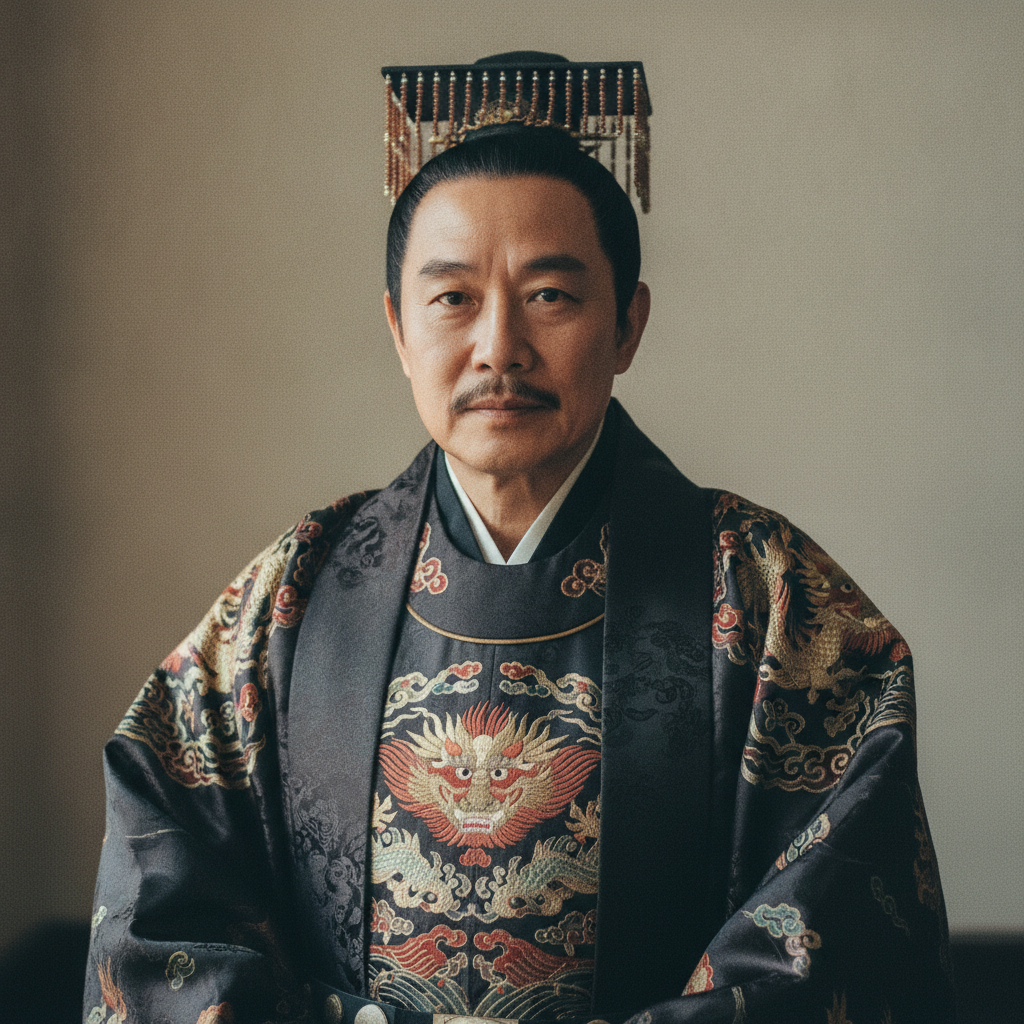
At a glance he would have read as an unmistakable courtly and military presence: a face shaped by determined features rather than florid softness, dark almond-shaped eyes with a steady, authoritative gaze, and a firm jaw that suggested energy and purpose. Skin tone would align with northern-central Han China—an East Asian complexion with warm, yellow-brown undertones typical of the region. Hair was almost certainly straight and black, swept up into the customary topknot and bound neatly, a style reinforced by tomb figurines and court depictions. In public and ritual settings Emperor Wu would wear layered, flowing imperial robes with broad sleeves and patterned borders, fastened by a carved belt and punctuated by jade or metal ornaments; for major ceremonies he would don the formal headdress (mian or guan) that marked sovereign authority. Accessories were measured: ritual crowns, wide ceremonial sleeves that emphasized stately gestures, and boots or shoes consistent with elite Han court dress. Jewelry would be restrained and emblematic—jade and gilt used to underline status rather than personal flamboyance. Physically he likely projected a compact, athletic bearing shaped by years of military campaigns and long hours of court activity: not towering, but solidly built with broad shoulders, upright posture, and controlled movements. His mien combined imperial dignity with the readiness of a commander—eyes alert, shoulders squared, gestures deliberate. Grooming followed elite Han norms, so he was probably clean-shaven or only lightly whiskered, with hair kept tidy and nails trimmed to reflect courtly discipline.
Height / build
Likely tall for his time · Likely sturdy / robust
Hair
Likely black (dark), later graying · Likely straight · Likely full in youth, later slightly receding or thinning
Eyes
Likely dark (brown/black)
Complexion
Likely light-to-medium East Asian tone
Face
Likely broad/oval face · Likely straight, medium bridge
Notable features
Commanding bearing, erect posture, ritual hairstyles and imperial regalia (mianfu crown) would have been distinctive.
Grooming
Probably clean-shaven or with minimal neatly trimmed moustache · Hair worn in the Han topknot or tied-up style; well-groomed for ritual and court appearances.
Dress / presentation
Imperial Han ceremonial robes (mianfu) and court dress: long silk robes, embroidered borders, ceremonial crown (mian) for formal occasions.
height build
Height
Likely tall for his time
Imperial nutrition and physical regimen plus literary emphasis on his commanding presence make above-average height probable.
height build
Build
Likely sturdy/robust
Active military campaigns, horseback riding, and the physical demands of rule suggest a solid, muscular or stocky build.
hair
Hair color
Likely black (dark)
Typical Han Chinese hair color; archaeological depictions and later portraits show dark hair.
hair
Hair style
Topknot / tied-up (Han court style)
Han ritual and court protocol required men to wear hair tied up in a guan or topknot; tomb art and textual sources confirm this fashion.
face
Eye color
Likely dark (brown/black)
East Asian populations overwhelmingly display dark brown/black irises; no record of unusual eye color exists.
skin
Complexion
Likely light-to-medium East Asian tone
In Emperor Wu's world authority was communicated through dignity and ritual correctness: a composed face, upright posture, neat hair tied in the court topknot, and immaculate ceremonial robes. Physical vigor and the bearing of a soldier-statesman were admired because they signaled the capacity to lead campaigns and enforce law.
Emperor Wu belonged to the northern Han ruling elite. Imagine a North-Central Chinese man of the 2nd–1st century BCE: straight black hair, dark eyes, an East Asian complexion, and a physically resilient build shaped by horseback riding and military life rather than modern gym training.
Modern images often glamorize him (youthful, highly stylized, or Westernized features) or overplay exotic armor and long flowing hair; historically he would look like a dignified Han statesman-warrior in formal robes and topknot.
Films and novels often show Emperor Wu as either a youthful, romantic prince with long flowing hair or as heavily bearded and wildly armored. Historically he would more commonly be shown as a mature, dignified ruler with hair bound in a topknot and wearing ritual robes—his military authority was displayed through posture and regalia, not fantasy armor.
Likely taller than the average person of his day—above-average height for late 2nd–1st century BCE northern China.
Likely dark brown to black.
Likely black and straight, worn tied up in the Han topknot; later in life it would have shown gray.
Probably clean-shaven or with only minimal, neatly trimmed facial hair in official portraiture.
His ritual robes and crown, upright posture, and an authoritative, military-informed bearing would make him immediately recognizable as emperor.
By combining contemporary textual descriptions of bearing and ritual, Han tomb art and clothing finds that show hairstyle and dress, and later portrait traditions to form a consistent visual impression.
Shiji (Records of the Grand Historian) — biography of Emperor Wu
Sima Qian, Shiji · completed c. 94 BCE (early Han)
Early biographical narratives emphasize Emperor Wu's vigor, martial exploits, and authoritative presence—useful for judging how contemporaries described his bearing.
Hanshu (Book of Han) — official imperial history
Ban Gu, Hanshu · completed c. 1st century CE
Official history adds ritual and court detail about Han emperors and confirms protocols for imperial dress and grooming that shaped how Emperor Wu would appear publicly.
Han dynasty funerary figurines and tomb artifacts (e.g., Mawangdui materials)
Han archaeological record (Mawangdui, Changsha and other Han tombs) · excavations 20th century onward; artifacts date to 2nd–1st century BCE
Tomb figurines, murals, and textiles show hairstyles (topknots), court robes, and physical types of Han elites—key visual evidence for clothing, hair, and general physique.
Stone reliefs and sculptures from Western Han contexts
Western Han funerary reliefs and stone carvings · 2nd–1st century BCE
Reliefs depict court figures with upright posture, tied hair, and robes; they reflect stylistic norms for elite appearance though rarely identify named individuals.
Later imperial portraits and temple images of Emperor Wu
Song–Ming dynasty painted portraits and ritual images · 10th–17th centuries CE (later portrait tradition)
Later portraits shaped the popular image of Emperor Wu—usually showing him as a mature, bearded or clean-shaven ruler in imperial robes; useful for reception history but not direct evidence.
Northern Han Chinese of the imperial class generally had light-to-medium complexions; public outdoor activity could darken skin.
grooming
Facial hair
Probably clean-shaven or minimally trimmed
Imperial portrait conventions and Han court images rarely emphasize heavy beard; facial hair, if present, would be neat.
clothing
Ceremonial dress
Mianfu (imperial ceremonial robes) with crown in formal settings
Emperors wore mianfu for ritual and state events; archaeological textiles and textual regulations detail this attire.
face
Face shape
Likely broad to oval
Generalized reconstructions of Han elite iconography and surviving sculptures suggest broader, fuller faces rather than narrow European profiles.
other
Public bearing
Commanding, ritualized posture
Contemporary texts emphasize his commanding presence, and court ritual reinforced an upright, dignified public stance.