hair
Hair length
Long, worn in braids or tresses
Sargonic and Sumerian depictions of elite women and priestesses show long braided or tasseled hair; temple images emphasize elaborate hair arrangements.
Portrait reconstruction
0–0 · Sumer (city of Ur), southern Mesopotamia · Late 3rd millennium BCE (Sargonic period, c. 23rd century BCE)
Enheduanna likely appeared as a formally dressed Sumerian high priestess: dark braided hair, a tasseled kaunakes skirt, broad bead collars, pronounced kohl-lined eyes, and elegant jewelry.
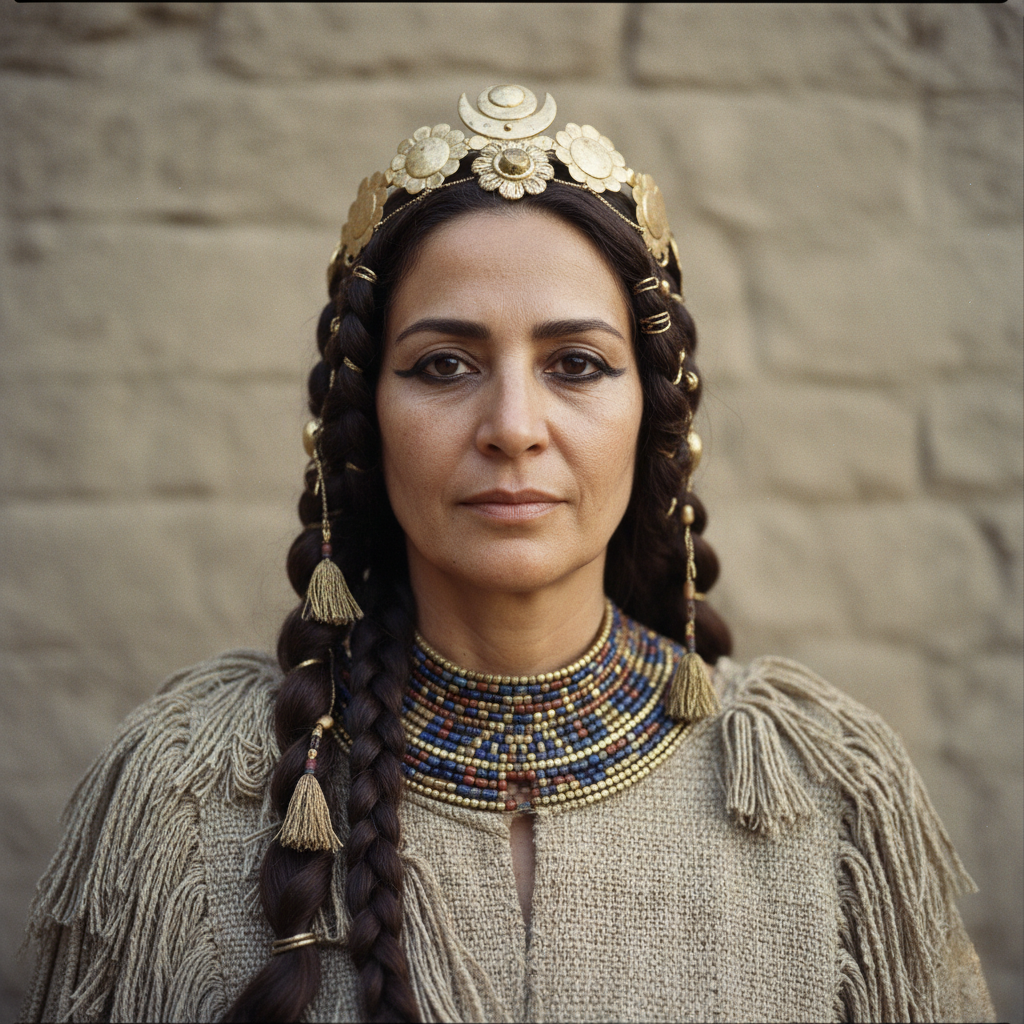
Her hair was probably dark and worn long—arranged in thick braids or ropes that fell over her shoulders or were coiled and pinned into a formal piled coiffure. Period reliefs and seals show elite women with heavy, regular braids often finished with small tassels; Enheduanna would have followed that polished, structured look. For dress she would have worn the ritual textiles of the temple: a kaunakes-style skirt or fringed wool garment with neatly arranged tufts, often layered with a long robe or shawl for processions. Across her chest sat one or more broad beaded collars—rows of stone or shell beads—plus armlets, earrings, and possibly delicate finger rings; jewelry was both decorative and a visible mark of office. Her face was likely presented in the idealized style of the period: strong, almond-shaped kohl-rimmed eyes emphasized with dark pigment, neatly shaped brows, a straight-profiled nose and full lips rendered in votive imagery. She would have been clean-shaven and groomed, with an upright, statuesque posture suited to ritual performance and public presence.
Height / build
Likely average height · Likely slender to average build
Hair
Likely dark (black to dark brown) · Likely straight to wavy · Likely normal hairline, often arranged in long braids or tresses
Eyes
Likely dark (brown)
Complexion
Likely medium‑olive to light brown
Face
Likely oval to slightly elongated · Likely straight to gently rounded
Notable features
Long braided or tasseled hair, prominent eye makeup, broad beaded collar, ornate headdress or diadem signifying priestly rank.
Grooming
Probably none · Likely wore heavy-lined eyes (kohl), carefully arranged braided hair or tresses, and temple jewellery; grooming would be formal and ritual-appropriate.
Dress / presentation
Long fringed kaunakes-style robe or tasseled skirt with a broad beaded chest collar and ceremonial headdress/diadem
hair
Hair length
Long, worn in braids or tresses
Sargonic and Sumerian depictions of elite women and priestesses show long braided or tasseled hair; temple images emphasize elaborate hair arrangements.
hair
Hair color
Likely dark (black to dark brown)
Population context for southern Mesopotamia and contemporary figurative art conventions point to dark hair for local elites.
eyes
Eye color
Likely dark (brown)
Near Eastern populations overwhelmingly exhibit dark eyes; Sumerian statues emphasize large, dark‑lined eyes but not specific hue.
clothing
Robe and skirt
Long fringed/tasseled robe (kaunakes-style) with ritual drapery
Temple and elite dress from Ur and Akkad shows tasseled skirts and layered robes worn on ritual occasions and by priestly figures.
clothing
Jewelry and collar
Broad beaded collar and temple jewelry
Votive statues of female devotees and priestesses wear wide beaded collars and prominent necklaces marking status.
grooming
In Sargonic Sumer, authority for women in the temple depended on visible ritual markers: layered and tasseled robes, wide beaded collars, and formal headdresses. Cosmetics—especially heavy eye-lining—accentuated the eyes in a way that signaled both beauty and sacred attention. Enheduanna’s appearance would therefore emphasize ritual dignity and recognizability over personal fashion statements.
Enheduanna belonged to the cultural and genetic milieu of southern Mesopotamia: a mix of Akkadian-speaking elites and long-established Sumerian urban populations. Visually this translates to Near Eastern features—dark hair and eyes, medium olive skin—and to clothing and jewelry styles specific to Ur’s temple elite.
Modern art often turns Enheduanna into a Greco-Roman–styled or fantasy goddess; the historically likely image is austere, fully clothed, and tied to Sumerian temple costume and cosmetics.
Modern portraits frequently turn Enheduanna into a Greco‑Roman or fantasy goddess—bare-armed, heavily sexualized, or shown with Northern European features. Historically, she would have been fully clothed in ritual garments, presented as a solemn priestly figure with Near Eastern features and ritual cosmetics.
Likely average height for a Bronze Age Mesopotamian woman.
Likely dark (brown).
Likely dark—black to dark brown—worn long and arranged in braids or tresses.
She would have been presented as ritually dignified and striking—authority and sanctity were the markers of her status rather than sensual beauty.
Probably not; female depictions from the period are clean-shaven and beards are a male marker.
We combine her documented role and rank with surviving Sargonic and Sumerian visual conventions for elite female priestesses to create a responsible reconstruction.
Enheduanna Hymns and Temple Texts
Sumerian hymns attributed to Enheduanna; temple administrative records · c. 23rd century BCE (Sargonic period)
These texts identify her rank (En/ˀen) and ritual role, indicating she dressed and acted as a high priestess—important context for reconstructing ceremonial appearance.
Votive statues and female priestess figures from Ur and nearby sites
Museum collections (e.g., British Museum, Penn Museum, Iraq Museum) — Sumerian votive statuary · Early 3rd millennium – Sargonic and Ur III periods
Votive statues of elite women and priestesses show long tasseled garments, broad beaded collars, formal upright postures, and stylized hair—visual template for Enheduanna’s ceremonial attire.
Akkadian/Sargonic reliefs and cylinder seal imagery
Akkadian and Sargonic period reliefs and seals (various museums) · c. 24th–22nd centuries BCE
Court and temple imagery from the Sargonic world depict elite women in long braided styles and ritual garments; these conventions inform likely hair and dress for Enheduanna.
Studies of Mesopotamian dress and cosmetics
Modern archaeological and art-historical syntheses (e.g., Leick, Oates, Kramer) · 20th–21st century scholarship
Scholarly syntheses summarize how kaunakes skirts, bead collars, and kohl were used by elites—providing cultural dress norms applicable to Enheduanna.
Sargonic inscriptions referencing priestly appointments
Royal and temple inscriptions of the Sargonic dynasty · c. 23rd century BCE
Administrative inscriptions confirm Enheduanna’s official title and status, implying the ceremonial regalia she would have used as a public temple figure.
Makeup
Likely heavy eye-lining (kohl)
Mesopotamian reliefs and statues emphasize large eyes and texts/art document the use of eye cosmetics in ritual and elite grooming.
skin
Complexion
Likely medium-olive to light brown
Population and geographic context of southern Mesopotamia favor an olive to light brown complexion among local elites.
height build
Build
Likely slender to average build
Artworks of elite Sumerian women show upright, slender bodies; elite lifestyle and diet would produce a moderate physique.
face
Facial hair
Probably none
As a woman and priestess, she would have been depicted clean-faced; Sumerian female figures are shown without facial hair.
other
Headdress
Ceremonial diadem or distinctive temple headdress
High-ranking priestesses are shown with diadems or special headgear in Mesopotamian art distinguishing ritual status.
cultural
Public bearing
Ritually authoritative and composed
Her office as En (high priestess) demanded solemn, composed presentation; surviving hymns and temple records emphasize ritual role.