hair
Hair color
Likely red
His epithet 'the Red' and saga texts specifically describe him with red hair and beard.
Portrait reconstruction
950–1003 · Norse North Atlantic (Norway → Iceland → Greenland) · Viking Age (late 10th century)
Erik the Red likely had vivid red hair and a full red beard, fair freckled skin, light eyes, and a broad, seafaring Norse build.
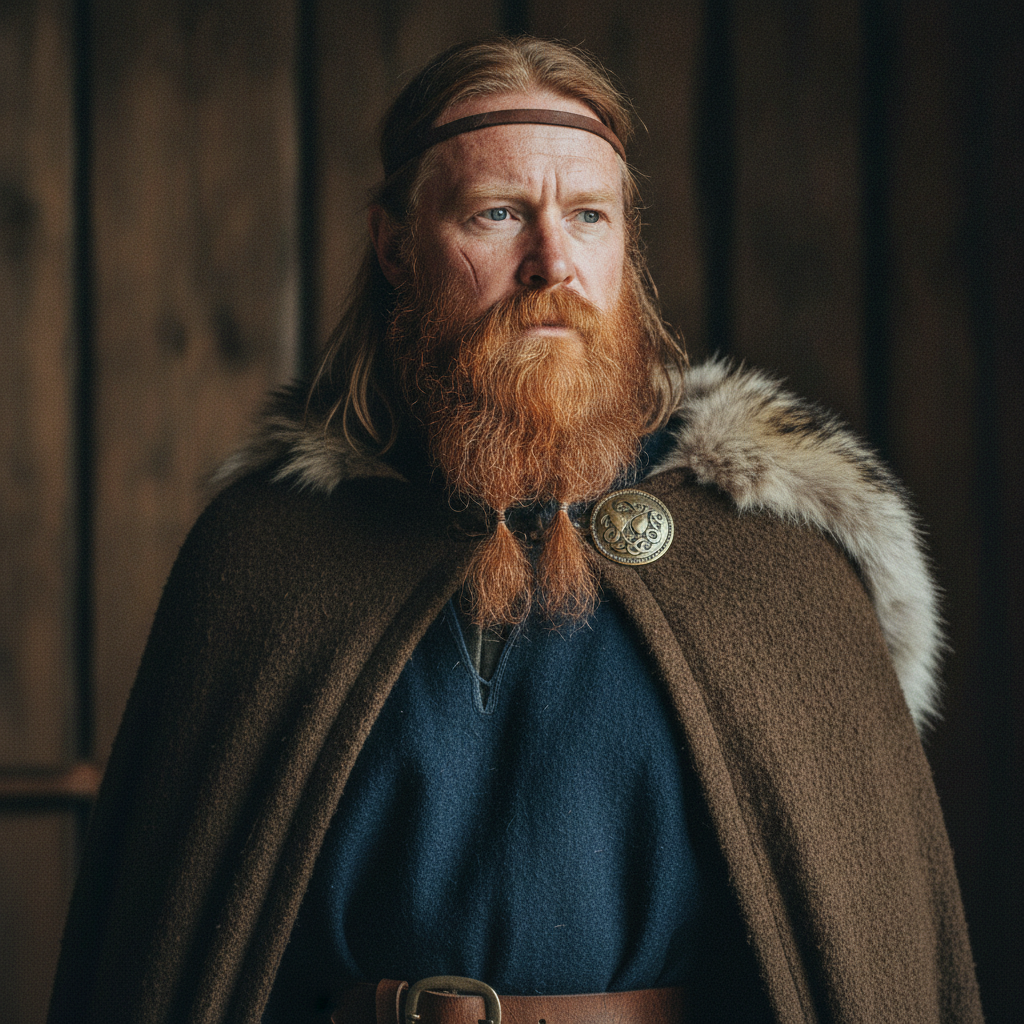
His most striking feature would have been his hair: a thick mane of red—deep copper to auburn—and a matching full beard that framed a square, weathered face. The sagas call him "the Red," and that nickname points to a vivid red head of hair and a ruddy, freckled complexion that caught the eye. His eyes were likely light—blue, grey, or green—and set beneath a broad brow. Time at sea and on harsh coasts would have given his skin a sun-weathered, ruddy tone with freckles; wind lines and a few shallow scars from raids or travel would add to a rugged, commanding presence. Physically he would have been sturdy and muscular from rowing, sailing and labor: broad-shouldered, solidly built rather than towering, with the compact power common to Norse seafarers. As a chieftain he would have kept his hair and beard groomed—combed, possibly tied or braided—and presented an appearance both practical for the North Atlantic and authoritative to his followers.
Height / build
Likely tall for his time · Likely broad/robust
Hair
Likely red (hair and beard) · Likely straight to slightly wavy · Likely normal (no special baldness reports)
Eyes
Likely blue or blue-gray
Complexion
Likely fair and freckled, ruddy from outdoor life
Face
Likely long to oval · Likely straight to prominent
Notable features
Red hair and beard; freckled fair skin; commanding presence; possible battle-scars
Grooming
Likely a full, prominent red beard · Groomed in line with chieftain status: trimmed beard, shoulder-length hair often tied or loose, practical but decorated clothing and brooches.
Dress / presentation
Rich Norse chieftain dress: layered wool tunics, cloaks fastened with brooches, leather boots, possibly fur trim and metal ornamentation
hair
Hair color
Likely red
His epithet 'the Red' and saga texts specifically describe him with red hair and beard.
grooming
Beard
Likely a full prominent red beard
Norse chieftains and saga descriptions emphasize beards; sagas associate Erik with a vivid red beard.
skin
Complexion
Likely fair and freckled, with a ruddy outdoor look
Saga language notes a ruddy/freckled appearance and Norse populations were fair-skinned; seafaring life adds windburn and ruddy tone.
eyes
Eye color
Likely blue or blue-gray
Light eyes were common in Norse populations of Norway and Iceland; sagas do not contradict this general pattern.
height build
Height
Likely tall for his time
Chieftains and successful seafarers were often above average in stature; Viking-age male averages suggest someone taller would appear imposing.
height build
Build
Likely broad and muscular/robust
Norse culture prized visible signs of strength and status: robust bodies, prominent beards, weather-hardened faces, and well-made clothing or metal fittings that signaled rank. Physical presence and the ability to lead in raids or settlements mattered as much as pure beauty.
Erik belonged to the Norse populations of Norway and Iceland. These groups frequently had fair skin, light eyes and a range of hair colors including blond and red; a red-haired chieftain like Erik would be fully within regional variation and visually prominent among peers.
Modern images often exaggerate Viking uniformity (giant horned helmets, cartoonish fierceness) or tidy Hollywood looks; Erik should look rugged, weathered and functionally well-dressed for a chieftain, not cinematic fantasy.
Modern images overplay fantasy elements (horned helmets, uniform ferocity) and often sanitize Viking leaders into movie-handsome types. Erik was likely more rugged, weather-beaten and practically dressed for life at sea and in Greenland than many glamorized portrayals.
Likely tall for his time — he would have appeared imposing among contemporaries.
Likely blue or blue-gray, following common Norse eye color patterns.
Probably — his epithet 'the Red' and saga descriptions point to red hair and a red beard.
Likely a full, prominent beard — typical for Norse chieftains and specifically associated with his epithet.
His bright red hair and beard, fair freckled skin, tall robust frame and fine cloak and brooches marking his status.
Medieval Norse sagas and later tradition give direct descriptive clues (notably his nickname), and archaeological/population context help fill in clothing, build and likely eye/skin traits.
Eiríks saga rauða (Saga of Erik the Red)
Eiríks saga rauða · c. 1250–1300 (written down)
A principal saga that names him 'the Red' and describes his appearance (red hair/beard, ruddy/freckled look) and actions; provides the primary literary image used by later tradition.
Landnámabók (The Book of Settlements)
Landnámabók · compiled c. 12th–13th century
An early Icelandic compilation on settlers that lists Erik and related family details, contributing to the traditional portrait of his origins and personal traits.
Norse naming practices and epithets
Medieval Norse literary practice · medieval
Use of descriptive nicknames (e.g., 'the Red') commonly conveyed visible physical traits; supports reading of Erik’s epithet as a direct descriptor.
Archaeological evidence for Norse clothing and status dress
Textile and grave finds from Iceland and Greenland · modern archaeological research (20th–21st c.)
Finds of woolen tunics, cloaks, brooches and leather indicate chieftain dress and grooming that would fit Erik's social rank.
Osteological and population studies of Viking-age Scandinavia
Anthropological studies of Viking skeletal remains · 20th–21st c.
Skeletal analyses provide average stature and build ranges for Norse men, supporting likely height/build estimates for a chieftain like Erik.
Genetic and phenotype surveys of Scandinavian populations
Modern population genetics literature · 21st century
Genetic and anthropological data indicate high frequencies of light eyes and fair complexions in Norse populations—useful context for inferring likely eye and skin tone.
Active seafaring, raiding and settlement leadership favor a sturdy, muscular frame in contemporary and archaeological context.
face
Face shape & nose
Likely long/oval face with a straight to prominent nose
Common facial proportions in Scandinavian skeletal remains and typical saga descriptions of leaders suggest an elongated facial shape and strong nose.
clothing
Dress
Likely well-made Norse chieftain dress: wool tunics, cloak, brooches, leather boots
Archaeological clothing finds from Norse Greenland/Iceland show layered wool garments and metal dress fittings for those of status.
grooming
Hair style
Likely shoulder-length, practical and possibly tied back
Norse men commonly wore medium-length hair; chieftains often kept hair manageable but presentable.
other
Distinctive presence
Conspicuous and commanding — red hair and beard would make him stand out
Red hair was notable enough to become his nickname; combined with chieftain dress and stature this would make him visually arresting.
Later statues and artistic depictions
Various 19th–20th century artworks and monuments · 19th–20th century
Modern images often draw on saga descriptions and romanticized Viking imagery; useful for cultural reception but not reliable for physical accuracy.