hair
Hair color
Likely dark (dark brown to black)
Most Levantine and Persian women of the period were dark‑haired; literary tradition and regional population context support this.
Portrait reconstruction
0–0 · Achaemenid Persia (Susa / Shushan court) · 5th century BCE (Achaemenid Persian Empire)
Esther would likely have looked like a young Near Eastern woman—olive skin, dark hair piled or braided beneath a cap or veil, dark kohl-rimmed eyes, and richly layered, jewel-laden court clothes.
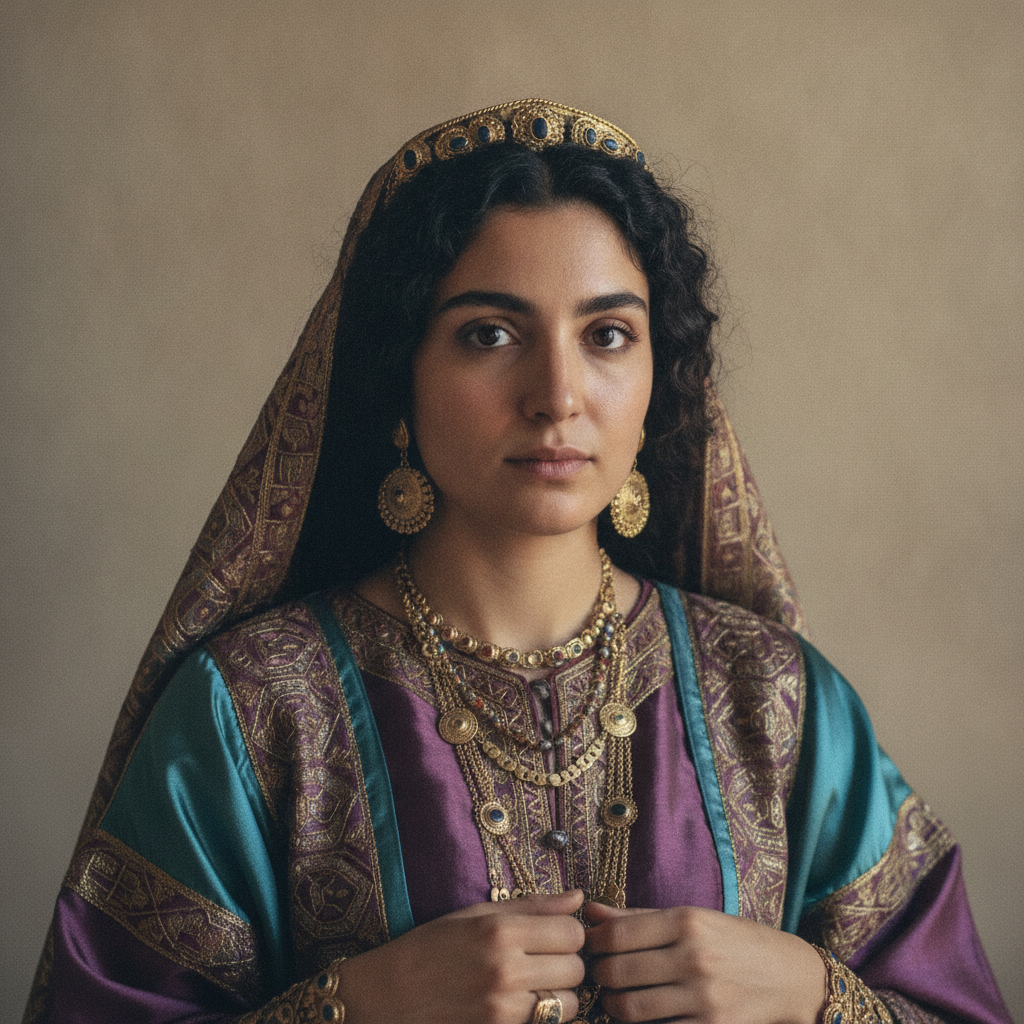
Face and complexion: Esther probably had an olive to light-brown complexion and the smooth, youthful features of a woman in her late teens or early twenties. Her eyes were likely dark brown and emphasized with kohl; brows would be shaped and the skin smoothed with oils and light powders to give a polished courtly look. Facial proportions would reflect Levantine features—straight or gently aquiline nose and full lips—presented in a way meant to read as elegant and refined at court. Hair and headwear: Her hair was likely dark—black or deep brown—long and worn in elaborate styles: braids, coils, or piled rolls fastened with ribbons, gold thread, beads, and pins. Achaemenid noble women commonly covered or framed their hair with caps, veils, or diadems, so Esther’s hair would often be partly hidden beneath a decorated headpiece that revealed styled fringes or curls. Dress, jewelry, and cosmetics: Court clothing was layered and richly patterned—long-sleeved tunics and flowing robes with embroidered borders, a fitted belt, and finely woven shawls. Esther would have worn multiple pieces of jewelry (drop earrings, stacked necklaces, armlets, rings and hair ornaments) in gold and precious stones, and used kohl, red or brown pigments for lips and cheeks, and scented oils to create a glossy, fragrant appearance worthy of the royal audience.
Height / build
Likely average height (for her time) · Likely slender to average build
Hair
Likely dark (dark brown to black) · Likely wavy to coily/wavy · Likely normal; hair often arranged under veils and ornaments
Eyes
Likely dark (brown)
Complexion
Likely Mediterranean / olive to light brown
Face
Likely oval to gently rounded · Likely straight to moderately projecting
Notable features
Large dark eyes, dark hair often ornamented, refined face from court grooming, conspicuous jewelry and crowned headgear when in royal dress
Grooming
None · Elaborate grooming: cosmetics, oils, scented unguents, hair styling and ornamentation were likely used in the royal selection process.
Dress / presentation
Achaemenid Persian royal dress — long embroidered robes, layered garments, heavy jewelry, veils, and a diadem or hair ornaments
hair
Hair color
Likely dark (dark brown to black)
Most Levantine and Persian women of the period were dark‑haired; literary tradition and regional population context support this.
eyes
Eye color
Likely dark (brown)
Brown eyes dominate populations of the Near East and Persia; descriptions that emphasize 'beautiful eyes' in literature typically refer to dark eyes.
skin
Complexion
Likely Mediterranean / olive to light brown
Esther was from the Levant and living at the Persian court; regional genetic and artistic evidence points to an olive/medium complexion.
height build
Height
Likely average height (for her time)
Archeological and osteological data for ancient Near Eastern women indicate shorter statures than modern northern Europeans; court women generally reflected local averages.
height build
Build
Likely slender to average
Women selected for royal households were cared for and kept in good health and grooming but were not necessarily heavily built; textual emphasis is on beauty and grooming.
clothing
Achaemenid court culture prized controlled, ornate display: fine textiles, layered jewelry, and polished grooming as signals of status and beauty. For women, attractiveness was expressed through hair arrangements, scented oils, smooth skin, and richly embroidered robes—appearance was as much about status signaling as physical features.
Esther would have looked like a Levantine/Jewish woman living in imperial Persia: physically similar to other people from the eastern Mediterranean and western Iran—dark hair and eyes, olive skin—while her clothing and grooming set her apart at court.
Modern European and Hollywood portrayals often depict Esther as fair‑skinned and European; historically she would more likely have been dark‑haired with a Middle Eastern complexion and wearing Persian court fashions.
Western paintings and films frequently cast Esther with European features (fair skin, light eyes) and modern fashions; historically she would more likely have had Middle Eastern features and would have been shown in Achaemenid garments and jewelry rather than Greco‑Roman or modern evening wear.
Likely average height for an ancient Near Eastern woman (shorter than modern northern Europeans).
Likely dark (brown).
Likely dark—dark brown to black—styled and ornamented.
Yes — the Book of Esther and later tradition describe her as strikingly beautiful and chosen for the king on that basis.
Achaemenid royal clothing: long embroidered robes, layered garments, veils, heavy necklaces, earrings, and hair ornaments or a diadem.
No authenticated portrait of Esther survives; reconstructions depend on textual description and Achaemenid material culture.
Book of Esther
Bible (Book of Esther) · composition debated; tradition places events 5th century BCE, text extant in final form by 4th–2nd century BCE
Describes Esther as a beautiful young woman chosen for the king’s harem and prepared with cosmetics and special treatments before meeting the king.
Antiquities of the Jews
Flavius Josephus, Antiquities (1st century CE) · c. 93–94 CE
Retells the Esther story with additional details and Hellenistic context; preserves later Jewish traditions about her beauty and court life.
Persepolis and Achaemenid reliefs and seal impressions
Persepolis reliefs and imperial iconography · circa 6th–5th century BCE
Visual record of Achaemenid court dress and jewelry: long robes, layered garments, headpieces, and ornamental detail for elites that inform how a queen would have been dressed.
Herodotus on Persian dress and customs
Herodotus, Histories (5th century BCE) · c. 440s BCE
Provides outsider descriptions of Persian court dress, grooming and luxury habits that match the material culture seen at Persepolis.
Archaeological finds: cosmetic containers, mirrors, jewelry
Achaemenid archaeological reports · excavations 20th–21st centuries (Persepolis, Susa, other sites)
Material culture shows wide use of cosmetic vessels, mirrors, and luxury jewelry among the elite; supports grooming and ornamentation practices described in texts.
Medieval and Renaissance artistic depictions of Esther
European manuscript illuminations and paintings · medieval–Renaissance periods
Artistic portrayals that shaped later visual imagination of Esther, often portraying her with European features and contemporary dress of the artists’ times.
Clothing style
Achaemenid royal dress — long embroidered robes, veils, and jewelry
Contemporary Persian reliefs and historical descriptions of Persian court attire show layered garments, heavy ornamentation, and headpieces consistent with royal presentation.
grooming
Cosmetics and grooming
Likely used cosmetics, oils, perfumes, and hairstyling
Archaeological finds (cosmetic jars, mirrors) and textual descriptions indicate cosmetic use at Persian courts; the selection process described in Esther involved grooming.
face
Facial hair
None
Women in the literary and artistic record of the period are presented as free of facial hair; grooming practices aimed to produce a smooth feminine face.
cultural
Perceived attractiveness
Considered striking and attractive
The Book of Esther explicitly states she was chosen for her beauty; Jewish and later traditions emphasize her exceptional attractiveness and poised bearing.
other
Headgear and jewelry
Likely wore diadems, hair ornaments, and substantial jewelry in court
Achaemenid queens and elite women are depicted and described wearing crowns/diadems, earrings, necklaces and elaborate hairpieces.
Modern historical syntheses on Achaemenid dress and women
Scholarly works (e.g., Maria Brosius; Amélie Kuhrt; Pierre Briant) · 20th–21st century
Modern scholarship synthesizes textual and material evidence to reconstruct elite female appearance and court presentation in Achaemenid Persia.