hair
Hair color
Likely dark to graying
Hellenistic Greeks typically had dark hair; later depictions show Euclid as dark-haired with gray in older portrayals.
Portrait reconstruction
0–0 · Alexandria, Ptolemaic Egypt (Greek-speaking) · Hellenistic period (c. 300 BCE)
Euclid probably looked like a Mediterranean Greek scholar: olive-skinned, dark-haired, with a neatly kept short beard and Hellenistic robes.
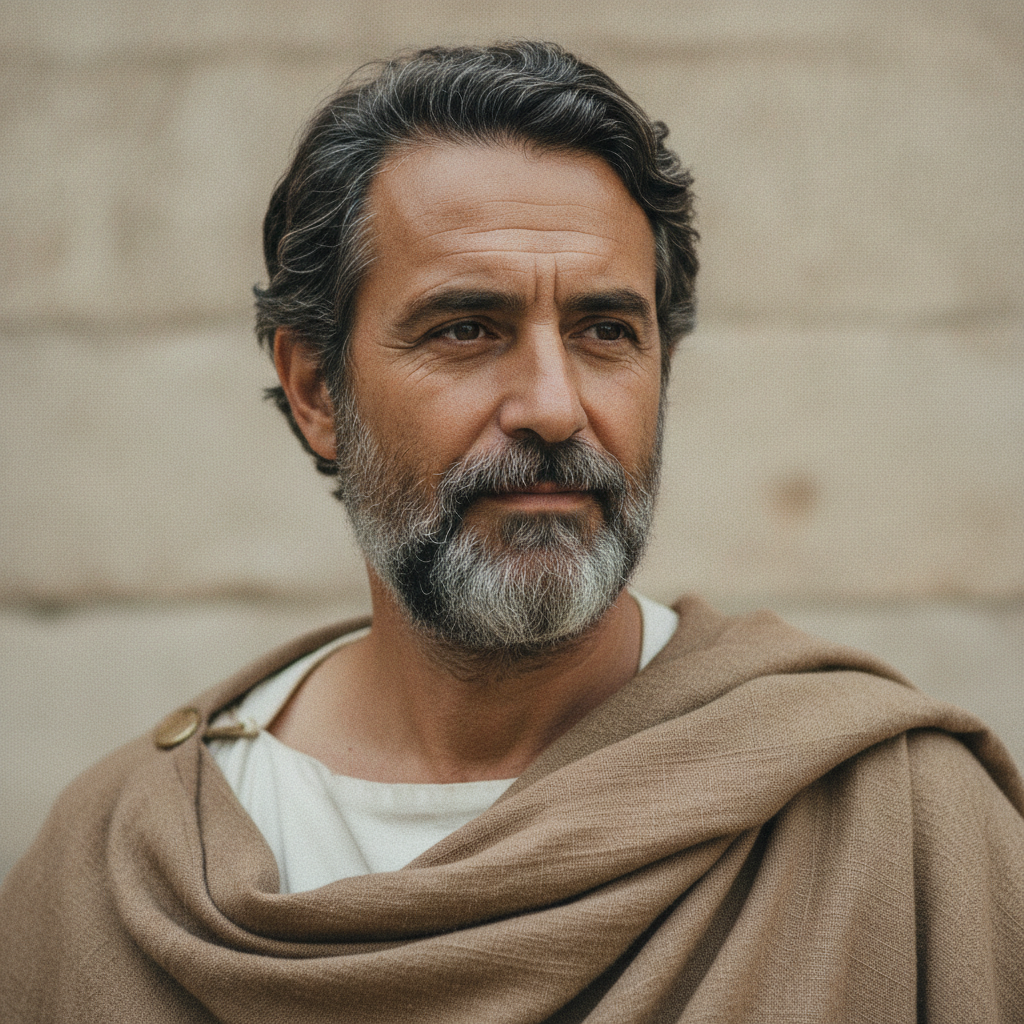
Face and hair: Imagine an olive-to-light-brown complexion with dark brown eyes and dark hair—straight to gently wavy—kept short or cropped. His face would be composed and attentive, with a strong, practical jaw and a neatly trimmed short beard, the common mark of a learned man in his time. He likely carried the calm gravitas of a teacher rather than the wild look of a mystic. Age and build: He was probably middle-aged to older in most portraits—forty to sixty—showing the quiet lines of concentration rather than extreme age. Stature would be modest by modern standards (roughly average for eastern Mediterranean men of the period), with a lean, well-proportioned body shaped by daily teaching and writing rather than heavy labor. Clothing and accoutrements: He likely wore a simple chiton and a himation (a draped scholarly cloak) in muted natural dyes—practical, respectable, and Greek in style. Common visual props: a stylus and wax tablet, a compass or straightedge, and papyrus scrolls or diagrams; he would often be pictured seated or standing beside a drawn geometric figure, fingers stained with ink or wax from demonstration.
Height / build
Likely average height · Likely slender to average build
Hair
Likely dark to graying · Likely wavy · Likely receding or thinning with age
Eyes
Likely dark
Complexion
Likely Mediterranean complexion
Face
Oval to slightly long · Straight to slightly aquiline
Notable features
Gentle forehead furrows, graying hair at temples, scholarly demeanor
Grooming
Probably a neatly kept full beard · Likely short, groomed hair and a trimmed beard in the style associated with Hellenistic scholars.
Dress / presentation
Hellenistic Greek scholar's cloak (himation) over a tunic (chiton)
hair
Hair color
Likely dark to graying
Hellenistic Greeks typically had dark hair; later depictions show Euclid as dark-haired with gray in older portrayals.
eyes
Eye color
Likely dark
Dark brown eyes were predominant in eastern Mediterranean populations, matching common iconographic choices.
other
Beard
Probably a neatly kept full beard
Greek intellectuals were commonly depicted bearded; medieval and Renaissance portraits of Euclid follow this convention.
clothing
Typical dress
Hellenistic scholar's cloak (himation) over a tunic (chiton)
As a learned man in Alexandria, Euclid would wear the standard Hellenistic scholarly robes shown in later portraits and in contemporary depictions of philosophers.
height build
Height
Likely average height
Average male stature in the ancient eastern Mediterranean suggests Euclid was around the regional mean rather than notably tall or short.
height build
Build
In Hellenistic society a learned man's appearance signaled intellect and restraint: simple, well‑draped robes (himation), a neatly kept beard, and reserved expression. Excessive ornament or armor was inappropriate for teachers; dignity and moderation were prized.
Alexandria was a melting pot of Greeks, Egyptians, Jews, Levantines and others; Euclid would likely show typical Mediterranean features—olive skin, dark hair and eyes—possibly with subtle local admixture from the city's mixed population.
Modern images often turn Euclid into a medieval European sage with long white hair or a caricatured wizard; historically he would have appeared as a Hellenistic Greek scholar with darker features.
Modern depictions often turn Euclid into a snowy‑haired, medieval European wizard or a generalized 'ancient sage' in flowing robes; historically he would have appeared darker‑featured and dressed as a Hellenistic Greek teacher rather than a medieval cleric.
Probably not notably tall; Likely average height for a Mediterranean man of his era.
Likely dark (brown), the dominant eye color in the region.
Likely dark, with gray in later life.
Probably—a neatly kept full beard, in line with Hellenistic scholarly fashion.
A tunic (chiton) with a himation (cloak) draped as the conventional Hellenistic scholar's dress.
No authenticated contemporary portrait is known; our visual image comes from later medieval and Renaissance iconography combined with Hellenistic context.
Proclus, Commentary on the Elements (biographical notes)
Proclus (5th century CE) · 5th century CE (commentary preserved)
Contains the best-known ancient biographical notices about Euclid's life and teaching in Alexandria; provides context for his role but no physical description.
Suda (Byzantine encyclopedia entries)
Suda · 10th century CE (compilation)
Later Byzantine lexicon that preserves traditional attributions about Euclid and helped transmit his image into the medieval world.
Medieval manuscript illuminations of the Elements
Various medieval copies (12th–15th centuries) · 12th–15th centuries CE
Illustrated copies commonly depict Euclid as a bearded, cloaked older man teaching geometry—this iconography shaped later European images of him.
Renaissance and later prints/statues of Euclid
Renaissance artists and printmakers · 15th–18th centuries CE
Renaissance art adopted and adapted medieval portrayals, reinforcing the image of Euclid as a bearded classical sage in Hellenistic dress.
Hellenistic philosopher portrait conventions
Classical art and sculpture studies · scholarly syntheses (modern)
Statues and busts of Hellenistic philosophers show common features (beards, himation, composed expression) that inform reconstructions of how learned men appeared in Euclid’s era.
Demographic and osteological studies of ancient Mediterranean populations
Archaeological and anthropological research · modern scholarship
Provide baseline data on stature, common complexion and phenotypes for people living in Alexandria and the eastern Mediterranean in antiquity.
Likely slender to average build
Scholars led less physically strenuous lives and are commonly depicted as leaner than soldiers or laborers in ancient art.
skin
Complexion
Likely Mediterranean complexion
Alexandria's population of Greeks, Egyptians, and settlers makes an olive/medium Mediterranean skin tone the most probable.
hair
Hair texture
Likely wavy
Wavy hair is common in Hellenistic Greek portraiture and fits regional phenotypes.
grooming
Grooming style
Likely neat and restrained
Later images and cultural expectations depict scholars with carefully trimmed hair and beards to signal discipline and respectability.
face
Prominent facial features
Forehead lines and graying at temples
Euclid is traditionally represented as a mature man; age markers like forehead furrows and graying are commonly added in portraits to indicate wisdom.