height build
Height
Likely tall for his time
Contemporary accounts describe him as long-limbed and larger than many of his contemporaries, and steppe riders who led armies were often described by chroniclers as physically imposing.
Portrait reconstruction
1162–1227 · Mongolian steppe; founder of the Mongol Empire · Late 12th–early 13th century
Genghis Khan likely had a broad, weathered face with high cheekbones, dark hair, small eyes, probably clean-shaven, and a compact, muscular build.
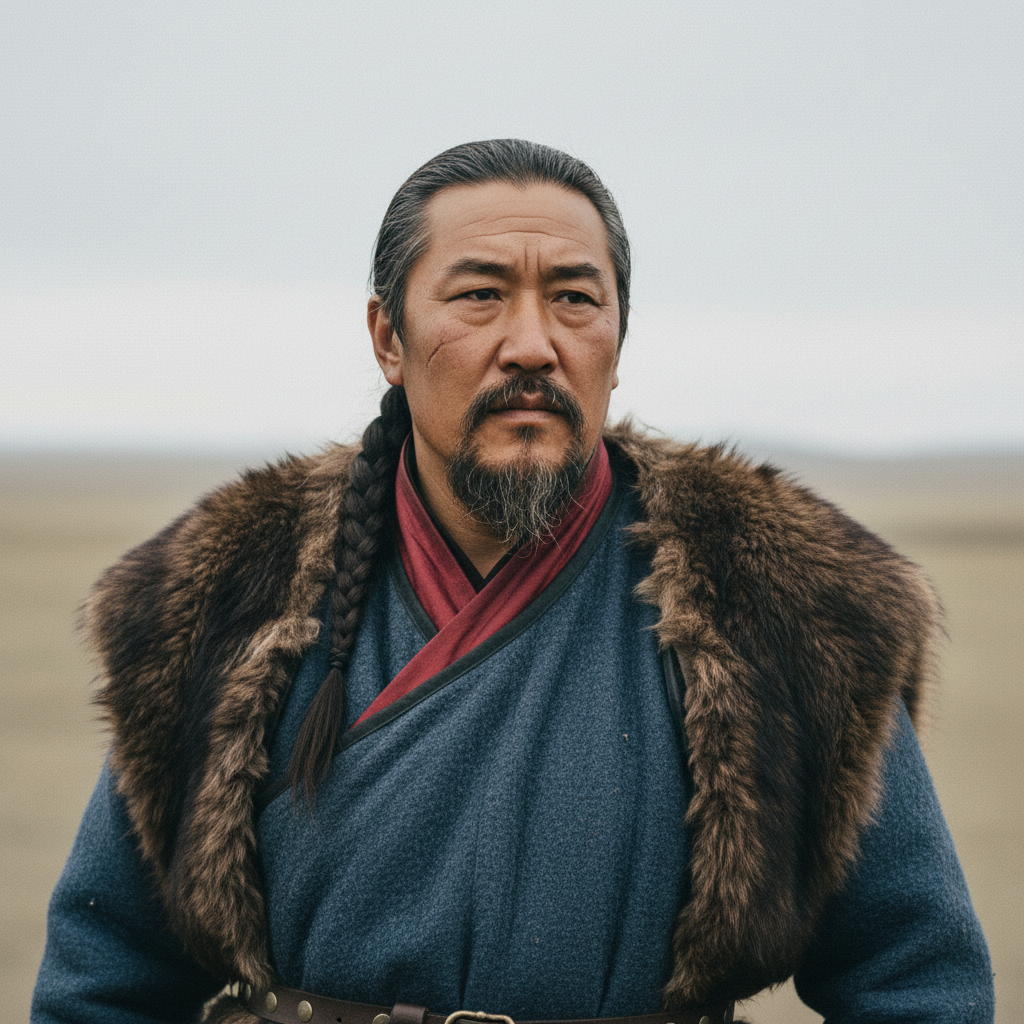
Face and hair: He would have presented a broad, strong face with pronounced cheekbones and a square jaw—features often repeated in early Mongol and Persian portraits. Hair was most likely dark and straight; he probably kept it short or cropped for practicality, and many reconstructions favor little or no facial hair, suggesting a generally clean-shaven appearance. Skin and marks: Years on the open steppe and in campaigns would give his skin a bronzed, wind‑chapped tone and a weathered texture; small healed scars or a faint long scar from battle are consistent with accounts that emphasize his endurance and combat experience. His eyes were likely dark and somewhat narrow, offering a sharp, focused expression rather than a soft look. Body and dress: Genghis Khan was probably compact and powerfully built—muscular, sturdy, and enduring rather than tall and slender—suited to constant riding and fighting. In everyday and military settings he would have worn practical leather, furs, and wool with simple armor; later imperial portraits dress him in court robes, but the everyday visual would be rugged and utilitarian.
Height / build
Likely tall for his time · Likely slim and wiry / athletic
Hair
Likely black, dark to graying in later life · Likely straight · Probably full as a young man; likely receding/greying with age
Eyes
Likely dark (brown)
Complexion
Likely medium to tan (steppe/Inner Asian complexion)
Face
Likely broad, strong jaw and high cheekbones · Likely straight to slightly broad
Notable features
Long-limbed, weathered skin, high cheekbones, penetrating gaze; likely battle scars
Grooming
Probably moustache with short beard or goatee (common among Mongol elites) · Practical grooming: hair typically tied for riding; facial hair present but kept relatively trimmed for warrior practicality.
Dress / presentation
Steppe leader's attire: coat-like 'deel', layered furs, leather riding boots, and sometimes lamellar/scale armor or imported silk robes for ceremonial use
height build
Height
Likely tall for his time
Contemporary accounts describe him as long-limbed and larger than many of his contemporaries, and steppe riders who led armies were often described by chroniclers as physically imposing.
height build
Build
Likely slim, wiry, and muscular
A lifetime of riding and campaigning favors lean endurance musculature rather than heavy build; sources emphasize his strength and endurance.
eyes
Eye color
Likely dark (brown)
Inner Asian populations overwhelmingly show dark brown eyes; no reliable source indicates light eyes.
hair
Hair color
Likely black, dark to graying in later life
Medieval portraits and population context point to dark hair; texts note his aging with graying hair in some accounts.
hair
Hair texture
Likely straight
Mongol and broader Inner Asian hair is typically straight; portraits and traditional depictions show straight hair tied back.
grooming
Facial hair
Mongol culture prized endurance, horsemanship, and practical signs of martial success—scars, a weathered complexion, and a sturdy riding build were marks of status. Nobility displayed high-quality furs, well-made deels, and sometimes silk or decorative horse gear when meeting foreign rulers, but daily presentation favored mobility and function.
Temüjin came from the Mongolic/Tungusic-Turkic milieu of the Central Asian steppe. That population context points to straight, dark hair, dark eyes, high cheekbones and a medium/tan skin tone—features reflected in period depictions and later Mongol portraits used by Yuan and Persian artists.
Modern films and paintings often exoticize or hybridize his image (Western features, heavy armor, or purely East Asian portraiture); the real look was practical, steppe-rooted, and shaped by function over ornament.
Movies and fantasy art alternate between two errors: casting Genghis Khan as a generic 'Western' conqueror in heavy plate armor, or else using stylized East Asian or shamanic imagery. In reality he was a steppe horseman whose clothing and grooming were functional and his authority came from presence and martial skill rather than ornate armor in everyday life.
Probably—sources describe him as long-limbed and taller than many contemporaries, so 'likely tall for his time' is a good estimate.
Likely dark brown—typical for Inner Asian populations and consistent with period portraits.
Likely black, dark to graying in later life; not typically described as bald though hair would thin and grey with age.
Probably—period portraits and traditions show Mongol elites with moustaches and trimmed beards or goatees.
His long-limbed, commanding presence, penetrating gaze, worn skin and possible battle scars—he would read as a battle-seasoned leader rather than a courtly ornament.
They offer consistent visual themes—high cheekbones, dark hair, strong jaw—but most surviving portraits are later copies or created in foreign courts and should be read as traditionalized images rather than photographic likenesses.
The Secret History of the Mongols
Secret History of the Mongols (near-contemporary Mongol chronicle) · c. 1240
Near-contemporary Mongol chronicle offering anecdotes and descriptions that emphasize Temüjin’s endurance, presence, and numerous campaigns—useful for inferring build, scars, and public presence.
Jami' al-tawarikh (Compendium of Chronicles)
Rashid al-Din, Persian chronicle with portraits · c. 1300–1312
Fourteenth-century Persian history contains narrative descriptions and painted portraits of Genghis and his successors; these portraits established a visual tradition emphasizing strong cheekbones and dark hair.
Mongol and Yuan court portraits
Yuan dynasty and later Mongol portraits (China/Mongolia) · 13th–15th century (various)
Rendered portraits produced in Mongol and Chinese courts present a blend of Inner Asian facial features and ceremonial dress; later copies and portraits influenced how Genghis's face was visualized in Asia.
Persian and Arabic chronicles
Juvayni, Rashid al-Din, and other Islamic historians · 13th–14th century
Persian historians who encountered Mongol courts recorded narrative descriptions of Genghis and his comportment, emphasizing his commanding presence and wartime experience, which support inferences about scars and weathering.
Ming and later 'official' portraits
Ming dynasty and later East Asian depictions · 14th–17th century
Posthumous official portraits circulated in East Asia; they standardize traits (broad face, moustache, robes) but often reflect later court styles more than a contemporary likeness.
Modern forensic and artistic reconstructions
Modern artists and forensic reconstructions (various) · 20th–21st century
Probably moustache with a short beard or goatee
Many period portraits and later descriptions of Mongol elites show moustaches and trimmed beards; functional grooming suited to a mounted warrior.
skin
Complexion
Likely medium to tan, weathered from sun and wind
Steppe life produces sun-darkened, weathered skin; textual and portraitual context supports a rugged complexion.
face
Facial structure
Likely high cheekbones and a broad, strong jaw
Portrait tradition and Inner Asian phenotype patterns point to pronounced cheekbones and robust jawline.
face
Nose
Likely straight to slightly broad
Portraits and regional phenotypes generally show a straight nasal profile with some breadth typical of the region.
other
Scars and weathering
Likely had visible battle scars and weathered skin
Numerous campaign narratives record his battles and wounds; scars would be expected and prized as marks of prowess.
clothing
Typical dress
Steppe leader attire: deel, furs, riding boots, and occasionally armor or imported court robes
Mongol leaders combined practical riding clothing with high-quality materials and ceremonial garments for diplomacy.
comparison
How he'd stand out in a crowd
Long-limbed horseman with a penetrating gaze and scars; commanded attention through bearing rather than ornament
Chroniclers emphasize his presence, endurance, and leadership rather than luxurious decoration; his look was functional and authoritative.
Contemporary reconstructions combine period portraits, textual descriptions, and population traits to produce possible visualizations—useful for imagining his look but dependent on interpretive choices.