height build
Height
Likely tall for his time
Epic descriptions present him as larger-than-ordinary and iconography elevates kings' size; rulers were depicted as physically imposing compared to commoners.
Portrait reconstruction
0–0 · Uruk (southern Mesopotamia, modern Iraq) · Early Bronze Age / Early Dynastic Mesopotamia (legendary king of Uruk)
Gilgamesh likely looked like a tall, muscular Mesopotamian king with long dark hair, a full corded beard, and richly patterned royal dress.
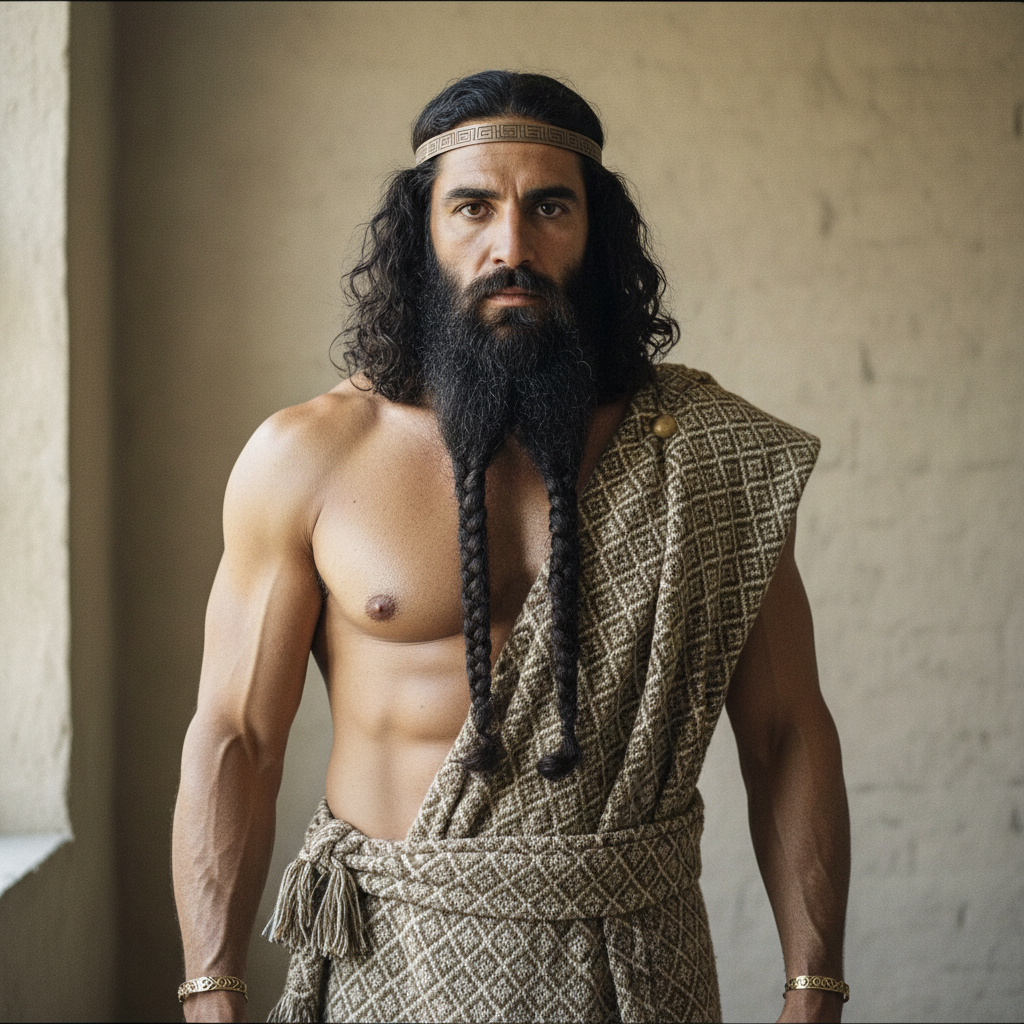
Physique and face: He would have presented as tall and broad-shouldered, with a muscular, athletic build befitting a warrior-king. Facial features likely included a strong jaw, prominent cheekbones, dark eyes, and an overall robust, angular face that reads as both noble and formidable. Skin tone would have matched southern Mesopotamian populations—olive to brown. Hair and beard: Long, dark hair modeled in flowing waves or tied back was the norm in heroic imagery; Gilgamesh would likely have worn his hair long and visible as a mark of status. He would almost certainly have sported a full, stylized "corded" beard—rows or tiers of sculpted beard common in Mesopotamian royal art—carefully groomed and possibly accented with a fillet or headband. Clothing and accoutrements: His clothing would signal elite rank: a richly patterned woolen robe or fringed kilt, decorated borders and geometric motifs, a broad belt, and heavy necklaces or armlets. In public or ritual contexts he might appear with a ceremonial mace, a finely worked dagger or sword at his side, and sturdy sandals—dressed to show authority as much as strength.
Height / build
Likely tall for his time · Likely muscular / broad-shouldered
Hair
Likely dark · Likely wavy to curly · Likely full hairline (long hair worn tied / braided)
Eyes
Likely dark
Complexion
Likely Mediterranean / West Asian (olive to light brown)
Face
Broad, strong jaw and square to oval face · Likely prominent, straight-to-aquiline nose
Notable features
Broad chest and shoulders, long braided beard, regal headband/diadem or patterned cloak, commanding posture
Grooming
Likely full, long, stylized beard (braided/corded) · Hair and beard were likely elaborately arranged and oiled, with beard cords or curls denoting elite status.
Dress / presentation
Sumerian/Uruk royal dress: fringed kilt, patterned cloak or shawl, jewelry and possibly a diadem
height build
Height
Likely tall for his time
Epic descriptions present him as larger-than-ordinary and iconography elevates kings' size; rulers were depicted as physically imposing compared to commoners.
height build
Build
Likely muscular / broad-shouldered
The epic emphasizes his strength and exploits; Mesopotamian royal imagery shows robust torsos for warrior-kings.
hair
Hair color
Likely dark
Population context for southern Mesopotamia indicates predominantly dark hair among inhabitants of Uruk.
hair
Hair style / texture
Likely wavy to curly, long and tied/braided
Mesopotamian elite men are routinely shown with worked, corded or braided hair on seals and reliefs; long hair signified status.
grooming
Facial hair
Likely full, long, stylized beard (braided/corded)
Royal male portraiture across Mesopotamia favors elaborate beards as a sign of masculinity and rank; epic heroes are bearded in iconography.
eyes
Eye color
In Gilgamesh's world, masculine authority combined visible strength, a carefully arranged beard and hair, and ornamental dress. Kingship was presented through physical vigor and groomed appearance: a long, corded beard, patterned garments, and jewelry signaled both divine favor and social control.
Gilgamesh would have resembled other inhabitants of southern Mesopotamia: dark hair and eyes, olive to light-brown skin, and physical features typical of Near Eastern populations of the third millennium BCE. The elite presentation—long hair, elaborate beard, rich textiles—distinguishes him from ordinary laborers.
Modern images often render Gilgamesh as a Greco-Roman or Northern-European blond hero or as a generic fantasy barbarian; historically he would look like a Mesopotamian ruler with dark hair, a long corded beard, and Sumerian royal dress.
Popular art often recasts Gilgamesh as a blond, Greco-Roman or fantasy barbarian rather than a Mesopotamian king. The real visual tradition favors dark hair, elaborately styled beards, and Sumerian dress—not the bare-chested, horned-helmeted barbarian trope.
Likely tall for his time—portrayals and epic language present him as larger and more imposing than ordinary men.
Likely dark (brown), consistent with southern Mesopotamian populations.
Likely dark, wavy to curly, kept long and tied or braided in status-enhancing cords.
Probably a full, long, stylized beard—braided or corded as in Mesopotamian royal imagery.
Yes—texts praise his striking appearance and heroic presence; he was presented as physically superior and charismatic.
Elite Sumerian dress: a fringed kilt, decorated cloak or shawl, jewelry, and possibly a headband or diadem marking kingship.
Epic of Gilgamesh (Standard Akkadian version)
Standard Akkadian Epic (compiled ~1st millennium BCE from older material); modern translations by Andrew George · Old/Standard Babylonian tradition (stories from 3rd–2nd millennium BCE; standard text ~1st millennium BCE)
Literary descriptions praise Gilgamesh's extraordinary strength, heroic bearing, and commanding presence—language that informs imagined physical stature and attractiveness.
Sumerian King List and Sumerian poems featuring Gilgamesh
Sumerian King List; Sumerian heroic poems (third-millennium fragments) · Third to second millennium BCE (compilations and copies)
Early textual tradition that places Gilgamesh as a royal figure and hero of Uruk, underpinning assumptions of elite dress and presentation.
Old Babylonian and Uruk-period cylinder seals showing hero/king fighting monsters or lions
Old Babylonian cylinder seal corpus / Uruk-period glyptic art · c. 3rd–2nd millennium BCE (various seals)
Seals depict a bearded, long-haired hero in patterned garments grappling with lions or monsters—iconography commonly linked to Gilgamesh-type figures and heroic kings.
Standard of Ur and other Early Dynastic visual scenes
Standard of Ur (Royal Cemetery, Ur) · c. 2600–2400 BCE
Panels show clearly differentiated elites: taller, better-attired figures with decorated robes and beards—useful parallels for royal appearance in Uruk.
Stele of the Vultures (relief imagery of elite warriors)
Stele of the Vultures · c. 2450 BCE
Reliefs show lined beards, patterned garments and hierarchical scale—demonstrates how Mesopotamian elites were visually shown as powerful and distinct.
Later Mesopotamian depictions of kings and heroes (Akkadian period onward)
Likely dark
Population genetics and frequent depictions of dark-eyed Mesopotamians imply dark brown eyes were most common.
skin
Complexion
Likely Mediterranean / light brown to olive
People of southern Mesopotamia typically had olive to light-brown skin tones; outdoor life would deepen complexion.
clothing
Clothing style
Fringed kilt and patterned cloak, jewelry and diadem
Sumerian royal dress in art shows fringed skirts, decorated veils/shal garments and ornamental headbands for elites.
face
Face / nose
Broad face with prominent straight-to-aquiline nose
Mesopotamian portraiture often emphasizes strong jawlines and prominent noses in elite male depictions.
cultural
Grooming
Elaborately groomed and oiled hair/beard
Textual praise of kingship and visual evidence show elite men used grooming as status display; beard- and hair-styling were common.
comparison
Presence in a room
Commanding and striking—would stand out by size, beard, and finery
Epic emphasis on charisma and iconographic markers of rank indicate he would be immediately recognized as ruler/hero.
Akkadian and Neo-Sumerian royal art · c. 2300–2000 BCE and later
Continuity in styles—corded beards, long hair, kilted garments—offers a visual tradition that informs reconstructions of legendary figures like Gilgamesh.