hair
Hair color
Likely dark (black to dark brown)
Mesopotamian royal images and regional population context indicate dark hair among elites; the stele shows dark coiffure styling.
Portrait reconstruction
1810 BCE–1750 BCE · Mesopotamia (Babylon) · Old Babylonian (c. 18th century BCE)
Hammurabi likely wore an ankle‑length robe, had dark hair and a groomed curled beard, and presented himself with the dignity of a king.
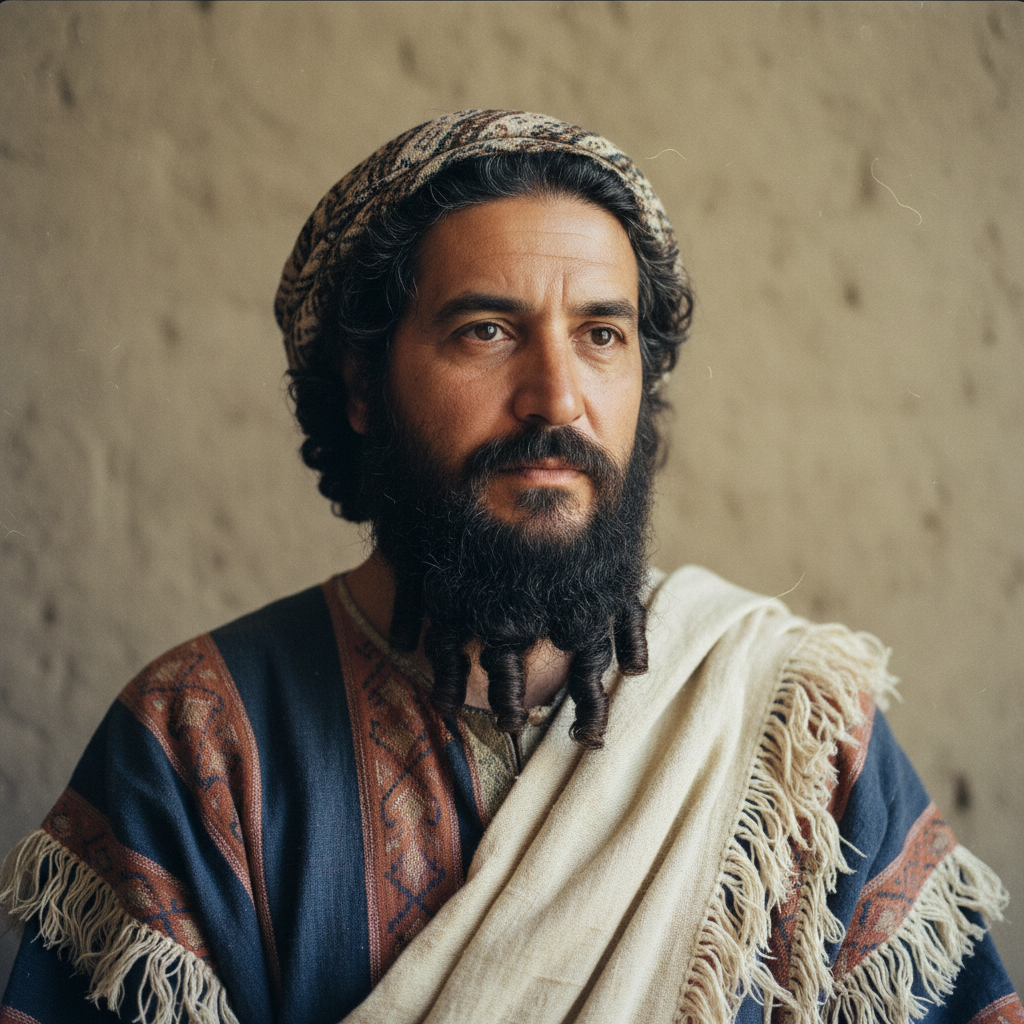
Face and hair: He probably had dark hair and a full, stylized beard shaped into tight curls or ringlets—an elite Mesopotamian look familiar from the stele and seal engravings. His facial features would have been presented in a dignified, somewhat idealized way: strong, broad features emphasized by the sculptor’s steady lines. Clothing and posture: Hammurabi is shown in an ankle‑length robe that falls in neat folds and may have had a belt or draped shoulder—royal dress meant to convey office and ritual authority. He would have stood or knelt with controlled, reverent posture, the public image of a lawgiver and temple patron rather than an informal portrait. Grooming and small details: Expect well‑kept hair, trimmed sideburns, and careful beard maintenance—grooming was a visible sign of status. He may have worn simple jewelry or a signet for sealing documents, and in ritual scenes he could appear barefoot or in sandals; he is not depicted with a diadem or horned crown, but with the plain, authoritative costume of an Old Babylonian king.
Height / build
Likely average to slightly tall for his time · Likely average build
Hair
Likely dark (black to dark brown) · Likely wavy to curly · Likely full hair, possibly receding with age
Eyes
Likely dark
Complexion
Likely Mediterranean / West Asian (olive to light brown)
Face
Likely broad to oval face · Likely straight to slightly aquiline
Notable features
Styled curled beard, long ankle‑length fringed robe, formal coiffure, authoritative posture
Grooming
Probably a full, carefully styled curled beard · Beard and hair likely groomed into the formal ringlets and rows seen in Mesopotamian royal iconography.
Dress / presentation
Ankle‑length patterned robe with fringes and possibly a shawl or ceremonial headdress
hair
Hair color
Likely dark (black to dark brown)
Mesopotamian royal images and regional population context indicate dark hair among elites; the stele shows dark coiffure styling.
grooming
Facial hair
Probably a full, curled beard
The stele's depiction and widespread Mesopotamian convention show kings with elaborately styled beards in rows of ringlets.
clothing
Typical dress
Ankle‑length fringed robe with decorative patterning
The basalt stele shows Hammurabi in a long, fringed garment; contemporary seals and reliefs show similar elite robes.
face
Face shape
Likely broad to oval
Mesopotamian portraiture tends to render rulers with broad, dignified faces; regional population features support this as a likely face shape.
eyes
Eye color
Likely dark
Population context for ancient Babylonia and common depiction conventions indicate dark eyes were most probable.
height build
Height and build
In Hammurabi’s world, authority was displayed through grooming and costume: long fringed robes, neatly arranged hair and elaborately curled beards signaled rank and piety. Physical presence mattered, but the emphasis was on ritual posture, inscriptions, and symbolic attributes—showing a ruler as mediator of divine order rather than a realistic individual portrait.
Hammurabi belonged to an Amorite dynasty ruling in a heavily Akkadianized Babylon; the population was a mix of West‑Semitic (Amorite) and local Mesopotamian groups. Picture a West Asian complexion, dark hair and eyes—features common across southern Mesopotamia.
Modern images often turn Hammurabi into a generic 'ancient warrior' or a Europeanized king; actual royal imagery shows him in ceremonial robe with a stylized beard and hair rather than bare‑chested combat gear.
Popular media often turns Hammurabi into a sword‑wielding, bare‑chested warrior or gives him European facial features. In reality he was most often represented in formal dress with a stylized beard and coiffure—more bureaucratic‑priestly king than action hero.
Likely average to slightly tall for his time—portraiture emphasizes presence more than exact height.
Likely dark—dark brown or brown tones were predominant in the region.
Likely dark—black to dark brown.
Yes—probably a full, carefully styled, curled beard as shown in royal imagery.
His formal ankle‑length fringed robe, styled beard and hair, and composed, ritual posture marking him as king and lawgiver.
Most visual impressions come from the top relief of the Code of Hammurabi stele and comparative Mesopotamian imagery, which supply grooming and costume details.
Stele of Hammurabi (top relief showing Hammurabi and Shamash)
Louvre Museum (Basalt stele of the Code of Hammurabi) · c. 1754 BCE (Old Babylonian period)
Relief at the top of the stele depicts Hammurabi in ankle‑length robe, with stylized hair and beard, kneeling/standing before the god Shamash—primary visual source for his attire and grooming.
Old Babylonian cylinder seals and reliefs
Various museum collections (Old Babylonian seals) · c. 19th–17th century BCE
Seal engravings and small reliefs show elite dress, beard styling, and coiffure conventions consistent with the stele.
Royal inscriptions and titulary of Hammurabi
Cuneiform inscriptions (royal texts) · circa reign of Hammurabi (c. 1792–1750 BCE)
Inscriptions identify Hammurabi’s titles and roles (king, lawgiver, builder) but do not give explicit physical description; they frame his public appearance as ritual and legal authority.
Assyrian and Neo‑Babylonian depictions of kings
Assyrian and Neo‑Babylonian reliefs and palace art · 1st millennium BCE (later periods)
Later Near Eastern royal iconography preserves the convention of bearded, robed kings; useful for cultural continuity though not direct portraits of Hammurabi.
Modern reconstructions and museum labels
Louvre and scholarly reconstructions · 20th–21st century
Contemporary museum reconstructions synthesize the stele relief and regional anthropology into public illustrations of Hammurabi’s appearance.
Likely average to slightly tall, average build
Kings are depicted with commanding proportions; biologically, ancient Mesopotamians were shorter than modern northern Europeans, so 'average to slightly tall' fits an elite ruler.
skin
Complexion / skin tone
Likely Mediterranean / West Asian (olive to light brown)
Amorite and Mesopotamian populations typically had olive to light‑brown skin tones; regional context supports this estimate.
hair
Hair texture
Likely wavy to curly
Royal depictions show curled rows and ringlets; local populations commonly have wavy to curly hair.
grooming
Grooming style
Carefully styled, ceremonial grooming
Royal iconography stresses neat beards and coiffures as marks of status; Hammurabi would follow elite grooming norms.
cultural
Public bearing
Authoritative and ceremonial
As king and lawgiver he is portrayed in formal, ritual posture (kneeling/receiving divine law) rather than in military action.