height build
Height
Likely tall for his time
Ancient narratives emphasize his commanding physical presence and leadership in battle, a trait often associated with above‑average height.
Portrait reconstruction
247 BCE–183 BCE · Carthage (born in North Africa), active in Iberia and Italy · Second Punic War era, Late 3rd–early 2nd century BC
Hannibal most likely looked like a dark‑haired, olive‑skinned man with an angular face, a prominent nose, intense dark eyes, and a lean, athletic frame.
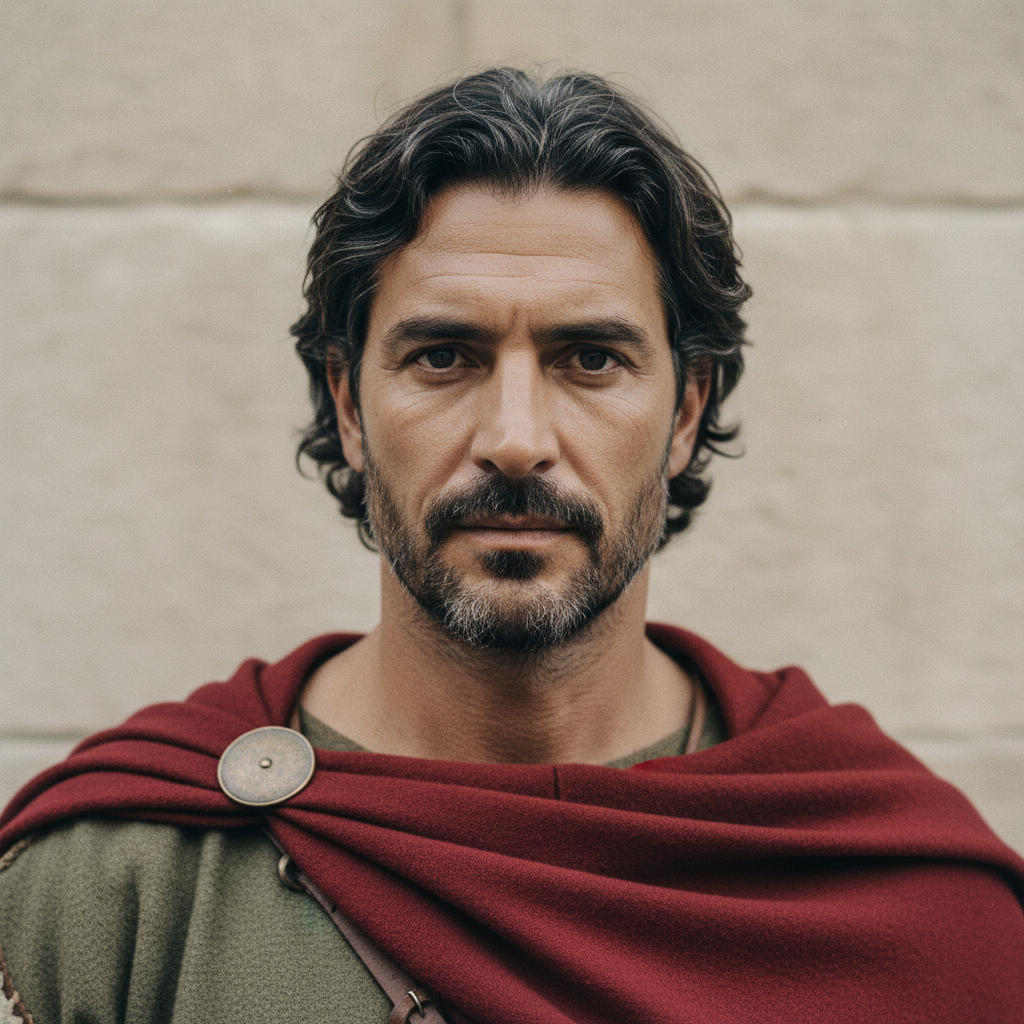
His face: picture a sharply angled face with high cheekbones and a strong, slightly aquiline nose—features that give an immediate impression of intensity and focus. His eyes were probably dark and alert, the kind of steady gaze associated with commanders who read a battlefield at a glance. Overall complexion would have been olive to a deeper Mediterranean brown, consistent with coastal North African and Levantine ancestry. Hair and grooming: likely dark, somewhat wavy hair kept short for campaigning, with a neatly trimmed beard or close stubble rather than a full flowing beard. His expression would read as controlled and determined—calm in public, fierce in command—so portraits often emphasize a taut mouth and a concentrated, penetrating look. Body and dress: imagine a lean, wiry build honed by long marches and battlefield exertion rather than heavy muscle mass; medium height by ancient Mediterranean standards and highly mobile. On campaign he would favor practical military dress—a plain tunic, a protective cuirass or leather gear, and a cloak fastened with a fibula—projecting purposeful austerity more than flamboyance.
Height / build
Likely tall for his time · Likely lean and wiry
Hair
Likely dark to graying · Likely wavy · Likely somewhat receding in later middle age
Eyes
Likely dark
Complexion
Likely Mediterranean complexion
Face
Likely oval to angular · Likely straight to slightly aquiline (prominent bridge)
Notable features
Prominent nose, keen dark eyes, weathered skin from campaigning, purposeful bearing
Grooming
Probably clean‑shaven or with closely trimmed beard/stubble · Likely kept hair short and practical for campaigning; elite status means grooming would be neat, even in the field.
Dress / presentation
Hellenistic/Punic military attire: short tunic, cloak (often draped), and practical boots; sometimes depicted with a commander’s cloak over armor.
height build
Height
Likely tall for his time
Ancient narratives emphasize his commanding physical presence and leadership in battle, a trait often associated with above‑average height.
height build
Build
Likely lean and wiry
Decades of long marches, mountain campaigns and active field command would favor an endurance‑oriented, wiry musculature.
hair
Hair color
Likely dark to graying
Punic (Phoenician) ancestry implies dark hair; later portraits and literary notes reference graying during later campaigns.
hair
Hair texture
Likely wavy
Mediterranean and Levantine populations commonly have straight to wavy hair; surviving busts and depictions of contemporaries show wavy styles.
hair
Hairline
Likely somewhat receding (midlife)
Later period busts and portraits traditionally identified as Hannibal show a higher forehead consistent with midlife receding hairline.
eyes
Eye color
Carthaginian elite taste blended Phoenician tradition with Hellenistic styles. Generals presented themselves as functional and authoritative: neat hair, practical tunics and cloaks, and a bearing that signaled control and discipline. Ornamentation was less flamboyant in the field; symbols of status were more evident in ceremonial contexts.
Hannibal’s family came from the Phoenician‑derived elite of Carthage; physically he would resemble coastal North African and eastern Mediterranean populations—dark hair, dark eyes, olive to brown skin—similar to other Punic elites and many Iberian allies he commanded.
Modern films and paintings often exaggerate exotic traits (e.g., wildly dark or flamboyant outfits) or make him overwhelmingly non‑Mediterranean; historically he would have looked recognizably Mediterranean and practical in dress.
Modern films and art often turn Hannibal into an exotic 'outsider' with stylized clothing, dramatic facial scars, or non‑Mediterranean features. Historically, he would have looked Mediterranean and practical — impressive through bearing and leadership, not theatrical costume or monstrous features.
Likely tall for his time — ancient writers emphasize his commanding physical presence.
Likely dark.
Likely dark, often graying during his later campaigns.
Probably clean‑shaven or with a short trimmed beard/stubble.
His intense, commanding bearing — a purposeful expression, military cloak, and the look of a seasoned commander.
Descriptions come from ancient historians and later portraiture; physical statues attributed to him are Roman and later, so reconstructions combine texts, cultural context, and surviving images.
Polybius — The Histories (accounts of Hannibal and the Second Punic War)
Polybius · 2nd century BC (c. 150–120 BC)
Near‑contemporary narrative emphasizing Hannibal’s leadership, composure and battlefield presence; provides contextual descriptions of behavior and stature rather than a detailed physical portrait.
Livy — Ab Urbe Condita (history of Rome including Hannibal)
Livy · Late 1st century BC – early 1st century AD
Roman narrative that describes Hannibal’s actions and character; contributes to impressions of his commanding presence and occasional descriptive phrases later used in portraiture.
Plutarch and Appian — Later ancient biographies and histories
Plutarch; Appian · 1st–2nd century AD
Later classical accounts that include colorful descriptions and anecdotes shaping Hannibal’s long‑term image; useful for how later antiquity visualized him.
Roman marble busts traditionally identified as Hannibal
Various Roman imperial period sculptures (museum collections) · 1st century BC – 2nd century AD (Roman period)
Several later Roman busts have been labeled 'Hannibal' by collectors and scholars; they show an angular face, prominent nose and intense gaze — features that inform modern visual reconstructions though their direct connection to Hannibal is uncertain.
Silius Italicus — Punica (epic poem about the war)
Silius Italicus · 1st century AD (c. 1st century)
Poetic, later depiction that dramatizes Hannibal’s character and appearance; influenced medieval and Renaissance imagery more than historical fact.
Renaissance and modern portraits and prints
Various artists (16th–20th centuries) · 16th–20th centuries
Artistic imaginings that shaped popular images—often dramatized, sometimes exoticized; useful for understanding how modern ideas of Hannibal formed but not for direct appearance evidence.
Likely dark
Mediterranean/Levantine background makes dark eyes the most probable trait.
face
Nose
Likely straight to slightly aquiline
Many later portraits and sculptural types attributed to Hannibal display a prominent nasal bridge; such noses are common among Mediterranean elites depicted in Hellenistic art.
grooming
Facial hair
Probably clean‑shaven or short beard
Hellenistic and Punic elites often favored neat grooming; later Roman images vary but commonly show Hannibal without heavy beard.
skin
Complexion
Likely Mediterranean complexion
Punic ancestry from Phoenician settlers in North Africa and long southern European campaigns produce a darker Mediterranean skin tone.
clothing
Typical dress
Hellenistic/Punic military tunic and cloak
Contemporary commanders in the western Mediterranean combined local Punic dress with Hellenistic military cloak and practical campaign gear.
cultural
Presence
Commanding and intense
Ancient writers repeatedly emphasize Hannibal’s persuasive will, composure, and striking battlefield demeanor — traits that register visually as intensity and command.
comparison
Compared to Romans
Recognizably Mediterranean but distinct in Punic dress and bearing
Cultural clothing and grooming would mark him as Carthaginian rather than Roman even while sharing Mediterranean physical features.
Punic and Phoenician cultural context (archaeological and historical summaries)
Archaeological syntheses of Punic culture · Modern scholarship (20th–21st c.)
Provides population and dress context—how Punic elites dressed and groomed, and common physical traits among coastal North African and Levantine populations.