height build
Height
Likely tall for his time (around 6'0"–6'2")
Diplomatic descriptions and portraits show him taller than most courtiers; comparative measures from armor and effigies support a stature above average.
Portrait reconstruction
1491–1547 · England · Early Modern (Tudor England)
Henry VIII looked like a tall, square-jawed king with ruddy fair skin, reddish-auburn hair, light eyes, and an unmistakably broad, padded Tudor silhouette.
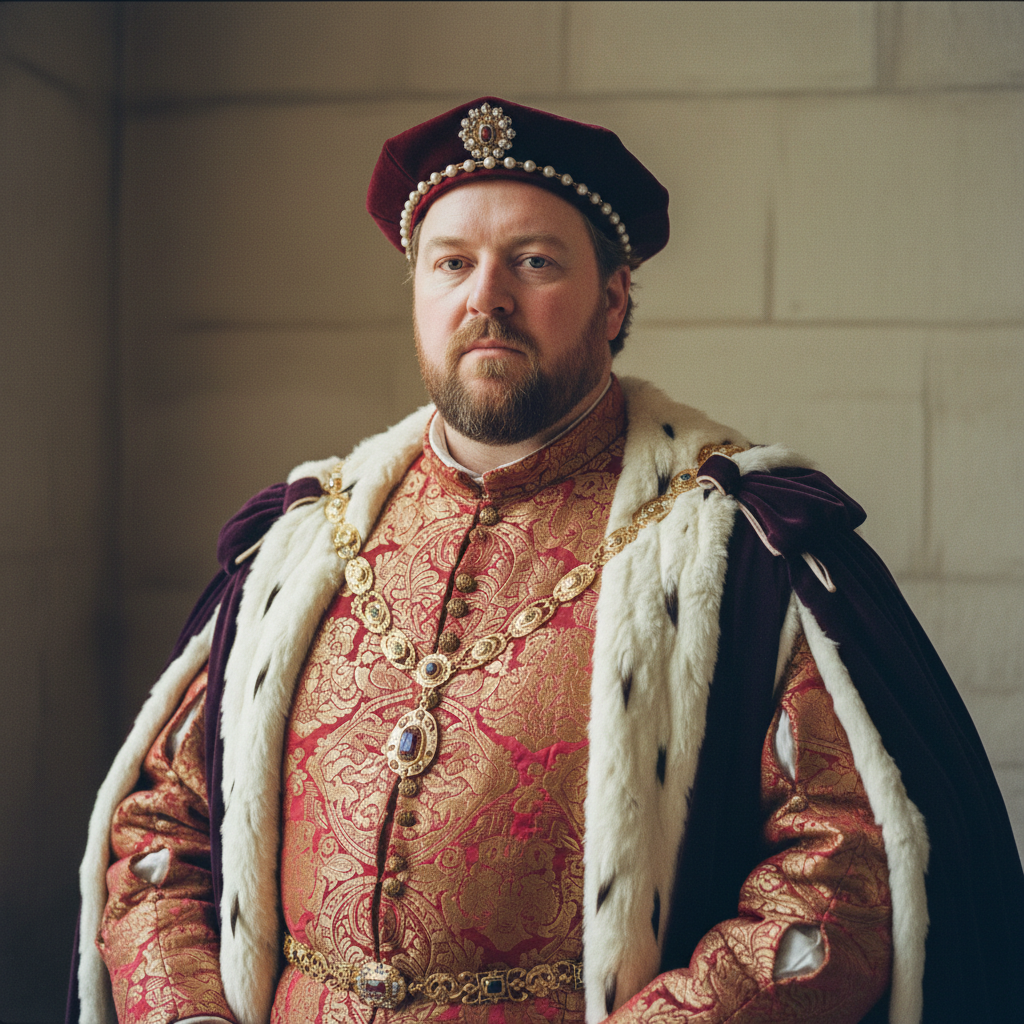
Height and build: Henry projected height and power—contemporary portraits and descriptions present him as well over average stature, probably around 6' (1.8–1.9 m), with very broad shoulders, a thick neck, and a strong, square jawline. In his younger years he appears muscular and athletic; by the last decade of his life his face and body became much fuller, giving him a heavy, imposing presence. Face, hair and grooming: His skin was fair with a ruddy or florid tone; his hair was likely a deep auburn to reddish-brown, cut relatively short and often covered by caps or hats. Portraits and court fashion show him most often clean-shaven or with only minimal facial hair—his jaw and chin were prominent, his nose straight, and his eyes light in color (pale gray or light hazel is likely). Dress and silhouette: Henry’s appearance was amplified by Tudor tailoring: heavily padded doublets, wide-shouldered gowns, fur trims, and jewelled collars that created a square, majestic silhouette designed to read as power at a glance. Armor from the Greenwich workshops and royal wardrobe inventories confirm the extreme padding, rich fabrics, and ornament that made him look larger-than-life on canvas and in person.
Height / build
Likely tall for his time (around 6'0"/1.83–6'2"/1.88 m) · Likely heavily built — broad-shouldered and muscular in youth; very large/obese in later life
Hair
Likely auburn/reddish, later graying · Likely straight to slightly wavy · Likely receding, with thinning at the temples and crown later in life
Eyes
Likely light — blue or gray
Complexion
Likely fair with a ruddy (flushed) complexion
Face
Square, broad-jawed · Straight and prominent
Notable features
Very broad shoulders and chest, full round face in later life, strong jawline, often shown with a flat jeweled cap or wide-brimmed hat.
Grooming
Probably clean-shaven in his youth; later wore a trimmed beard and mustache · Carefully groomed and cosmetically managed (pale face and rouge were fashionable); hair and facial hair kept neat and styled to royal fashion.
Dress / presentation
Extravagant Tudor royal dress — heavy brocade, furs, velvet, jewels, wide sleeves and explicit display of rank (often with a prominent codpiece and ornamented belts).
height build
Height
Likely tall for his time (around 6'0"–6'2")
Diplomatic descriptions and portraits show him taller than most courtiers; comparative measures from armor and effigies support a stature above average.
height build
Build
Likely broad and heavily built — athletic in youth, extremely large later
Accounts of his youth describe athletic prowess and jousting; later portraits and observers record marked weight gain and a wide, powerful torso.
hair
Hair color
Likely auburn/reddish, later graying
Multiple portraits and family portraits show reddish tones; later images and descriptions note graying.
hair
Hairline
Likely receding with thinning at the crown in later life
Portraits and effigies show a high forehead and reduced hair at temples; descriptions of later years refer to thinning hair.
eyes
Eye color
Likely light (blue or gray)
Many painted likenesses and court records imply light eyes typical of northern European nobility; painted irises are light rather than dark.
skin
In Tudor England physical signs of vigor—broad shoulders, a strong stance, and an assertive face—were read as proof of masculine authority. Henry deliberately emphasized these traits with padded garments, wide silhouettes, and sumptuous decoration to make his body read as royal power. Cosmetics (paler skin, rouge) and well-trimmed hair/facial hair were part of courtly grooming.
The Tudor royal line combined Welsh and English roots with continental marriages; Henry's fair-to-ruddy skin, light eyes and reddish hair are consistent with late medieval northern-European elites and are echoed across portraits of his family.
Modern media often exaggerates his late-life obesity and villainous looks; the iconic Holbein image is a deliberate royal pose and not a casual snapshot — many films compress decades of change into a single caricature.
Movies commonly freeze Henry's final decades into a single grotesque image—hobbling, enormously obese, and monstrous. While he did become very large and ill in the 1540s, many iconic images (e.g., Holbein) are idealized or represent a middling phase; not every portrait captures the same stage of life.
Yes — likely tall for his time, roughly around 6'0"–6'2" (1.83–1.88 m), so he would have appeared noticeably taller than most contemporaries.
Likely light — blue or gray, as indicated by painted likenesses and descriptions of his appearance.
Probably auburn/reddish in youth, becoming grayer with age; hair appears straight to slightly wavy in portraits.
He was clean-shaven in his youth and early reign, later adopting trimmed beard and mustache styles common at court.
He was considered striking, virile and majestic — more imposing than delicately handsome; contemporaries admired his vigor, especially in youth.
Portraits give a strong visual sense but are crafted images — they emphasize royal authority and may idealize features; taken together with written accounts they form a consistent portrait of his look.
Portrait of Henry VIII by Hans Holbein the Younger (full-length, c.1536–1537)
Hans Holbein the Younger / National Portrait Gallery reproduction · c.1536–1537
Iconic frontal portrait presenting Henry as broad-shouldered, square-jawed, with reddish hair, light eyes, and elaborate royal dress; a constructed royal image emphasizing power.
Multiple miniatures and portraits (various artists, 1510s–1540s)
Tudor court portraiture (various painters) · 1510s–1540s
Series of dated likenesses that together show changes across Henry's life — athletic youth, mature king, and much heavier later years; consistent features include fair/ruddy skin and a strong jaw.
Letters and dispatches of Eustace Chapuys (imperial ambassador)
Eustace Chapuys, ambassador to Henry VIII's court · 1529–1545 (letters)
Diplomatic correspondence that remarks on Henry's stature, presence, and changing health/weight, often comparing him to other European rulers and court figures.
Funeral effigy and tomb imagery (St George's Chapel, Windsor)
Tudor funeral effigy and tomb · 1547 (funeral effigy date)
Effigies and tomb sculptures present an idealized king with royal garments and a broad form; useful for posture, garments and proposed silhouette.
Royal wardrobe inventories and Greenwich armour
Royal inventories; Greenwich workshops · 16th century
Detailed records of fabrics, cuts and decorations confirm the extravagant, heavily padded silhouettes and jeweled accessories seen in portraits.
Tudor coinage portraiture
Henry VIII coins (medals and coins) · 16th century
Profile representations show facial outlines and royal attributes; coins are stylized but confirm key facial proportions used in other media.
Complexion
Likely fair with a ruddy (flushed) tone
Portraits consistently show fair skin with rosy cheeks; written descriptions mention ruddy complexion.
grooming
Facial hair
Probably clean-shaven early; trimmed beard and mustache later
Early portraits show a clean-shaven face; later images and Tudor fashion show a trimmed beard/tuft as he ages.
clothing
Dress
Extravagant Tudor royal garments with furs, jewels, and wide silhouettes
Surviving portraits and inventories document sumptuous fabrics, jeweled collars, and the broad silhouette that emphasized chest and shoulder breadth.
face
Jaw and face
Square, strong jawline and broad lower face
Portraiture emphasizes a powerful jaw and square face to convey strength and authority.
other
Presence
Commanding and majestic — built for display
His portraits, posture and dress are designed to project sovereign power and virility; contemporaries note his imposing presence.