face
Nose
Prominent, aquiline nose
Multiple surviving portraits and coin portraits emphasize a projecting, curved nose consistent across media.
Portrait reconstruction
73 BCE–4 BCE · Judea (client king under Rome) · Late Hellenistic / Early Roman (1st century BCE)
Herod probably had short dark hair with a receding hairline, a prominent nose, a broad, clean‑shaven face, and an olive to light‑brown complexion.
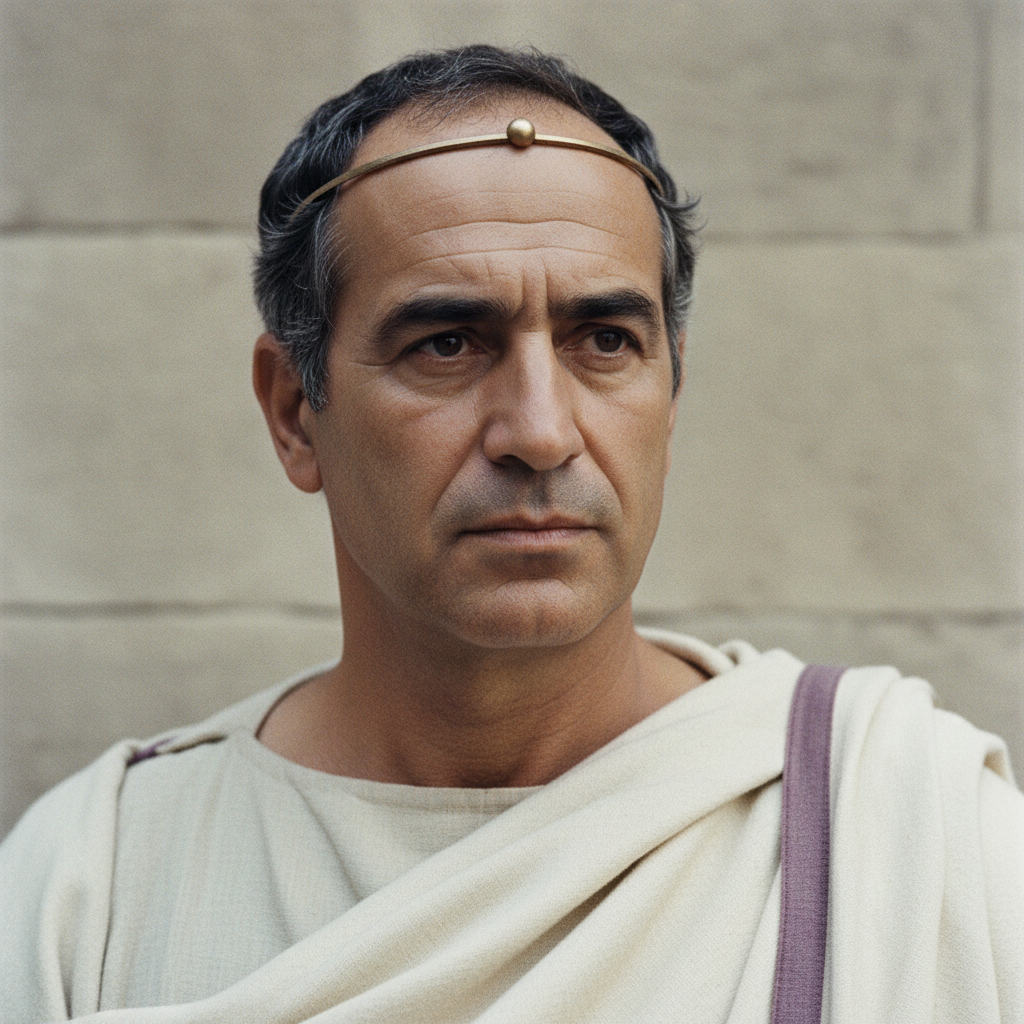
Herod’s hair was likely dark and cut short in the Roman style, with a receding forehead that made his brow and nose more prominent. Portrait heads and coins consistently show a compact hairstyle rather than long curls or a flowing mane. Facial hair appears absent in those images, so he was probably clean‑shaven like many Hellenistic and Roman elites. His most striking feature was likely a strong, prominent nose and a broad face set beneath a heavy brow; several portrait heads emphasize that profile. As he aged, portraits and accounts suggest his face acquired harder lines—creasing around the mouth and deeper folds at the cheek—giving him a harsh, imposing bearing. Skin tone was probably in the Mediterranean range: olive to light‑brown, consistent with Levantine ancestry and the region’s climate. Overall he would have read as a compact, solidly built ruler: Roman‑influenced grooming and dress, the pronounced nose and broad features of a Levantine noble, and facial lines that signaled authority and age rather than youthful softness.
Height / build
Likely average to slightly above average height for his time · Likely solid / stocky (robust)
Hair
Likely dark to graying · Likely straight to slightly wavy · Receding (thinning at temples/front)
Eyes
Likely dark (brown)
Complexion
Likely Mediterranean complexion (olive to light‑brown)
Face
Broad, full face · Prominent, aquiline (hooked) nose
Notable features
Aquiline nose, receding hairline, broad face, dignified Romanized bearing
Grooming
Probably clean‑shaven · Short, neatly trimmed hair and clean‑shaven face in the Roman/Hellenistic elite fashion; carefully presented in public.
Dress / presentation
Elite Hellenistic‑Roman dress (togas/pallium, royal diadem or crown on ceremonial occasions)
face
Nose
Prominent, aquiline nose
Multiple surviving portraits and coin portraits emphasize a projecting, curved nose consistent across media.
hair
Hairline
Receding / thinning at the front
Busts and medal‑type portraits show a high forehead and thinning hairline; Roman elite portraiture commonly records such features.
hair
Hair color
Likely dark to graying
As an eastern Mediterranean man, natural hair would be dark; many portraits indicate darker hair with signs of age.
grooming
Facial hair
Probably clean‑shaven
Coins and portraits nearly always depict him without a beard, matching Roman elite grooming norms of the period.
eyes
Eye color
Likely dark (brown)
Typical eastern Mediterranean pigmentation and absence of contrary evidence make dark/brown eyes the most plausible.
skin
Complexion
Likely Mediterranean (olive to light‑brown)
Herod operated in a visual culture that prized Roman civic dignity and Hellenistic royal magnificence. That meant neat grooming (short hair, clean‑shaven face), a controlled, authoritative bearing, and public dress that signaled both Roman allegiance (togas/pallium) and local royal status (diadem or crown in ceremonial contexts). Showing age and gravitas could enhance authority more than youthful beauty.
Herod was of Idumaean (Edomite) descent ruling a mixed Judean population; his appearance would fit eastern Mediterranean types—olive skin, dark hair and eyes—while his royal role and elite marriage alliances brought Hellenistic and Roman visual languages into his portraits.
Modern films often over‑sensationalize Herod as exotic, monstrous, or theatrically flamboyant; surviving portraits and coins show a Romanized, sober elite appearance rather than caricature.
Popular films and later art often cast Herod as grotesque, otherworldly, or exotically dark; archaeological portraits and coins instead show a Romanized, sober elite figure—less theatrical villain, more pragmatic client ruler who used Roman dress and grooming to project power.
Likely average to slightly above average height for a first‑century BCE eastern Mediterranean man.
Likely dark brown—typical for eastern Mediterranean populations.
Probably not—he is usually shown clean‑shaven, following Roman elite fashion.
Likely balding or with a receding hairline, not fully bald.
Elite Hellenistic‑Roman garments—togas or pallia for civic occasions and a royal diadem or distinctive insignia in ceremonial settings.
They present a consistent visual type—clean‑shaven, short hair, prominent nose—used as a public image; while not photographic, the recurrence across media supports identification.
Herodian coin portraits (bronze coins)
Numismatic corpus (Meshorer and others) · 37–4 BCE (Herodian minting period)
Bronze coins struck under Herod show a beardless, short‑haired male bust with a pronounced nose and receding forehead—key visual evidence used for his likely facial features and grooming.
Sebaste / Samaria head (archaeological portrait often attributed to Herod)
Sebaste archaeological find (Samaria) · 1st century BCE–1st century CE (attributed)
A marble head found at Sebaste (Samaria) shows a broad face, receding hairline, and pronounced nose similar to coin portraits; widely discussed as a possible representation of Herod or contemporary elite.
Other Herodian portrait heads (e.g., from Caesarea and Jerusalem contexts)
Herodian-era sculptural portraits (various finds) · 1st century BCE–1st century CE
Several portrait heads from Herodian architectural contexts share stylistic traits—short hair, clean‑shaven visage, prominent nose—forming a consistent visual type attributed to Herod or his court.
Flavius Josephus — narrative accounts
Flavius Josephus, Antiquities of the Jews; The Jewish War · 1st century CE
Josephus provides descriptions of Herod’s personality, public acts, and occasional remarks about his physical presence and aging; used to contextualize portraits and public image though not a painterly description.
Later Roman/Byzantine and medieval depictions
Medieval and Renaissance images of Herod · Middle Ages–Renaissance (later)
Artistic traditions preserved stories about Herod’s appearance but often idealize or demonize him; these images are useful for understanding later reception rather than primary likeness.
Idumaean/Judean background and regional ancestry point to an olive/medium brown complexion.
height build
Build
Likely solid / stocky (robust)
Royal lifestyle and depictions implying a commanding presence favor a sturdy, well‑nourished build rather than a lean warrior's frame.
clothing
Typical dress
Hellenistic‑Roman elite garments (pallium/toga), ceremonial diadem
As a Roman client king Herod adopted Roman civic dress for public functions and Hellenistic royal insignia in ceremonial contexts.
face
Face shape
Broad, full face with strong jaw
Sculptural portraits show a wide, full face and pronounced jawline, consistent across several artifact portraits attributed to him.
other
Age appearance
Mostly portrayed as middle‑aged to older
Most portraits and coins depict him with signs of maturity (receding hairline, lined face) consistent with his appearance in later life.