height build
Height
Likely average to short for modern standards
Fits typical female stature in 12th‑century northern Europe (~150–160 cm).
Portrait reconstruction
1098–1179 · Rhineland, Holy Roman Empire (modern Germany) · High Middle Ages (12th century)
Hildegard of Bingen likely appeared as a veiled Benedictine abbess with a long face, prominent nose, and striking, visionary eyes.
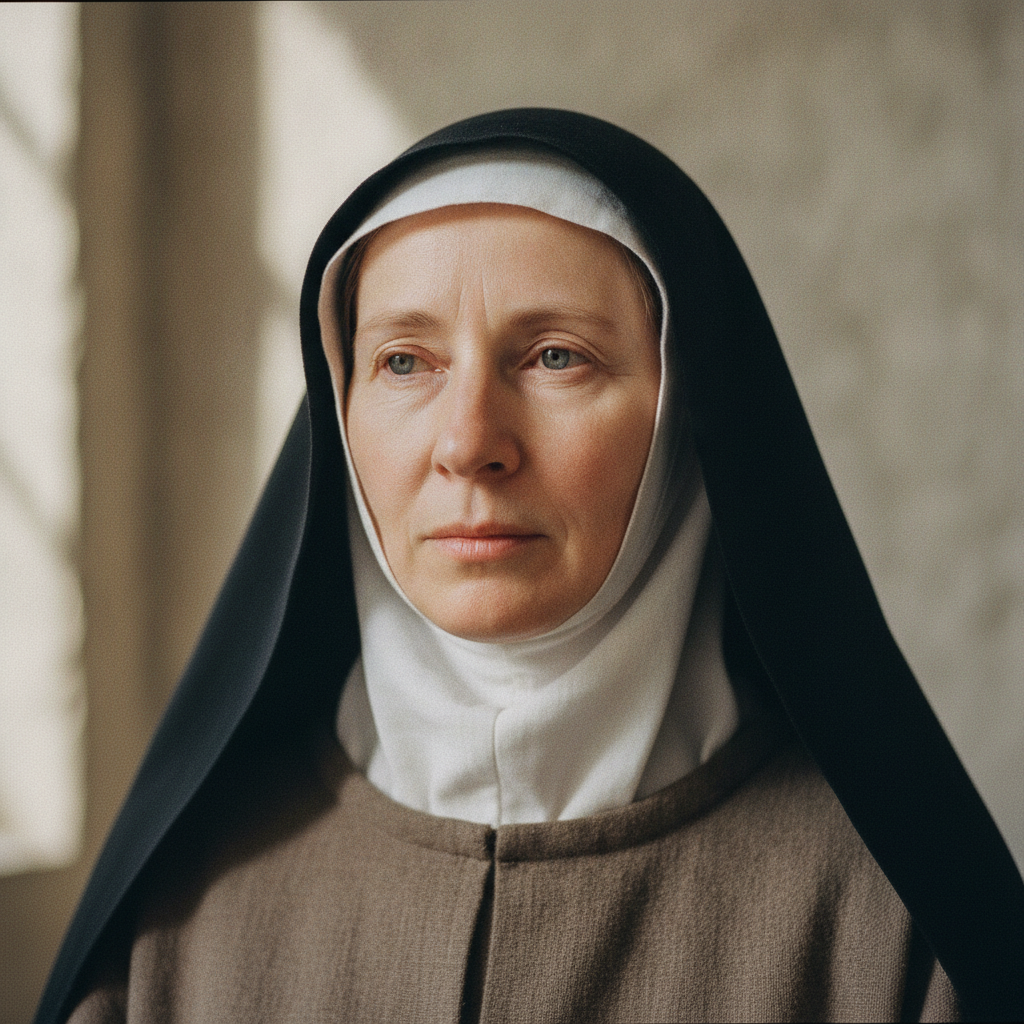
In the manuscript images that shape her portrait, Hildegard’s face is long and narrow—an elongated jaw and forehead framing a prominent, slightly hooked nose that gives her profile a clear, memorable silhouette. Her eyes are often drawn large and focused, conveying intensity and the inward gaze of a visionary; imagine a steady, piercing look rather than softness. Her hair would have been concealed beneath the nun’s wimple and veil, so visible hair is unlikely—if seen, it was probably dark brown, typical of Rhineland women. The habit and wimple leave only the face and neck exposed, which accentuates the face’s length and the eyes’ expressiveness. She is usually shown as middle‑aged to older, with a composed, authoritative bearing and subtle lines suggesting life and leadership rather than youthful smoothness. Clothing and posture complete the visual: a plain Benedictine veil, wimple and dark habit, often with a simple clasp or cross; she carries the air of an abbess—upright, deliberate, and inwardly intense. Overall, think of a austere but striking presence: compactly dressed, face narrow and memorable, eyes that read as both seeing and commanding.
Height / build
Likely average to short for modern standards (average for 12th‑century northern European women) · Likely slender to average build
Hair
Likely light brown to auburn · Likely straight to gently wavy · Likely hair normally covered by veil; hairline unknown when uncovered
Eyes
Likely light—blue‑gray or green (common in the region)
Complexion
Likely fair, possibly ruddy from northern climate
Face
Likely long/narrow face · Likely prominent or straight (often shown as pronounced in medieval images)
Notable features
Long face, prominent nose, intense visionary gaze; usually shown with halo or symbolic flames in visions
Grooming
None (female, clean-shaven face) · Typically veiled and wimpled as a Benedictine nun; hair and jewelry modest or absent in public.
Dress / presentation
Benedictine habit: wimple, veil, tunic/scapular and sometimes an abbess's cloak; plain, modest colors and no ostentatious jewelry
height build
Height
Likely average to short for modern standards
Fits typical female stature in 12th‑century northern Europe (~150–160 cm).
height build
Build
Likely slender to average
Monastic life, modest diet, and noble background support a moderate, not heavy, build.
eyes
Eye color
Likely light—blue‑gray or green
Light eyes were common in the Rhineland population; medieval portraits emphasize bright, intense eyes for visionary figures.
hair
Hair color
Likely light brown to auburn
Northern German ancestry and later depictions that suggest lighter tones when hair is shown.
hair
Hair texture
Likely straight to gently wavy
Regional hair texture tendencies and how her hair is sometimes stylized in manuscript images.
grooming
Hairline/coverage
Likely covered by a wimple and veil
As a Benedictine nun and abbess she is almost always shown veiled in contemporary images and would present this way publicly.
In Hildegard's world, female religious authority was expressed through modest, veiled dress and a dignified bearing rather than ornament. An abbess's public presence emphasized sobriety, visible office (habit and veil), and spiritual charisma—so her look would read as austere and authoritative rather than glamorous.
Hildegard came from the Rhineland region, whose 12th‑century population tended toward fair complexions and a higher incidence of light eyes than southern Europe. Picture her as a northern medieval German woman: fair skin, likely light brown or reddish hair, and eyes that could be blue‑gray or green.
Modern portraits often show long loose hair, flowing red locks, or romanticized youth—actual presentation was far more austere and veiled.
Contemporary films and romantic paintings often show Hildegard with flowing uncovered red hair or as a youthful bohemian figure. In reality she presented almost always veiled in a habit and is most often depicted as a mature, sober abbess; the romantic loosened-hair trope is a modern invention.
She was probably average to short by modern standards—around the typical 12th‑century female height (roughly 150–160 cm).
Likely light—blue‑gray or green, consistent with northern German population traits and how manuscripts emphasize bright eyes.
Most likely light brown to auburn when shown, but she usually wore it covered by a wimple and veil.
She would have been seen as striking and authoritative rather than conventionally ornamental—her charisma and visionary reputation made her visually compelling.
She normally wore a Benedictine wimple and veil as an abbess; public images show her veiled almost always.
We rely on 12th‑century manuscript portraits, her role and monastic dress rules, and modern scholarly synthesis to make a best-supported visual portrait.
Scivias manuscript illuminations (Rupertsberg/Wiesbaden copies)
Scivias miniatures, 12th century · 12th century (c.1150s–1160s)
Multiple contemporary manuscript miniatures depict Hildegard veiled in a Benedictine habit with a long face, prominent nose, and intense gaze—these images are the primary visual tradition shaping her appearance.
Hildegard's own works and letters (descriptive context)
Liber Scivias, Liber Divinorum Operum, Letters · 12th century (authored by Hildegard)
Hildegard's writings concern visions and spiritual matters and occasionally reference her role and public presence; they do not give a medical portrait but support the image of an authoritative, visionary figure.
Medieval vitae and later contemporary descriptions
Later medieval biographies and short vitae · 12th–13th centuries
Hagiographic accounts reinforce the iconographic trend—emphasizing her spiritual authority and visions rather than physical detail, but they contributed to visual conventions used by illuminators.
Post‑medieval and Romantic depictions
19th–20th century paintings and film portrayals · 1800s–2000s
Later art often romanticized Hildegard with loose flowing hair and sensual presentation; useful for modern popular image but less reliable for historical appearance.
Scholarly syntheses on Hildegard's life and image
Modern biographies and studies (e.g., Barbara Newman, Sabina Flanagan) · late 20th–21st century
Modern historians synthesize manuscript images, textual evidence, monastic rules and population context to reconstruct a plausible portrait emphasizing habit, age, and bearing.
Miniatures from Liber Divinorum Operum and related manuscripts
Liber Divinorum Operum miniatures, 12th century · 12th century
face
Facial features
Likely long face with a prominent/straight nose
Manuscript portraits and later medieval descriptions commonly emphasize a narrow face and pronounced nose in images of Hildegard.
skin
Complexion
Likely fair (possibly ruddy)
Northern European background and manuscript skin-toning conventions favor a fair complexion.
clothing
Typical dress
Benedictine habit with wimple and veil
Hildegard was an abbess; surviving images and the rule of Benedict indicate a modest monastic habit.
other
Facial hair
None
Female; manuscript and textual conventions show her clean‑faced.
cultural
Public bearing
Commanding, visionary stare
Illuminations emphasize an intense gaze to mark her prophetic role; texts describe her authoritative spiritual presence.
comparison
How she'd stand out
Veiled abbess with a visionary mien—seen as spiritually striking in a crowd
Clothing and the hallmark depiction of her vision-bearing face made her visually distinct in a monastic setting.
Additional manuscript illustrations show Hildegard in visionary scenes—again reinforcing the veiled abbess image with a distinctive face and expressive eyes.