face
Facial type
Likely oval to rounded face
Skeletal studies of Yayoi/Jōmon-descended populations show predominately oval/rounded facial proportions typical of East Asian groups of the period.
Portrait reconstruction
0–0 · Yamatai (ancient Japan; central/western Honshū/Kyūshū debated) · Late Yayoi — early 3rd century CE
Himiko probably wore her long dark hair piled and pinned and stood about 150–155 cm tall, dressed in layered ceremonial robes with beads and hair ornaments that marked her role as shaman-queen.
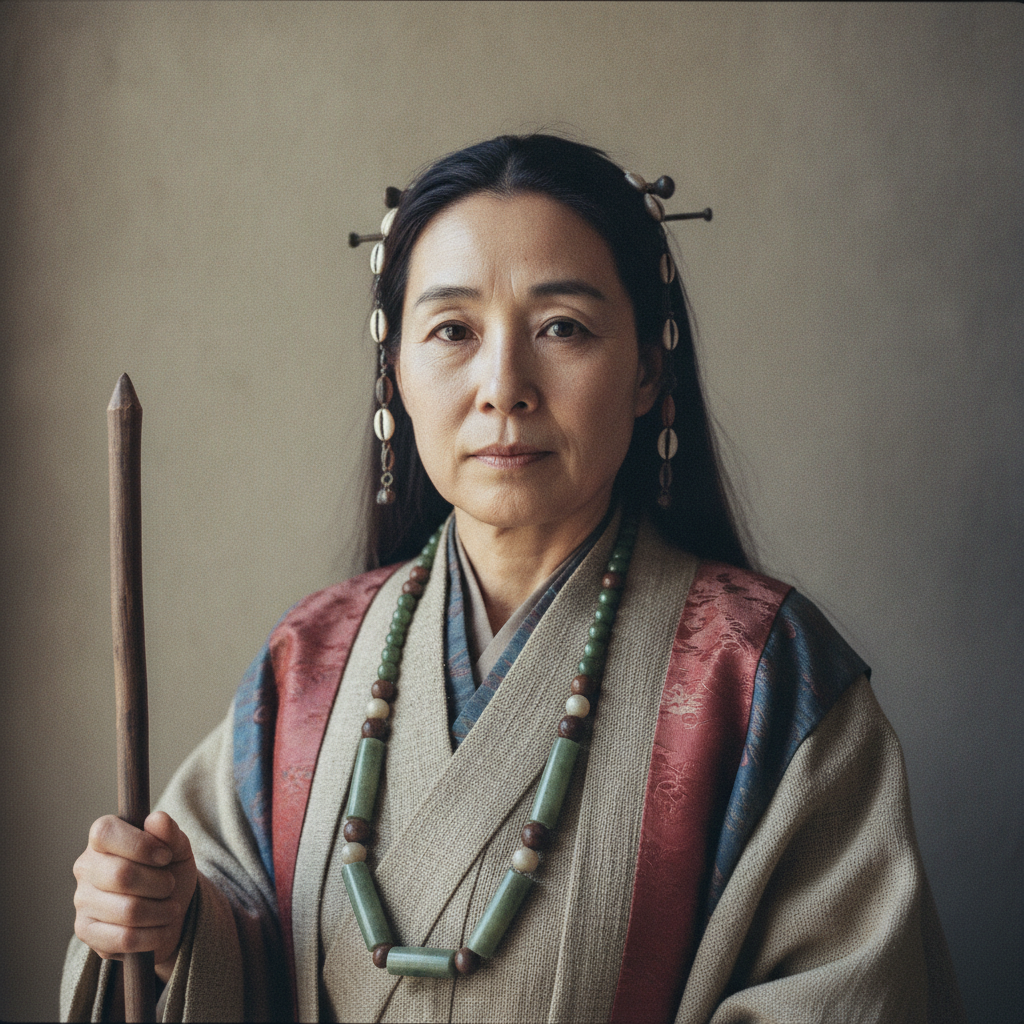
Hair and face: Likely long, straight dark hair—fastened up in a high or low chignon and secured with wooden or metal hairpins and bead strings so only the face and a neat hairline were visible. Her face would have been shown with calm composure rather than theatrical display: smooth skin, arched brows, and a focused expression that matched ritual duties. Build and skin: Physically she would have resembled other Yayoi women of elite status—compact and sturdy, roughly 150–155 cm tall, with a posture shaped by ceremonial life rather than athletic labor. Her skin tone would have matched the East Asian populations of the archipelago: not pale-modernized, but a natural medium tone shaped by outdoor life and the era’s climate. Clothing and color: Himiko’s garments were probably layered and substantial—woven tunics or robes worn over undergarments, arranged in broad panels or overlapping wraps. High-status textiles, beadwork, and contrasting edges (perhaps woven or dyed trims) signaled rank; white and reddish hues or natural ochres could feature in ritual dress. The overall effect was dignified and ceremonial rather than ornate frippery. Accessories and ritual accoutrements: She likely wore necklaces of glass, stone, or magatama beads, metal or shell ornaments, and a prominent hairpin or small headdress. Important ritual items—such as a mirror, staff, or special textile—would be part of her presence, handled with care by attendants and displayed as symbols of authority during ceremonies.
Height / build
Likely average to short for modern standards (about 150–155 cm) · Likely average to slight build
Hair
Likely dark (black to very dark brown) · Likely straight to slightly wavy · Likely full hairline, hair worn long and styled for ritual
Eyes
Likely dark (brown)
Complexion
Likely light to medium East Asian (yellow-brown) complexion
Face
Likely oval to rounded · Likely straight, moderate nose typical of East Asian populations
Notable features
Regal posture and shamanic accoutrements (staff, beads, layered robes) rather than distinctive facial oddities
Grooming
None (female) · Likely well-groomed: long hair arranged in ritual style, possible application of ritual pigments or jewelry, conservative presentation befitting a sacred ruler.
Dress / presentation
Likely ceremonial layered robes of hemp/ramie (possibly with imported silk elements), ritual jewelry and hair ornaments
face
Facial type
Likely oval to rounded face
Skeletal studies of Yayoi/Jōmon-descended populations show predominately oval/rounded facial proportions typical of East Asian groups of the period.
eyes
Eye color
Likely dark brown
East Asian populations of the archipelago characteristically have dark brown irises; no contrary evidence exists.
hair
Hair color
Likely black to very dark brown
Historic East Asian phenotype and later Japanese descriptions point to dark hair as the regional norm.
hair
Hair style/texture
Long, straight to slightly wavy, arranged for ritual
Shamanic and elite women commonly wore long hair; archaeological hair-ornament finds and later ritual descriptions support ceremonial hair arrangement.
skin
Complexion
Likely light to medium East Asian (yellow-brown)
Population and climatic context imply a regional East Asian complexion typical of Yayoi-era populations.
height build
Height
In Himiko’s world, visible signs of ritual power — composed demeanor, specific robes, and symbolic jewelry — mattered more than conventional attractiveness. As a shaman-queen she projected sacred distance: seclusion, formalized gestures, and ritual accoutrements defined her public look.
Late Yayoi people were East Asian in phenotype, reflecting mixtures of local Jōmon and incoming continental Yayoi groups. That population context points to dark hair and eyes, straight to slightly wavy hair, and the facial proportions common to the region—making Himiko visually continuous with later Japanese populations.
Popular images often sexualize or Europenize her features; the historic Himiko was likely a dark-haired East Asian woman presented in austere, ritual garments.
Manga, films and fantasy art often sexualize or westernize Himiko—showing pale skin, light-colored eyes, or European features. Historically she was most likely a dark-haired East Asian woman in ceremonial dress, not a Victorian/European-style queen.
Likely not by modern standards — about 150–155 cm, typical for Yayoi women.
Likely dark brown.
Likely black or very dark brown and straight to slightly wavy, worn long for ritual styling.
She was regarded as commanding and ritually appropriate rather than described in terms of conventional beauty.
Likely layered ceremonial robes of hemp/ramie (possibly with imported silk elements), plus ritual jewelry and hair ornaments.
They combine the 3rd-century Chinese textual description, later Japanese traditions, and archaeological/anthropological data about Yayoi elites to make plausible, evidence-grounded reconstructions.
Records of the Three Kingdoms (Wei Zhi) — 'Account of Wa'
Wei Zhi (3rd century, Chinese) · c. 297 CE (compiled records)
The principal near-contemporary written description of Himiko; portrays her as a female shaman-ruler who lived in seclusion, maintained ritual authority, and was served by many attendants—this shapes assumptions about her dress and public presentation.
Kojiki and Nihon Shoki (later Japanese chronicles)
Kojiki & Nihon Shoki (8th century) · 8th century CE
Later Japanese mytho-historical texts that indirectly influence ideas about early rulers and ritual practice; they provide cultural context though they mention Himiko only obliquely or not by name.
Archaeological finds from Yayoi elite contexts (textiles, ornaments)
Yayoi archaeological reports (various) · various — modern excavations
Grave goods, hair ornaments and textile impressions from elite Yayoi burials indicate layered clothing, bead jewelry and hair accessories used by high-status individuals—supporting likely ceremonial dress for Himiko.
Physical anthropology of Yayoi-period skeletons
Physical anthropology studies (modern) · 20th–21st century
Skeletal analyses give average stature and body proportions for Yayoi women (roughly 150–155 cm), supporting height and build estimates.
Medieval and modern artistic reconstructions
Various (manga, paintings, TV dramas) · 20th–21st century
Modern images vary widely and often import later aesthetic tastes (anime, Western influences); useful for cultural reception but not historical appearance.
Likely around 150–155 cm (average for the time)
Physical anthropology of female skeletal remains from the Yayoi period clusters near this range.
height build
Build
Likely average to slight
As a ritual elite rather than manual laborer, she likely had a moderate build consistent with other high-status women in the period.
grooming
Facial hair
None
Female; no historical indication of facial hair; East Asian women rarely show facial hair prominence.
clothing
Dress
Ceremonial layered robes, ritual jewelry and hair ornaments
Chinese texts emphasize her ritual role; archaeological textiles and ornaments from elite Yayoi burials suggest layered garments and ornaments used by elites.
cultural
Public presentation
Reserved, ritual-focused, and authoritative
Wei Zhi portrays her as a secluded shamanic ruler who maintained authority through ritual, suggesting composed and formal public presentation.
comparison
Compared to contemporaries
Similar East Asian features but distinguished by ritual dress and status
Physically similar to other Yayoi women, but set apart by ceremonial garments, attendants, and symbolic accoutrements described in texts.