height build
Height
Likely average height
Archaic Greek male height averages and no ancient description of unusual height point to average stature.
Portrait reconstruction
0–0 · Ionia (eastern Aegean coast) · Archaic Greece (traditionally 8th century BCE)
Homer likely looked like an elderly Ionian bard—long-faced, partially bald with dark hair, a full beard and pronounced nose, clothed in simple draped garments.
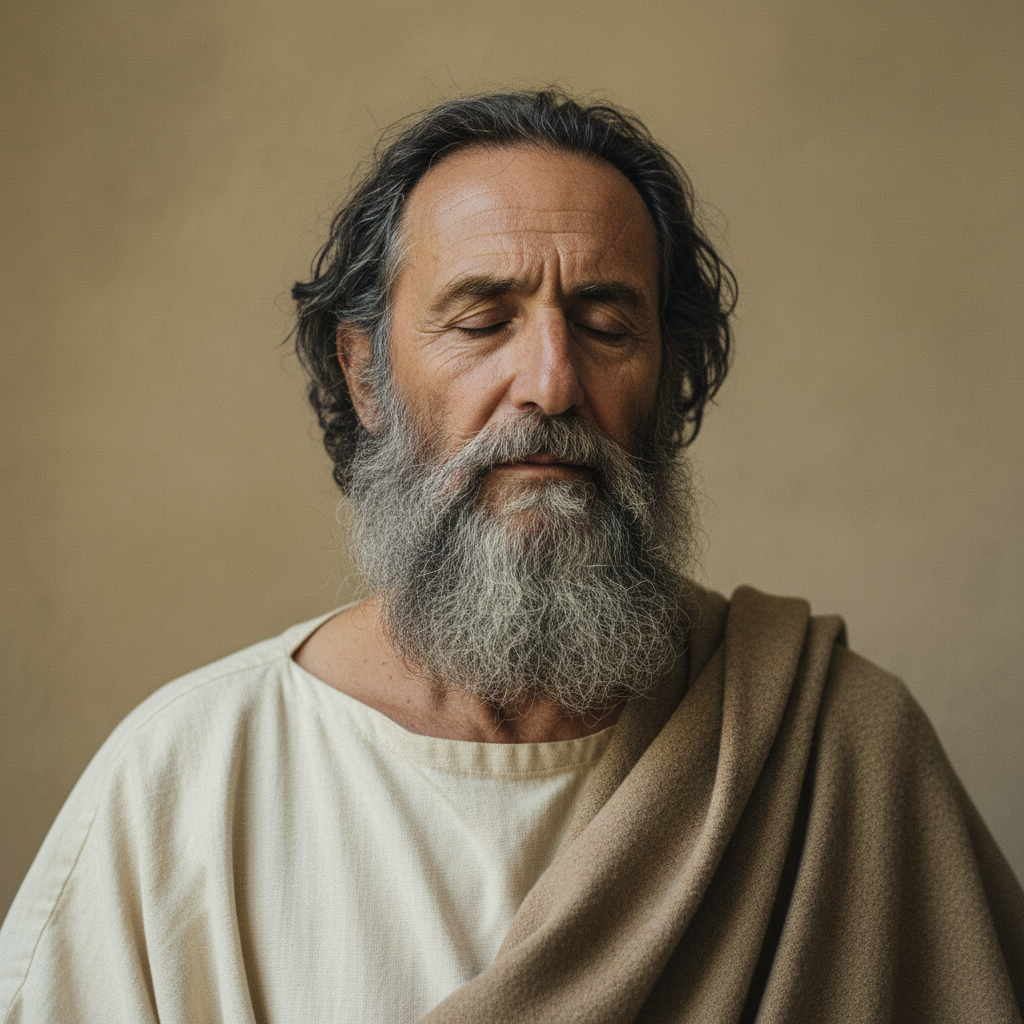
Face and head: Imagine a long, narrow face with high cheekbones and a prominent, slightly aquiline nose that anchors the profile. The brow is heavy and the forehead lined; eyes are deep-set and often portrayed as sightless or half-closed, giving a concentrated, inward look. Skin tone would be olive to sun-weathered tan from life on the eastern Aegean coast. Hair and beard: Likely dark-haired in youth, now showing a receding hairline or balding at the crown with hair remaining at the temples; a full, substantial beard frames the lower face—more functional than stylized, either neatly kept or naturally shaggy. The overall effect is dignified and lived-in rather than ornate. Body, dress and bearing: A medium, wiry build shaped by travel and public performance; posture slightly stooped by age with a steady, deliberate gait. Clothing is simple draped wool—chiton and himation in muted natural tones—worn with sandals or barefoot. He would often be pictured with practical props: a staff, a scroll, or a small lyre, and hands that look practiced at gesturing and storytelling.
Height / build
Likely average height · Likely slender to average build
Hair
Likely dark to graying · Likely wavy · Likely receding
Eyes
Likely dark
Complexion
Likely Mediterranean complexion
Face
Likely long/oval and slightly gaunt · Likely prominent / aquiline
Notable features
Blind or sightless appearance (rolled/closed eyes), prominent nose, long beard, receding hairline
Grooming
Likely full beard (long, well-kept) · Presented as a dignified, older man with a trimmed but full beard and modestly kept hair, sometimes shown with hair thinning or balding.
Dress / presentation
Likely simple Hellenic poet’s dress: chiton and himation (draped cloak), plain and dignified
height build
Height
Likely average height
Archaic Greek male height averages and no ancient description of unusual height point to average stature.
hair
Hair color
Likely dark to graying
Busts and medieval portraits show dark hair that lightens with age; Ionian Greeks typically had dark hair.
hair
Hairline
Likely receding
Surviving classical and Roman portraits commonly present Homer with a receding hairline or partial baldness.
grooming
Facial hair
Likely full beard
Ancient and medieval depictions consistently show Homer with a full, long beard as the mark of an elder poet.
eyes
Eyes / blindness
Traditionally blind / deep-set eyes
Longstanding literary and pictorial tradition depicts Homer as blind, often with rolled or sightless eyes.
face
Face shape
Likely long and slightly gaunt
Hellenistic and Roman portrait types present Homer with an elongated, worn visage consistent with an older intellectual.
In Archaic and Classical Greece age, beard, and a composed bearing signaled authority and wisdom. Homer’s conventional presentation as an older, bearded man aligned with cultural ideals that associated experience and public voice with masculine dignity rather than youthful beauty.
Homer was traditionally placed in Ionia on the eastern Aegean; people there typically combined mainland Greek features with Anatolian influences—dark hair, olive skin, and Mediterranean facial proportions—so picture a Mediterranean rather than northern European type.
Modern portrayals often turn Homer into a white-bearded medieval monk or a fantasy prophet; historically he would have been a Mediterranean Greek bard with Hellenic dress and features.
Modern art often casts Homer as a medieval monk, a prophet, or a white-bearded sage in a toga; historically he was depicted in Greek dress and would have looked like a Mediterranean bard, not a northern European cleric.
Likely average height.
Likely dark; tradition also depicts him as blind or sightless.
Likely dark, often shown graying with age.
Probably a full, long beard.
Simple Greek draped clothing: chiton and himation (poet’s cloak).
The portrait is based on later ancient and medieval traditions and portrait types rather than contemporary likenesses—so it represents the historical image that stuck, not a photograph-like certainty.
Roman marble busts labeled 'Homer' (various museums)
Hellenistic/Roman portrait tradition · 2nd century BCE – 2nd century CE (copies and styles)
Multiple Roman-era marble busts present a long-faced, bearded, partially bald elderly man with prominent nose—these images set the canonical visual for Homer.
Townley / British Museum 'Homer' portrait
British Museum / Townley collection · Roman copy of Hellenistic type (date varies)
Famous marble portrait used by scholars and artists; shows receding hairline, full beard, and pronounced nose consistent with other 'Homer' types.
Byzantine and medieval manuscript portraits of Homer
Byzantine illuminated manuscripts (11th–14th century) · 11th–14th century CE
Manuscript portraits consistently picture Homer as an elderly blind bard in Greek dress, reinforcing the tradition of blindness and dignified, simple clothing.
Suda entry on Homer
Suda (Byzantine encyclopedia) · 10th century CE
Byzantine lexicon summarizing the long biographical tradition: describes Homer as blind and details various origin claims that influenced portraiture.
Vase paintings and iconography of bards/aoidoi
Classical and Archaic vase imagery · 6th–5th century BCE (various)
Vase imagery of singers and rhapsodes shows draped clothing and portable lyres; useful for clothing and social role context rather than direct likeness.
Ancient biographical tradition (Vitae Homericae)
Collection of ancient life sketches and anecdotes · Hellenistic to Roman periods (compiled later)
A body of ancient anecdotes and claims (birthplace, blindness, age) that informed later visual conventions but are not contemporary descriptions.
face
Nose
Likely prominent (aquiline)
Most portrait busts emphasize a strong, projecting nose as a defining facial feature.
skin
Complexion
Likely Mediterranean complexion
Ionian Greeks typically had olive to light-brown skin tones; regional population context supports this.
clothing
Clothing
Hellenic poet’s draped clothing (chiton + himation)
Art and literary convention present poets wearing simple, draped garments rather than military attire.
other
Overall presence
Venerable and commanding rather than youthful attractive
Depictions emphasize age, wisdom, and authority—traits valued in a poetic authority figure.