height build
Height
Likely average height
Urban elite women in Roman Egypt typically averaged moderate stature; nothing in sources marks her as unusually tall or short.
Portrait reconstruction
350–415 · Alexandria, Roman Egypt · Late Antiquity
Hypatia most likely looked like a Mediterranean woman in middle age with olive skin, dark hair bound modestly, dark eyes, and a calm, authoritative presence.
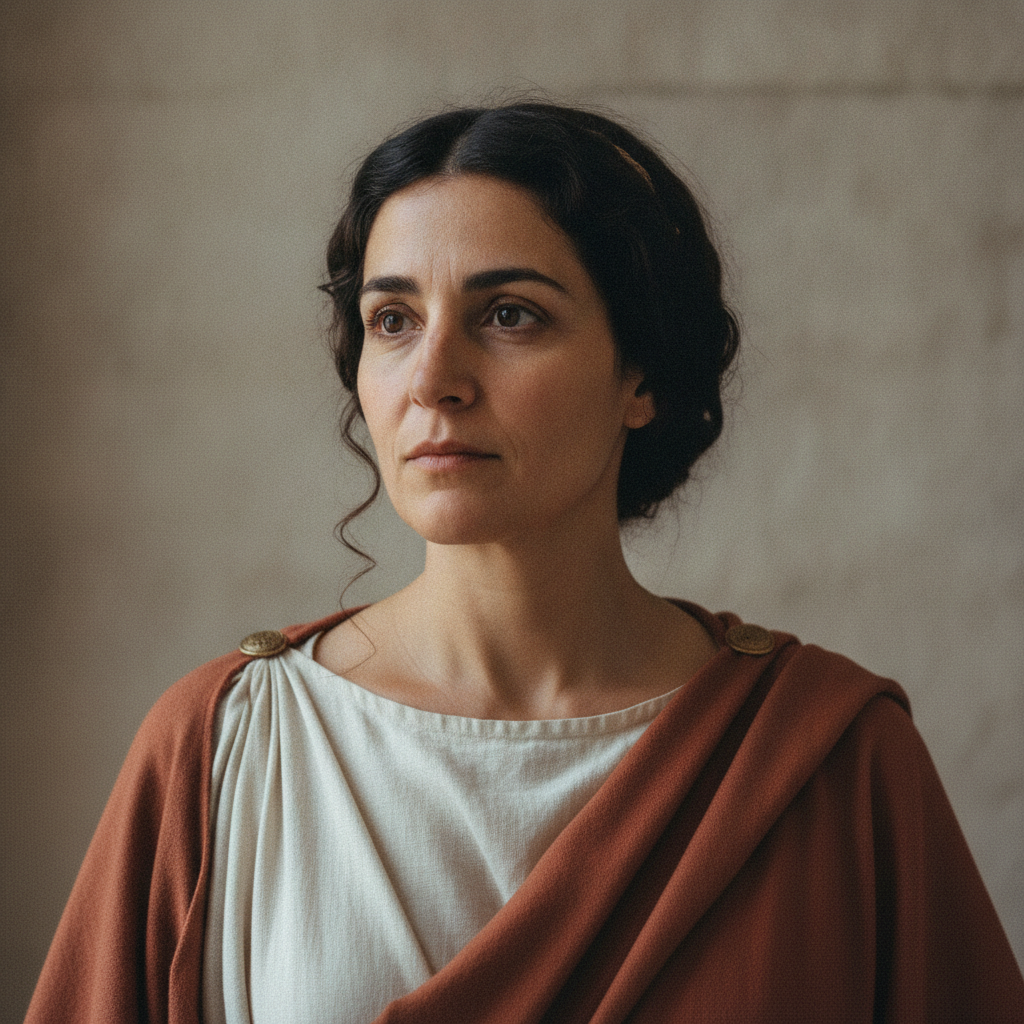
Face and complexion: Picture an olive to light‑brown complexion common in Alexandria’s Mediterranean mix, with dark brown or black eyes that read as steady and attentive. Her face would likely show the measured lines of an active teacher — not ornate, but expressive and alert. Hair and grooming: Her hair was probably dark and worn practical and controlled — braided or pulled into a low bun or knot at the back of the head, sometimes covered with a light veil or mantle when she taught in public. She likely kept a clean, unadorned appearance with little makeup and no theatrical styling. Clothing and small details: Expect a long tunic (a simple linen or wool chitōn) with a heavier mantle or himation draped over the shoulders; colors might be modest—whites, natural tans, or deeper dyed cloths used by Alexandrian elites—kept plain to signal scholarly seriousness. Jewellery, if worn, would be minimal: a ring or simple pins rather than lavish necklaces. Practical sandals, steady hands (often ink‑stained from teaching), and an upright posture complete the image. Presence and age: Descriptions of her as an established teacher fit a middle‑aged woman with a calm, commanding presence—someone whose appearance announced authority and intellect rather than social display.
Height / build
Likely average height · Likely slender to average build
Hair
Likely dark brown to black · Likely wavy to curly · Likely full; hair usually worn long and bound up
Eyes
Likely dark (brown)
Complexion
Likely Mediterranean / olive
Face
Likely oval to slightly long · Likely straight to slightly aquiline
Notable features
Commanding, composed expression; scholarly bearing; likely prominent nose and clear eyes
Grooming
None (female) · Neatly groomed: hair tied or wrapped, modest jewelry, sober but well-kept attire befitting an elite teacher.
Dress / presentation
Likely classical Hellenic-Roman elite female dress (tunic/chiton and himation), modest and elegant rather than ostentatious
height build
Height
Likely average height
Urban elite women in Roman Egypt typically averaged moderate stature; nothing in sources marks her as unusually tall or short.
height build
Build
Likely slender to average build
As an active teacher and intellectual living in an urban environment, she likely had a lean, functional physique rather than heavy musculature.
hair
Hair color
Likely dark brown to black
Alexandrian Greek-Egyptian elites commonly had dark hair; later images and cultural context support dark hair.
hair
Hair texture & style
Likely wavy/curly, worn long and bound up
Contemporary fashion for elite women favored long hair arranged in buns, braids, or bound styles; teaching women wore hair up for public duties.
eyes
Eye color
Likely dark (brown)
Brown eyes predominated in Mediterranean populations of Alexandria; no ancient source specifies otherwise.
skin
Complexion
In late antique Alexandria, elite appearance combined classical Greek ideals (symmetry, composure, and modest dress) with practical grooming for public life: neat hair, restrained jewelry, and clothing that signaled status without ostentation. For an intellectual woman like Hypatia, visual authority came from modest dignity and disciplined presentation rather than display.
Alexandria was a cosmopolitan port where Hellenic settlers, native Egyptians, Jews, and others mixed. As the daughter of Theon (a Greek mathematician) and an urban elite, Hypatia likely had a Mediterranean look—olive skin, dark eyes and hair, with features shaped by both Greek and Egyptian ancestries.
Modern portrayals often masculinize or glamorize her (e.g., blond, hyper-sexualized, or cinematic costumes); historically she was an educated, modestly-dressed Alexandrian woman with dark features.
Films and some paintings recast Hypatia as Northern-European blond or hyper-glamorous; historically she would have presented with darker Mediterranean coloring and sober, classical dress. Modern narratives also oversexualize or overly masculinize her; contemporary praise highlighted her learning and dignified presence.
Probably average height for an urban woman of her time.
Likely dark (brown).
Likely dark brown to black, probably worn long and bound up.
Yes—contemporary writers describe her as striking, dignified, and respectable.
Modest Hellenic-Roman elite female dress (tunic/chiton and himation), neatly arranged hair and restrained jewelry.
From contemporary textual descriptions of her presence and status, her social and ethnic context in Alexandria, and later artistic traditions used for reconstruction.
Socrates Scholasticus, Historia Ecclesiastica (Book 7, ch. 15)
Socrates Scholasticus · late 5th century (c. 440s–450s)
Describes Hypatia as an eminent philosopher and teacher in Alexandria and narrates her murder; emphasizes her public prominence and the outrage at her death—textual basis for claims about her dignity and public role.
Letters of Synesius of Cyrene
Synesius of Cyrene · late 4th – early 5th century
Synesius was a pupil of Hypatia and in his correspondence shows respect for her teaching and character; these letters support the view of Hypatia as a respected, active teacher and mentor.
Damascius (Fragments / later neoplatonist accounts)
Damascius / late Neoplatonist tradition · 6th century (fragments preserved later)
Later Neoplatonist sources recall Hypatia as an important philosopher and teacher in Alexandria, reinforcing her intellectual prominence and dignified reputation.
Suda entry 'Hypatia'
Suda (Byzantine lexicon) · 10th century
Late Byzantine encyclopedia giving a brief biographical note linking her to Theon and noting her scholarship; useful for confirming fame but late and summary in nature.
Medieval and modern portraits and icons
Various (medieval icons, Renaissance and modern paintings) · medieval–modern (various)
Post-antique visual depictions project later tastes and ideals; they influenced modern imaginings but are not contemporary likenesses—helpful for tracing later visual reception.
Regional anthropological and dress studies for late antique Alexandria
Scholarly studies on late antique Mediterranean populations and dress · modern scholarship (20th–21st c.)
Provide population, complexion, and clothing context used to build likely appearance estimates for Alexandrian elites.
Likely Mediterranean / olive
Alexandria’s Hellenic-Egyptian urban elite typically had olive skin tones due to regional ancestry and climate.
face
Facial features
Likely oval face with a straight to slightly aquiline nose and clear, commanding eyes
Classical descriptions emphasize her attractiveness and dignity; Greek portrait conventions for elite women often show straight/aquiline noses and composed expressions.
grooming
Facial hair
None
Female; contemporary sources and visual conventions show no beard; Synesius and historians describe her as a woman.
clothing
Dress
Hellenic-Roman elite female dress (tunic/chiton and himation), modest and scholarly
As an educated member of Alexandria’s elite and a public teacher, she would wear respectable female garments used in scholarly and civic contexts.
other
Demeanor / presence
Commanding, composed, intellectually authoritative
Contemporary writers praise her learning and public role; descriptions emphasize dignity and leadership in lecture settings.