hair
Hair color
Likely dark to graying
As a North African man of his era he would typically have dark hair; later life portraits and descriptions imply graying with age.
Portrait reconstruction
1304–1368 · Morocco / Wider Islamic world · Late Middle Ages
Ibn Battuta most likely looked like a North African scholar‑traveller: olive to medium‑brown skin, dark hair and eyes, a short beard, and layered robes topped by a turban.
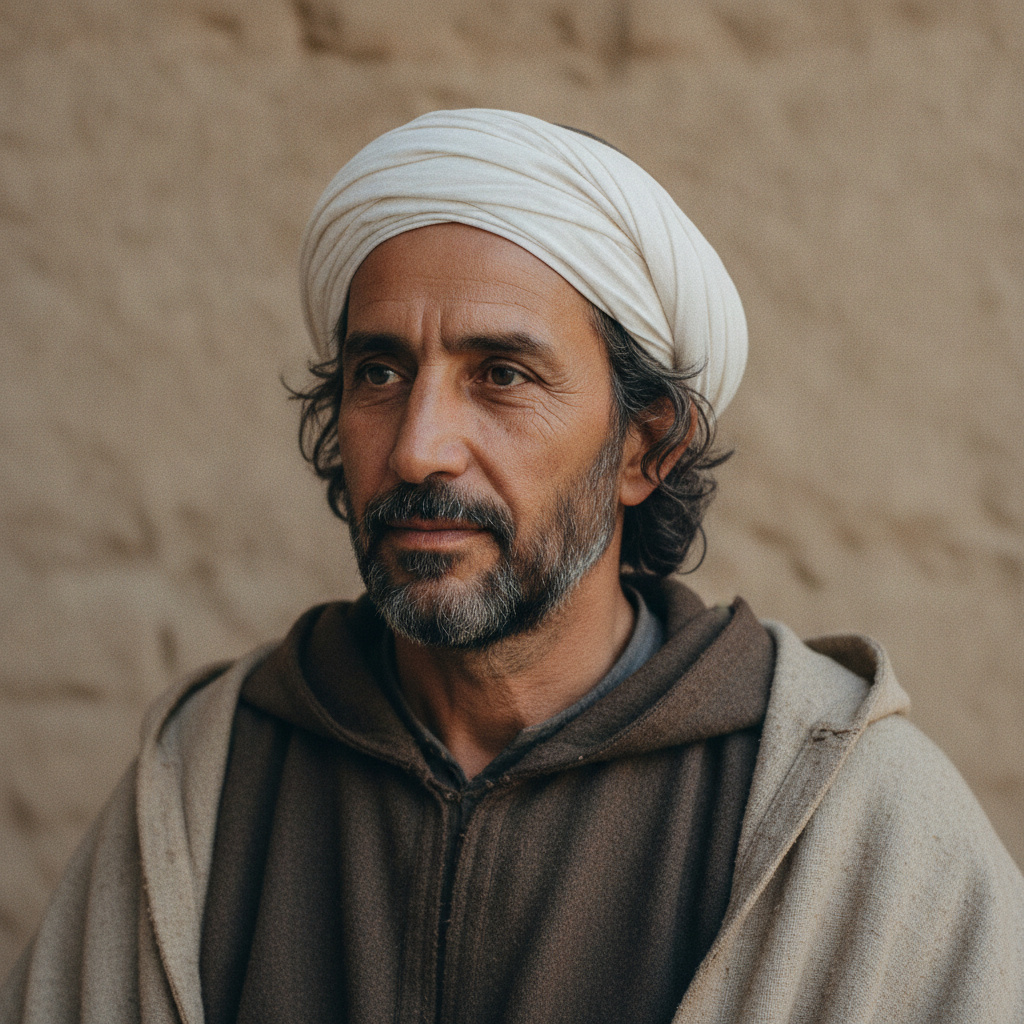
Face and complexion: He likely had an olive to medium‑brown complexion typical of fourteenth‑century Morocco and the western Islamic world, with dark brown eyes that a traveler’s friends and rivals would have noticed for their alertness and directness. His features were probably a balanced Maghrebi mix—neither extremely sharp nor heavy—giving him a weathered but composed look after years on the road. Hair and facial hair: His hair was likely dark and wavy to curly, cropped or tucked under a turban much of the time. As a Muslim jurist and respected traveller, he most likely wore a short to moderate beard—neatly kept rather than full and untrimmed—consistent with scholarly norms and the later manuscript portrayals that show him bearded. Build and bearing: Years of travel suggest a lean, wiry build rather than a heavy frame; endurance and practicality shaped his posture. He would have carried himself with a mix of calm authority and readiness—a scholar used to judging disputes but also accustomed to long journeys across deserts and cities. Clothing and travel kit: His everyday look combined scholarly dress with travel practicality: layered wool or linen robes, a cloak for cold nights, a wrapped turban or headcloth, simple sandals or boots, and practical accessories like a satchel, staff, and religious texts. Colors and fabrics varied by place and season, but the overall effect was dignified and functional rather than ornamental.
Height / build
Likely average height · Likely slender to average build
Hair
Likely dark to graying · Likely wavy to slightly curly · Likely receding or mature hairline (graying in later life)
Eyes
Likely dark
Complexion
Likely Mediterranean/olive
Face
Likely oval to slightly angular · Likely straight to slightly prominent
Notable features
Dark eyes, trimmed beard, turban and travel cloak; an alert, composed expression
Grooming
Probably a neatly trimmed beard (typical for a Muslim jurist) · Typically wore a turban and layered robes; grooming would be tidy and modest, fitting a learned man of his class.
Dress / presentation
Practical scholar's dress: robe (jubbah/djellaba), cloak, turban or headwrap, and travel boots; simple, functional rather than opulent
hair
Hair color
Likely dark to graying
As a North African man of his era he would typically have dark hair; later life portraits and descriptions imply graying with age.
eyes
Eye color
Likely dark
Dark eyes are overwhelmingly common in the Maghrebi populations and are the likeliest assumption for a Moroccan male of the 14th century.
skin
Complexion / Skin tone
Likely Mediterranean/olive
Regional ancestry (Arab‑Berber) in Morocco points to an olive to dusky tone common to western North Africa.
grooming
Facial hair
Probably a neatly trimmed beard
Muslim jurists and scholars customarily wore beards; many manuscript images and later portraits depict him bearded.
clothing
Typical dress
Practical 14th‑century scholar/traveler robes and turban
Travel accounts show him moving between Islamic courts and deserts; miniatures show layered robes and a turban, consistent with scholarly dress and travel needs.
height build
Height
In Ibn Battuta's world, modesty, learned dignity, and visible markers of piety were key. A neatly arranged beard, clean robes, and a turban signaled respectability and authority; clothing prioritized scholarly status and practical protection against sun and dust for a traveler.
Ibn Battuta came from Tangier in northwest Morocco — a region where Arab, Berber, Andalusi and Sahelian contacts produced Mediterranean/olive complexions, dark hair and eyes, and a range of facial types. Picture features common in that population rather than northern European types.
Modern images often romanticize him as an exotic, flamboyant explorer or give him Europeanized features; historically he would appear as a modest, learned North African traveler.
Popular portraits frequently exoticize Ibn Battuta with flamboyant, anachronistic costumes or westernize his face. The stronger historical read is a modest, practical Maghrebi scholar — less theatrical, more purposeful.
There is no authenticated contemporary portrait from Ibn Battuta's lifetime; later manuscript miniatures and Ottoman images shaped his visual image. These give useful cues about dress and status but should be read as stylistic representations rather than exact likenesses.
Likely average height for a 14th‑century North African man.
Likely dark — brown or very dark brown.
Likely dark, with graying in later life.
Probably — a neat, trimmed beard typical of a Muslim jurist.
Layered robes or djellaba, a cloak for travel, and a turban or headwrap — practical, modest, and suitable for courts and deserts.
No authenticated portrait from his lifetime survives; existing images are later stylized illustrations and modern commemorations.
Rihla (The Travels of Ibn Battuta)
Ibn Battuta, travelogue compiled by Ibn Juzayy · mid‑14th century (compilation c.1355)
Primary narrative of Ibn Battuta's journeys; contains extensive accounts of places and people but gives little sustained physical self‑description, instead offering clues about dress, behavior, and social rank.
Ottoman and Persian miniature depictions of Ibn Battuta
Various manuscript miniatures (16th–17th century copies and illustrations) · 16th–17th century (later copies)
Later illustrated manuscripts show Ibn Battuta with a turban, robes, and beard; images are stylized but indicate scholarly dress and headwear conventions used to depict him.
19th‑century European and North African portraits and prints
Woodcuts, paintings, and book illustrations · 19th century onward
Romanticized images from the 19th century often emphasize an exotic, adventurous look that mixes fact and invention; useful for showing reception history rather than historical likeness.
Modern statues and commemorative portraits (e.g., Tangier)
Modern public art · 20th–21st century
Public sculptures and murals reflect a modern visual shorthand — turban, cloak, beard — conveying his role as traveler and father of the Rihla rather than providing an authentic lifelike portrait.
Biographical and regional studies
Modern scholarly syntheses of Ibn Battuta and medieval Maghreb · 20th–21st century
Provide population context (appearance norms, dress, stature) used to make historically responsible estimates of physical traits such as complexion, hair, and dress.
Likely average height
No direct measures survive; demographic context places him within the regional average for medieval North African men.
height build
Build
Likely slender to average
Long-distance travel and regular overland journeys make a lean, durable build most plausible.
face
Face and expression
Composed, alert, and dignified
As a respected jurist and storyteller he would present a composed, authoritative expression; later illustrated portraits emphasize an engaged, thoughtful countenance.
hair
Hair texture
Likely wavy to slightly curly
Typical hair textures among Maghrebi men and depiction conventions in manuscript art support wavy/curly hair as likely.
other
Headwear
Usually a turban or headwrap
Medieval Islamic scholars and many manuscript depictions show him with a turban, a practical and status‑signaling head covering.