height build
Height
Likely average to slightly above average height
Viking‑age skeletal data place men near early medieval northern European averages; leaders often at least average height.
Portrait reconstruction
810–870 · Scandinavia / Viking world (operated in Britain & Ireland) · Viking Age (9th century)
Ivar the Boneless likely looked like a lean, wiry Norse leader with sandy‑brown hair, light eyes, weathered skin, fine clothing and weapons, and a distinctive gait or agility suggested by his epithet.
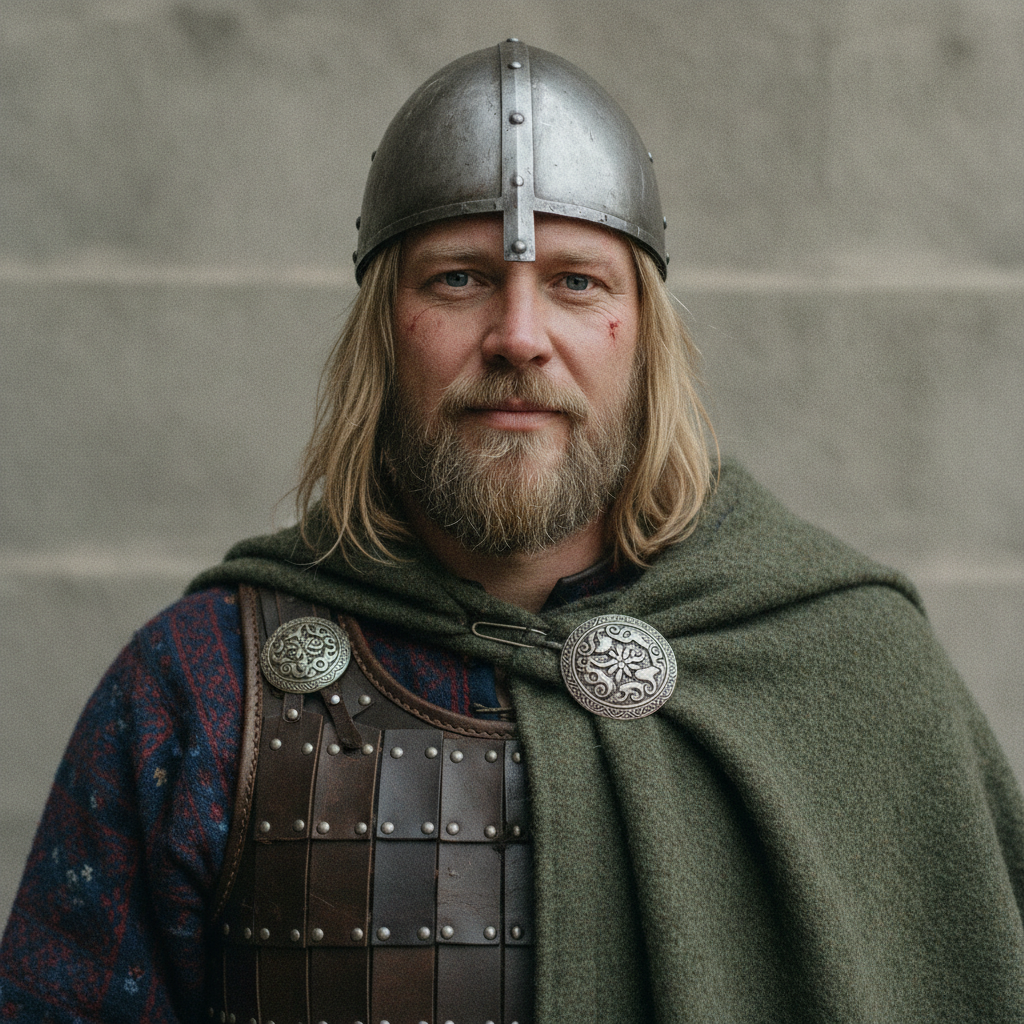
Physique and stance: He would most likely have been lean, wiry and athletically built from years of raiding and campaigning—sturdy rather than bulky, with powerful forearms and a narrow torso that betrayed constant physical work. His height would have been around the Norse average for the time (roughly 5'7"–5'9"), with a forward, purposeful carriage and scars or healed injuries on his hands, arms and jaw. Hair, face and grooming: His hair was probably sandy‑brown to light brown, worn medium length and often tied back or braided for practicality; combs and grooming tools were common among Norse elites, so his hair would be neat and kept. Facial hair was trimmed rather than wild—short stubble or a neatly cropped beard was a likely look, with clear, light‑colored eyes (blue or gray) and sun‑weathered, tanned skin from life outdoors. Clothing, jewelry and arms: As a leader he would wear well‑made wool and linen layers in muted or dyed colors, a heavy cloak fastened with a decorated brooch, a sturdy leather belt with pouches and a knife, and polished horseman’s or warrior’s boots. He would display status through simple but fine jewelry—arm‑rings, a finger ring, and perhaps an ornamental pin—and carry weapons appropriate to rank: a spear or axe at hand and a sword or seax as a visible sign of authority; chain‑mail or padded protection could appear in battle but not in everyday dress. Distinctive gait or mobility: The epithet “the Boneless” suggests a visible difference in movement—either a limp, a spinal or pelvic condition, or unusually supple agility. Visually this could mean a slight limp or the use of a staff or crutch in some moments, or conversely a notably limber, quick way of moving that set him apart from other commanders.
Height / build
Likely average to slightly above average height for his time · Likely solid, stocky to muscular (battle‑ready)
Hair
Likely blonde to light brown · Likely straight to slightly wavy · Likely normal; may have receded somewhat with age
Eyes
Likely blue‑gray
Complexion
Likely fair to ruddy (northern European)
Face
Likely broad‑oval to square · Likely straight to slightly aquiline
Notable features
Epithet 'the Boneless' suggests a visible mobility or limb difference or unusual gait; otherwise likely strong facial features and war scars.
Grooming
Probably had a full, trimmed beard (common for Norse leaders) · Likely kept long hair and a well‑kept beard, possibly braided or bound with metal fittings as an elite style.
Dress / presentation
Elite Viking dress: embroidered woolen tunic, cloak fastened with brooches, leather boots; in battle, mail or leather armor and helmet.
height build
Height
Likely average to slightly above average height
Viking‑age skeletal data place men near early medieval northern European averages; leaders often at least average height.
height build
Build
Likely solid, stocky to muscular
Active raiders and commanders required physical strength; contemporary descriptions praise martial ability consistent with a robust build.
hair
Hair color
Likely blonde to light brown
Scandinavian populations in the Viking Age commonly had fair hair; sagas and later tradition often portray Norse leaders with light hair.
hair
Hair texture & style
Likely straight to slightly wavy; long and often bound or braided
Archaeological finds and iconography show long hair and braids among Norse elites; grooming signalled status.
eyes
Eye color
Likely blue‑gray
High prevalence of light eye colors in Scandinavian gene pools during the Viking Age makes blue/gray the most likely.
skin
Complexion
Norse culture prized physical prowess, visible signs of status, and practical grooming. Long hair, neatly kept beards, decorated tunics, and metal fittings (brooches, arm rings) signalled rank. A leader like Ivar would balance ruggedness with visible markers of elite status: tidy hair/beard, quality textiles, and polished weapons.
Viking‑age Scandinavians commonly had fair skin, lighter hair (blonde to light brown), and blue/gray eyes, though regional and individual variation existed. Imagining Ivar, think northern features shaped by outdoor life—wind‑reddened skin and weathered hands of a man used to raiding and seafaring.
Modern media often exaggerates theatrical elements (extreme braids, bright red hair, monstrous disability) compared with the restrained, status‑focused grooming of historical Norse elites.
TV and film often make Ivar either grotesquely disabled or an over‑styled 'warrior with extreme braids and face paint.' Historical Norse elites were ornamented but not theatrical: their dress and grooming signalled status and function rather than fantasy spectacle.
Likely average to slightly above average height for a 9th‑century Scandinavian man.
Likely blue‑gray, the common eye color in Viking‑age Scandinavia.
Likely blonde to light brown, straight to slightly wavy, kept long and possibly braided or bound.
Probably yes — a trimmed or styled beard was typical for Norse leaders and likely part of his look.
Likely displayed a notable limb or gait difference referenced by his epithet, so an unusual movement or limb condition would have been visible.
They combine medieval textual descriptions, Norse cultural norms, and archaeological data on Viking bodies and dress to produce the most likely visual profile.
Anglo‑Saxon Chronicle (mentions Great Heathen Army & leaders)
Anglo-Saxon Chronicle · entries c. 865–878 (compiled late 9th century onward)
Lists leaders of the Viking force (including names linked to Ivar) and records campaigns in England; provides contemporary context for his activity and epithet usage in later sources.
Fragmentary Annals of Ireland (early medieval Irish account)
Fragmentary Annals of Ireland · compiled 11th century from earlier material
Records Viking leaders and campaigns in Ireland and Britain; uses descriptive epithets and traditions that contribute to the image of Ivar.
Norse sagas and legendary material (Ragnarssona þáttr; Tale of Ragnar's Sons)
Norse sagas (Ragnarssona þáttr; Tale of Ragnar's Sons) · 13th century and later (based on oral traditions)
Provides narrative detail about Ivar’s character, epithet 'the Boneless', and family; useful for cultural portrait but written centuries later.
Irish Annals (Annals of Ulster and others)
Irish annals (Annals of Ulster, etc.) · 9th–11th centuries (entries contemporary or near‑contemporary)
Record raids and leaders, occasionally noting epithets and events tied to Ivar and his brothers; provide a contemporaneous framework for appearance in sources.
Viking Age archaeological and osteological studies
Viking Age archaeological/population studies · 20th–21st century research
Skeletal analyses and grave goods inform averages for stature, evidence of diet and activity, and elite clothing/ornamentation—used to infer likely physique and dress of a leader like Ivar.
Viking iconography: carvings, brooches, and grave finds
Viking Age iconography and grave goods · 8th–11th century artifacts
Likely fair to ruddy
Northern European skin tones combined with outdoor life (wind, sun) produced fair but weathered complexions.
grooming
Facial hair
Probably a full, trimmed beard
Beards were a common sign of masculinity and status among Viking leaders; texts and iconography show bearded chiefs.
other
Epithet implication
Likely had an unusual limb or gait (visible difference)
His byname 'the Boneless' in multiple medieval sources implies a notable physical condition affecting limbs or movement.
clothing
Dress
Elite Viking clothing: tunic, cloak, brooches; martial accoutrements in war
Leaders are described and depicted wearing decorated textiles and metal fittings; archaeological elite graves show such clothing.
face
Facial features
Likely strong, angular features—broad jaw and prominent nose
Stereotypical Norse iconography and descriptions of leaders emphasize commanding, angular faces.
Visual motifs and equipment (combs, brooches, weapons) indicate grooming, hair styles, and clothing typical for Norse elites.