skin
Complexion
Likely Mediterranean/olive
Sidonian/Phoenician coastal background and Levantine population patterns point to an olive to light-brown skin tone common in the region.
Portrait reconstruction
0–0 · Northern Kingdom of Israel / Sidon (Phoenicia) · 9th century BCE (Iron Age Levant)
Jezebel would most likely have appeared as a dark‑haired, olive‑skinned Sidonian princess in richly worked robes, heavy gold jewelry, and kohl‑lined eyes.
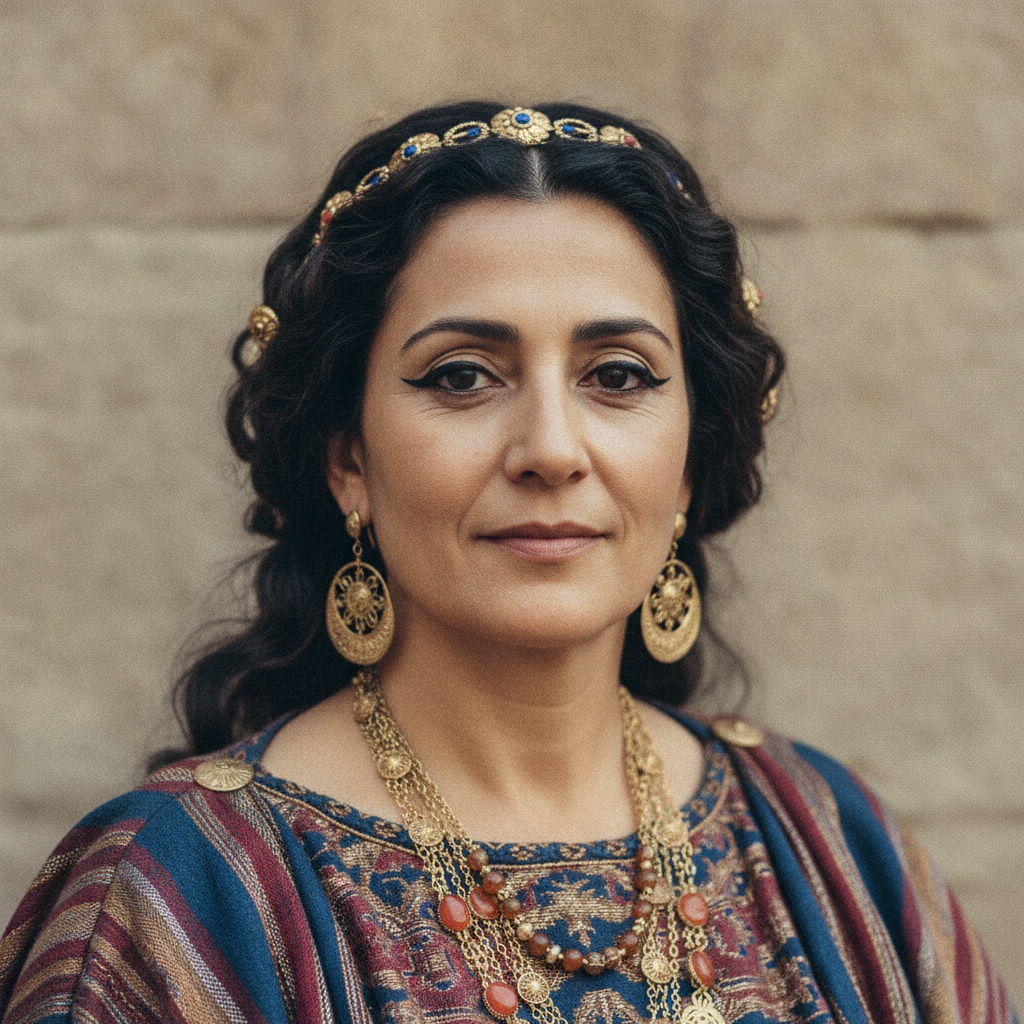
Face and skin: Jezebel would likely have had an olive to light‑brown complexion typical of the coastal Levant, with strong, dark eyebrows and almond‑shaped eyes made striking with kohl. Her features would read as Mediterranean—warm skin tone, a straight or gently aquiline nose, and full dark lashes accentuated by eye pigment. Hair and hairstyle: Her hair was probably dark brown to black, thick and worn long; elite Phoenician women favored elaborate styles—braids and coils threaded with gold pins, beads and small pendants, or bound beneath a decorated headband or diadem. Small jeweled hair‑ornaments and gold fillets would catch the light and mark her rank. Clothing and textiles: She would typically wear layered ankle‑length garments of fine linen or wool, likely dyed or trimmed with rich colors (Phoenicians were known for brilliant dyes) and patterned borders. A fitted tunic under a sleeved robe or a belted outer garment, possibly with a richly woven mantle for public appearances, would create a dignified silhouette. Jewelry and grooming: Heavy, expertly worked gold—earrings, multi‑strand necklaces of gold and semi‑precious beads, wide bracelets, finger rings, a chest pectoral or collar, and a small crown or diadem—would signal royalty. She would wear scented oils and perfumed unguents, and her skin and hair would be carefully groomed to a polished sheen.
Height / build
Likely average height · Likely slender to average build
Hair
Likely dark (black to dark brown) · Likely wavy to curly · Likely a full hairline, hair arranged in elaborate styles
Eyes
Likely dark
Complexion
Likely Mediterranean / olive
Face
Likely oval · Likely straight to slightly aquiline (Mediterranean profile)
Notable features
Almond-shaped, heavily kohl-emphasized eyes; prominent gold and bead jewelry; elaborately arranged hair with ornaments or a diadem.
Grooming
None · Heavily groomed for elite standards: kohl-lined eyes, scented oils, dyed/pinned hair and visible jewelry.
Dress / presentation
Elite Phoenician-Levantine royal dress—colorful woven robes, patterned cloaks, layered jewelry and a head diadem or hair ornaments.
skin
Complexion
Likely Mediterranean/olive
Sidonian/Phoenician coastal background and Levantine population patterns point to an olive to light-brown skin tone common in the region.
hair
Hair color
Likely dark (black to dark brown)
Mediterranean populations of the Levant and Phoenician depictions typically show dark hair pigmentation.
hair
Hair texture
Likely wavy to curly
Artifacts and regional population traits suggest wavy-to-curly hair was common and often styled in elaborate updos.
eyes
Eye color
Likely dark
Dark eyes predominate in coastal Levantine populations and are emphasized in Near Eastern beauty ideals.
grooming
Cosmetics
Likely used kohl/eye makeup and perfumed oils
Excavated cosmetic kits and textual/artistic evidence show elite Near Eastern women used eye paint and oils; Phoenicians traded perfumed products.
clothing
Clothing style
Elite Phoenician royal dress—colorful woven robes and patterned cloaks
Phoenician elites prized striking eyes (often emphasized with kohl), elaborate hair ornamentation, colorful patterned textiles, and conspicuous gold jewelry. Perfumes and oils were part of daily display—appearance was an active marker of rank and international trade connections.
Sidon lay at the crossroads of Mediterranean trade and had a mixed but characteristically Levantine population—Canaanite/Phoenician stock with Mediterranean pigmentation. That regional background makes olive skin, dark hair and dark eyes the most plausible appearance markers for a Sidonian princess like Jezebel.
Modern depictions tend to exoticize or sexualize Jezebel into a caricatured 'femme fatale'; the historical image is more likely a cultured, fashion-conscious Phoenician queen.
Later art, novels and films have turned Jezebel into a sexualized, exotic villain—often with exaggerated makeup and revealing dress. In reality, the material record points to a wealthy, fashion-aware royal woman who used jewelry, perfumes and foreign dress to project power—not an invented Hollywood seductress.
Likely average height for an Iron Age Levantine woman.
Likely dark—brown to very dark brown.
Likely dark—black or dark brown, probably worn wavy or curly.
Probably considered striking and fashionable—her foreign dress and jewelry would have drawn attention and signalled status.
No—female elites did not wear facial hair; she would have been clean-shaven and well-groomed.
No surviving portrait can be securely identified as Jezebel; reconstructions rely on her Sidonian origin and Phoenician elite material culture.
1 Kings (Hebrew Bible) — passages on Jezebel
1 Kings, chapters 16–21 · compiled/set in final form c. 7th–6th century BCE (narrating 9th century BCE events)
Identifies Jezebel as a Sidonian princess (daughter of Ethbaal) and repeatedly marks her as foreign and influential at court—this is the primary basis for inferring Phoenician dress and foreignness.
Phoenician jewelry and metalwork from Sidon
Sidon hoards and tomb finds · 9th–6th centuries BCE (archaeological contexts)
Gold earrings, necklaces, diadems and beadwork from Sidon show the types of high-status adornment available to Phoenician elite women and likely worn by a queen.
Eshmunazar II sarcophagus and Sidonian relief imagery
Eshmunazar II sarcophagus (Sidon) · circa 5th–4th century BCE (later than Jezebel)
Later Sidonian royal art preserves iconography of dress and regalia—useful as cultural context for elite Phoenician presentation even if later than Jezebel's time.
Phoenician ivory plaques and carved female figures
Ivory reliefs and decorative plaques from the Levant · 10th–6th centuries BCE
Small-scale carvings depict women with stylized hair and dress elements that inform reconstructions of elite hairstyles and ornaments.
Ancient Near Eastern cosmetic kits and kohl containers
Archaeological cosmetic finds (Egypt, Levant, Mesopotamia) · 3rd–1st millennia BCE contexts
Widespread evidence for eye-paint, perfumes and grooming tools among elites supports the idea that Jezebel would have used kohl and oils as part of her public appearance.
Later artistic depictions of Jezebel
Medieval and Renaissance paintings; 19th–20th century art and prints · various (medieval–modern)
These images shaped modern impressions (often exoticized or eroticized), but they reflect later cultural agendas rather than contemporary appearance.
Phoenician textile and iconographic evidence shows patterned, colorful garments among elites; biblical narrative also marks her as foreign and conspicuously dressed.
height build
Build
Likely slender to average build
Elite women often displayed a slender, elegant silhouette in Near Eastern art and had access to ample resources but also active court life.
other
Jewelry
Likely wore conspicuous gold and bead jewelry, possibly a diadem
Sidon was famous for metalwork and elite burials include earrings, necklaces and diadems used by high-status women.
comparison
Foreign visual impact in Israel
Would likely stand out as a foreign, stylish Sidonian queen among Israelite courtiers
Biblical texts stress her foreign origin; Phoenician fashions and jewelry differed from Israelite dress and would be noticeable.
cultural
Hairstyle
Likely elaborately arranged (braids/updo) with ornaments
Phoenician female portraits and luxury objects show complex hair arrangements and hair ornaments for elite women.
Modern survey: 'The Phoenicians' (Sabatino Moscati)
Sabatino Moscati, The Phoenicians · 1968
Comprehensive overview of Phoenician culture, trade, art and material markers of elite identity used here to infer likely regalia and grooming for Jezebel.