clothing
Garment
Camel-hair tunic with leather belt
Mark and Matthew explicitly describe him as clothed in camel's hair with a leather belt.
Portrait reconstruction
0–0 · Judea / Galilee (Roman Palestine) · late Second Temple period (early 1st century CE)
John the Baptist likely looked like a rough, wiry Levantine man with long, coarse hair, a full beard, and a camel‑hair garment.
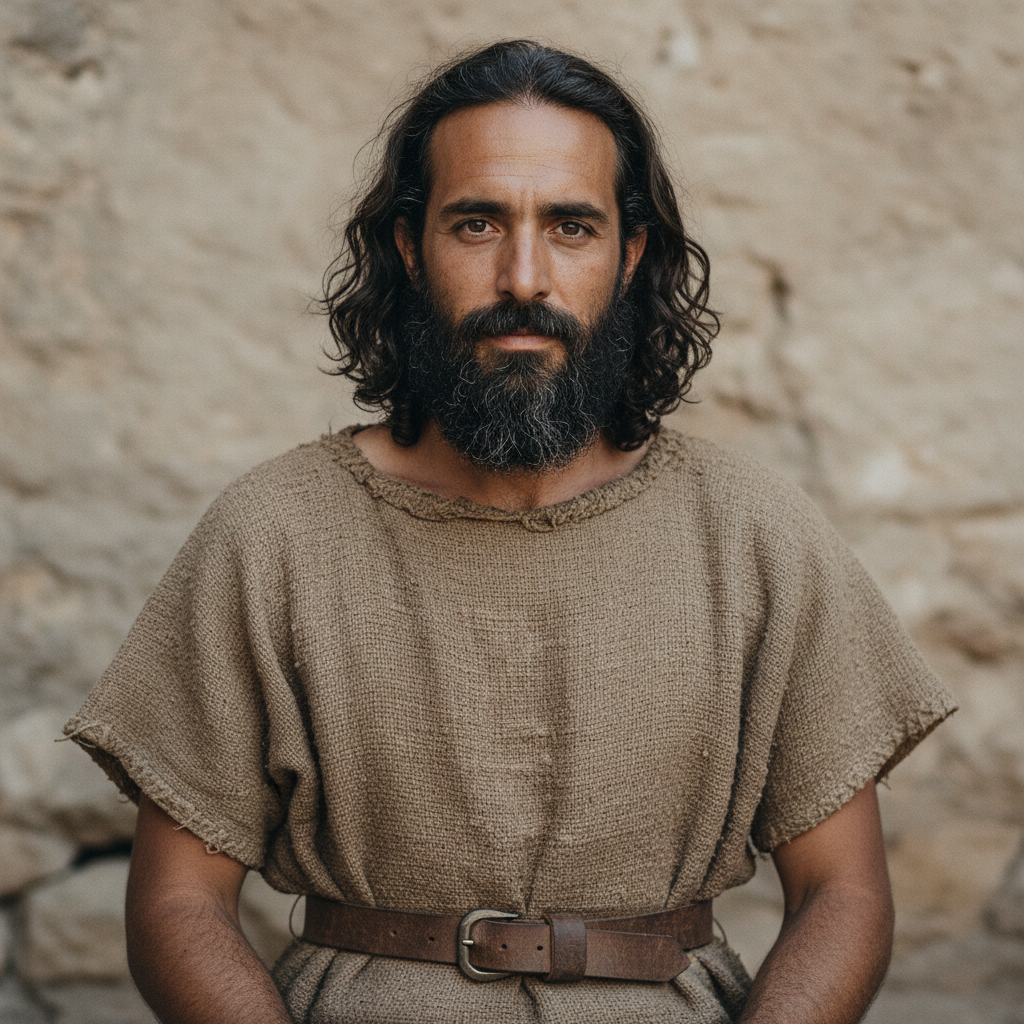
Face and hair: He probably had dark, coarse hair worn long and untrimmed and a full beard that framed a weathered, sun‑tanned face. His eyes were likely dark brown, set in a face shaped by wind and sun rather than by grooming—sharp, intense and direct rather than softened by fashion. Build and bearing: Expect a lean, wiry body hardened by long days in the wilderness—bony shoulders, callused hands, and a steady, energetic step. His diet of locusts and wild honey and a life spent outdoors would leave him wiry rather than fleshy, with taut skin and visible muscle from walking and preaching. Clothing and overall look: He would have worn a coarse camel‑hair garment or rough wool cloak, fastened by a simple leather belt or sash, with plain sandals. Hair, beard and clothing together made him look like a living prophet: unadorned, striking, and intentionally plain rather than neat or fashionable.
Height / build
Likely average height (about 165–170 cm / 5'5"–5'7") · Likely slender and wiry
Hair
Likely dark to graying · Likely wavy to curly · Likely full, worn long and unkempt
Eyes
Likely dark (brown)
Complexion
Likely olive / sun-darkened Mediterranean complexion
Face
Likely angular/long-faced · Likely straight to slightly aquiline
Notable features
Camel-hair tunic, leather belt, sun-weathered skin, full beard, striking ascetic presence
Grooming
Likely a full, untrimmed beard · Ascetic grooming: rough, practical — untrimmed beard, long hair or unkempt, minimal grooming or cosmetic use.
Dress / presentation
A coarse camel-hair garment (rough tunic), leather belt, simple sandals
clothing
Garment
Camel-hair tunic with leather belt
Mark and Matthew explicitly describe him as clothed in camel's hair with a leather belt.
grooming
Beard
Likely full and untrimmed
Jewish male norms and ascetic practice favor a full beard; later iconography consistently shows a full, rough beard.
hair
Hair length/condition
Likely long and unkempt
Wilderness asceticism and later artistic tradition portray him with longer, rough hair rather than a tidy haircut.
skin
Complexion
Likely olive / sun-darkened
A Galilean/Judean Jewish background combined with prolonged outdoor exposure implies an olive, weathered complexion.
eyes
Eye color
Likely dark (brown)
Dark brown eyes were and are predominant in the Levant; no ancient source suggests light eyes.
height build
Height
Likely average height (≈165–170 cm)
Archaeological/osteological data for first-century Levantine males indicate this range; no textual height data survives.
In first-century Jewish culture, prophetic authority was often signaled by austerity and visible difference from urban or priestly dress. John’s rough camel-hair garment and ascetic habits marked him not as a religious elite but as a holy outsider—someone whose appearance underscored moral seriousness and spiritual authority.
John would have resembled other free men of Galilee and Judea: Mediterranean/Semitic features, olive skin, dark hair and eyes. Imagine a rugged village man hardened by sun and wind rather than a pale, stylized figure from later European art.
Modern art and film often render John as European, fair-haired, very young, or fashionably groomed; the historical image is darker, older-looking, and far rougher.
Paintings and films often turn John into either a handsome, cleanly groomed youth or a romanticized European with light hair and skin. Historically, he was darker, older-looking, and deliberately rough in appearance to signal his ascetic identity.
Likely average height for a first-century Levantine man (about 165–170 cm / 5'5"–5'7").
Likely dark brown, the predominant eye color in the region.
Likely dark, wavy to curly, probably long and unkempt from ascetic life.
Yes — probably a full, untrimmed beard, consistent with Jewish male norms and ascetic presentation.
His coarse camel-hair garment, leather belt, unkempt look, and intense ascetic presence would make him immediately noticeable.
We combine Gospel descriptions (clothing/diet), historical context (Jewish/Levantine population traits), and centuries of iconography to form a likely visual profile.
Mark 1:6 — Clothing and diet
Gospel of Mark (New Testament) · c. 60–75 CE
Direct textual statement that John wore camel's hair and ate locusts and wild honey—primary basis for his ascetic, rough appearance.
Matthew 3:4 — Clothing detail repeated
Gospel of Matthew (New Testament) · c. 80–90 CE
Independent Gospel repeating Mark's description, reinforcing the camel-hair garment and ascetic diet as defining traits.
Luke 1:80 and Luke 3 — Wilderness life and public ministry
Gospel of Luke (New Testament) · c. 80–90 CE
Notes John living in the wilderness until his public appearance and places him in the tradition of prophetic predecessors, supporting ascetic visuals.
Josephus, Antiquities 18.5.2 — Historical notice
Flavius Josephus · c. 93–94 CE
Josephus describes John the Baptist as an influential preacher who urged virtuous living; useful for confirming his role and public impact, though he provides no physical description.
Byzantine iconography and mosaics (6th–15th c.)
Byzantine ecclesiastical art · 6th–15th century
Consistent visual tradition showing John with long hair, full beard, and camel-hair/rough garment—shaped Christian visual imagination of him for over a millennium.
Medieval and Renaissance paintings
European art (e.g., Titian, Caravaggio) · 14th–17th century
Artistic interpretations vary widely—from heroic bearded prophet to sensual youth—illustrating modern distortions and stylistic choices rather than historical facts.
Anthropological data for first-century Levant
height build
Build
Likely slender, wiry
Ascetic diet (locusts/wild honey) and a life of travel and preaching would favor a lean, muscular frame.
face
Facial features
Likely angular/long-faced with straight to slightly aquiline nose
Semitic Levantine facial types commonly lean toward these characteristics; later portrait conventions show similar traits.
other
Age at ministry
About early 30s
Gospel chronology (he preceded Jesus and Luke links their ages) places John roughly a few months older than Jesus; Jesus began public ministry around 30.
other
Immediate presence
Commanding, attention-grabbing
Sources describe large crowds coming to him and his prophetic authority; his rough appearance would have made him stand out in towns and marketplaces.
Archaeological and osteological studies · 20th–21st century studies
Provides regional averages for stature, likely complexion, and common phenotypic traits used to infer probable physical traits.
Traditional statues and devotional images
Church statuary and devotional art · medieval–modern
Reinforce a conventional image—long-haired, bearded ascetic in camel-hair—useful for cultural expectation but not historical verification.