height build
Height
Likely average height for his time
Roman‑period Levantine male skeletal series indicate an average adult height around 165–170 cm, making 'average' the best estimate.
Portrait reconstruction
0–0 · Judea / Galilee (Roman Palestine) · 1st century CE
Judas Iscariot most likely looked like a typical Galilean Jewish man: olive to brown skin, dark hair, a short beard, lean build, and simple tunic and cloak.
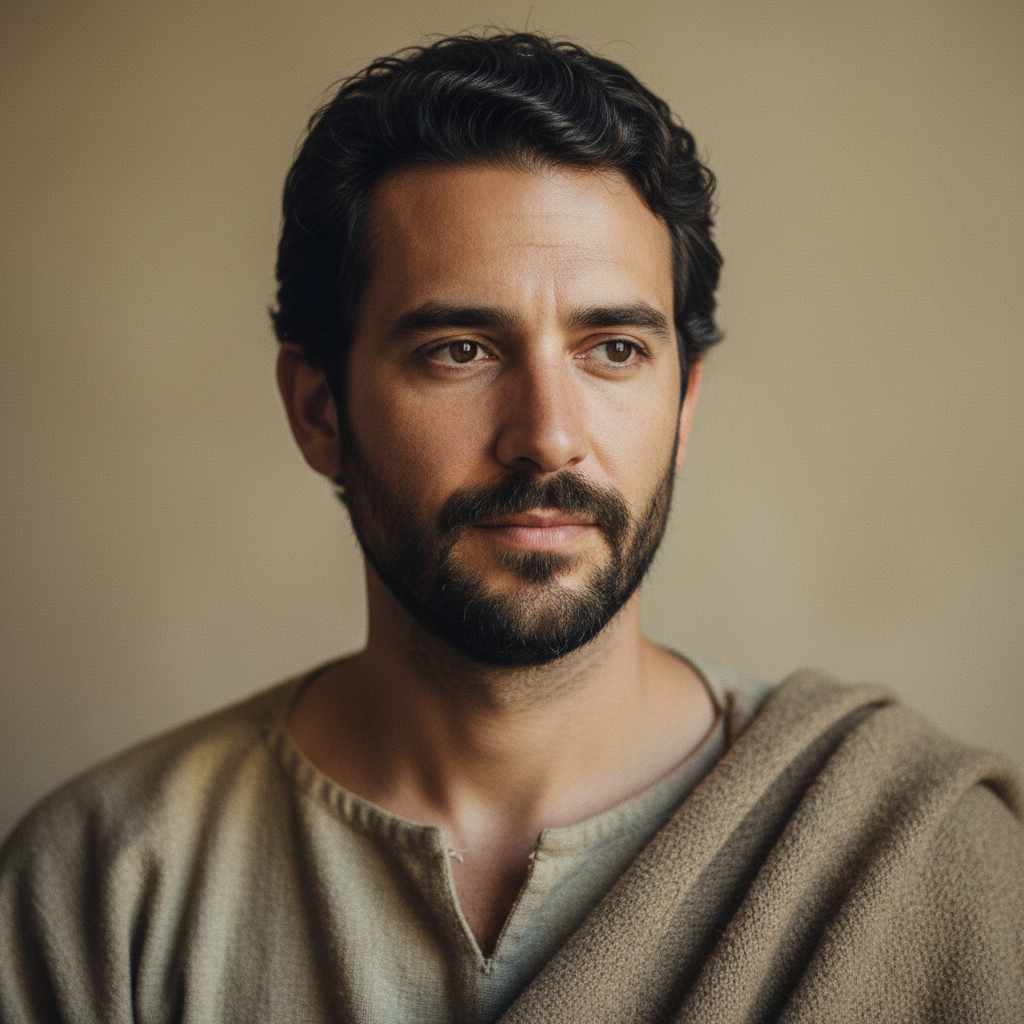
Face and skin: He would have had an olive to light‑brown complexion typical of Judea and Galilee, with dark brown eyes and dark hair—probably thick, wavy or tightly curled and kept short. His face was likely squared and purposeful rather than gaunt; cheekbones and jaw consistent with a Mediterranean appearance. Hair and facial hair: Following local and early Christian conventions, he probably wore a short to medium beard—neatly kept rather than long and flowing—and trimmed hair rather than a cropped Roman style. Any beard would have been practical and modest, framing the jaw without elaborate styling. Body, height and bearing: Osteological averages put adult men in the region around 1.6–1.7 m (about 5'4"–5'7"). He was likely lean and wiry from constant walking and daily tasks rather than bulky—broad‑shouldered enough for a working life, with hands toughened by travel and handling goods. His posture would have reflected an active, mobile life in towns and along roads.
Height / build
Likely average height for his time · Likely slender to average build
Hair
Likely dark to brown · Likely wavy to curly · Likely full
Eyes
Likely dark (brown)
Complexion
Likely Mediterranean / olive
Face
Likely oval to medium · Likely straight to slightly aquiline
Notable features
Dark eyes and hair, short beard, ordinary Levantine features (would blend with peers).
Grooming
Probably a short, kept beard · Likely kept hair and beard trimmed to local Jewish norms rather than the clean‑shaven Roman elite style.
Dress / presentation
Plain wool or linen tunic (knotless tunic) with a mantle / cloak and sandals typical of 1st‑century Jewish men.
height build
Height
Likely average height for his time
Roman‑period Levantine male skeletal series indicate an average adult height around 165–170 cm, making 'average' the best estimate.
height build
Build
Likely slender to average build
A traveling teacher's disciple who managed money likely had a practical, lean or average physique rather than heavy musculature.
eyes
Eye color
Likely dark (brown)
Dark brown eyes are overwhelmingly common historically in Levantine and Semitic populations.
hair
Hair color
Likely dark to brown
Dark hair predominated among first‑century Palestinian Jews; early icons and population data support this.
hair
Hair texture
Likely wavy to curly
Wavy to curly hair is common in Levantine populations and appears in regional portraits and mosaics.
grooming
Facial hair
Probably had a short, kept beard
In Judas’s world, public appearance emphasized modesty and piety: beards and modest tunics signaled adult masculinity, while ostentation was associated with Roman elites. As a disciple with duties among the group, he would present a sober, practical look that conveyed reliability rather than social rank.
Galilean and Judean men of the 1st century typically had Semitic Levantine features—olive skin, dark hair, dark eyes, and medium stature. Local skeletal and genetic research supports regional continuity of these traits, so imagining Judas as a Mediterranean‑type man is historically responsible.
Modern art and film often depict Judas as pale, European, or visually marked as a villain; historically he would most likely have looked like an ordinary Mediterranean Jew.
Western art and film frequently recast Judas as pale, European, or visually marked as a villain (darker shadows, sly features). These are cultural shorthand choices by later artists; historically, Judas would more likely have looked like his fellow Galilean Jews rather than a caricatured 'other.'
Likely average height for his time (around 165–170 cm / 5'5"–5'7").
Likely dark brown.
Likely dark to brown, probably wavy to curly, possibly beginning to gray if middle‑aged.
Probably — a short, kept beard in line with Jewish male norms of the period.
A plain tunic (inner garment), an outer mantle/cloak, and sandals—the typical clothing of 1st‑century Jewish men and itinerant teachers’ followers.
By combining Gospel roles, early Christian art conventions, archaeological skeletal data, regional population studies and ancient dress descriptions to create the most probable portrait.
New Testament Gospels (Matthew, Mark, Luke, John)
Christian Scriptures (Gospels) · late 1st century CE
Provide narrative roles (disciple, keeper of the money, betrayer) but contain no physical description; role informs clothing/status and social placement among disciples.
Early Christian art: Catacomb and sarcophagus images of apostles
Roman catacombs and sarcophagi (3rd–5th centuries) · 3rd–5th centuries CE
Early Christian imagery shows apostles as bearded, tunic‑wearing men—useful for reconstructing typical dress and facial hair conventions in early communities.
Byzantine icons and mosaics of the apostles
Byzantine mosaic/icon tradition (6th–14th centuries) · 6th–14th centuries CE
Consistently portray apostles with dark hair and beards in tunics and cloaks, establishing the long visual tradition for first‑century Jewish Christian figures.
Medieval & Renaissance Last Supper images (e.g., Giotto, Leonardo, Caravaggio)
Western medieval and Renaissance art · 13th–17th centuries
Provide examples of how Judas has been visually characterized over time; useful for understanding modern preconceptions though not historically decisive.
Osteological studies of Roman‑period Levantine populations
Archaeological osteology surveys (Israel/Palestine, Roman period) · 20th–21st century analyses
Skeletal series provide average stature, typical health markers, and body proportions for first‑century Levantine males—basis for height/build estimates.
Population genomics and Levantine continuity studies
Levantine genetic studies (e.g., Haber and colleagues; regional surveys) · 2010s
Genetic research indicates continuity of core Levantine ancestry components, supporting inferences about common regional features like dark hair and eyes.
Jewish male norms in the period favored beards; early Christian images show apostles with trimmed facial hair.
clothing
Clothing style
Plain tunic and mantle typical of 1st‑century Jewish men
Texts and archaeological textile evidence indicate tunic (basic garment) and outer mantle as standard male dress for Galilean/Judean men.
skin
Complexion / skin tone
Likely Mediterranean / olive
Ancestry and regional continuity of Levantine populations point to an olive to light‑brown complexion.
face
Nose / profile
Likely straight to slightly aquiline
Many Levantine portraits and surviving population facial types show straight to mildly aquiline nasal profiles.
comparison
Overall distinctiveness
Probably unremarkable — blended in with peers
Early Christian art usually depicts apostles similarly; nothing in texts marks Judas as physically exotic.
Josephus on Jewish dress and social markers
Flavius Josephus, Antiquities and Jewish War · 1st century CE
Provides contemporary background on clothing, social practice, and how Jewish men presented themselves relative to Romans—helps reconstruct likely garments for Judas.
Rabbinic/Talmudic references to male grooming and beards
Talmudic and rabbinic literature (compiled later) · 2nd–6th centuries CE (compilation)
Though compiled later, these texts preserve earlier norms favoring beards and modest grooming, supporting the inference that Judas likely wore a beard.